Estate Planning for Retirement: Key Steps for IRAs and 401(k) Assets
Secure your legacy with estate planning for retirement: protect IRA and 401(k) assets, minimize taxes, and avoid probate.



Secure your legacy with estate planning for retirement: protect IRA and 401(k) assets, minimize taxes, and avoid probate.
Estate planning for retirement starts with a simple checklist: review every IRA, 401(k), life insurance policy, and transfer-on-death account; confirm the primary and contingent beneficiaries; update your will and incapacity documents; and match your withdrawal plan to your family and tax goals.
For many retirees, beneficiary forms matter as much as the will because these accounts generally transfer under their beneficiary designation. Most non-spouse beneficiaries who inherit a retirement account must empty it within 10 years under the SECURE Act rules, which can create a large and poorly timed income-tax bill if no one plans ahead. IRS Publication 590-B explains the distribution rules for inherited IRAs.
A strong plan also prepares for the years before death. It includes a durable financial power of attorney, healthcare proxy, and living will, plus a clear plan for RMDs, Roth conversions, charitable giving, and any move to a new state.
I am Evan Luongo, and the next steps will help you connect your retirement income plan with the legacy you want to leave.
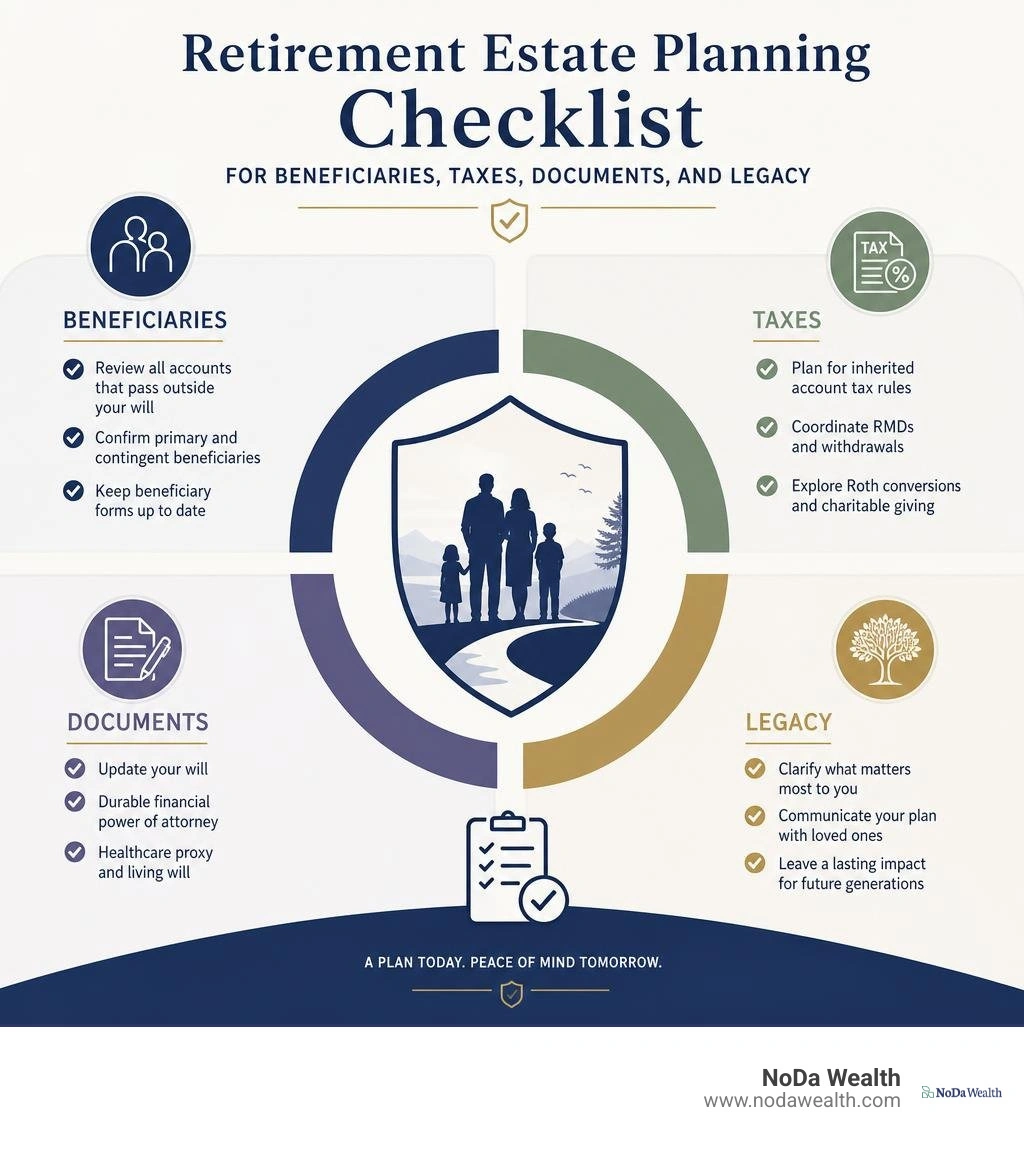
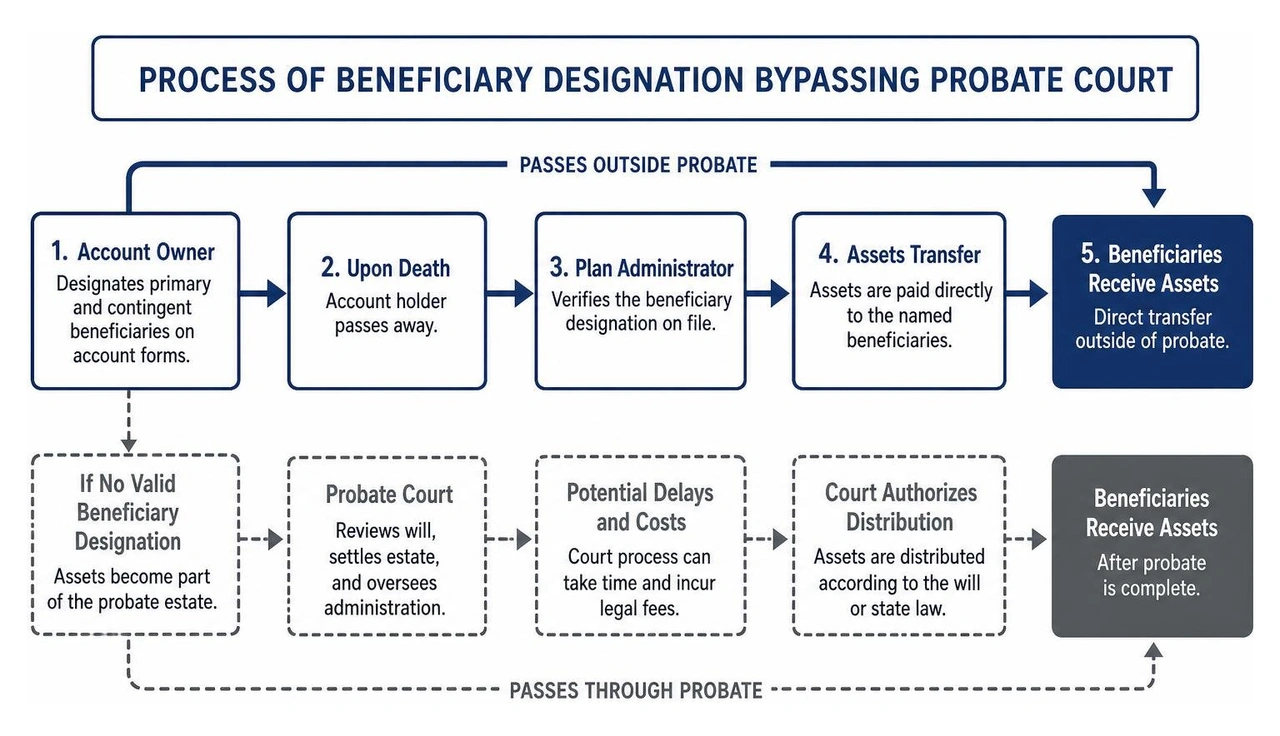
When you step into retirement, you might assume your last will and testament acts as the master conductor for everything you own. In reality, accounts with direct beneficiary designations—like your traditional IRAs, Roth IRAs, 401(k) plans, annuities, and life insurance policies—operate by private contract.
Contract law overrides testamentary documents. If your will states that all your assets should be divided equally among your three children, but your 401(k) beneficiary form still names an ex-spouse or a single sibling, the plan administrator is legally required to hand the funds to the person named on that form. The court handling your probate estate cannot redirect those retirement dollars. By keeping beneficiary designations updated, assets pass directly to your loved ones without probate delays, legal fees, or public disclosure. You can explore our blog for more insights on keeping your financial and retirement strategies aligned.
The legislative landscape for inherited retirement accounts shifted dramatically with the passage of the SECURE Act of 2019 and SECURE 2.0. Previously, non-spouse beneficiaries could utilize a "stretch IRA" strategy, taking distributions gradually over their own single life expectancy. This allowed decades of continued tax-deferred compound growth.
Under current rules, most non-eligible designated beneficiaries—such as adult children—must empty the inherited IRA or qualified plan completely by December 31 of the tenth year following the account owner's death.
This 10-year window often forces withdrawals during an heir's peak earning years, potentially pushing them into higher federal and state income tax brackets and eroding a substantial portion of their inheritance.
Minor oversights on beneficiary paperwork can trigger major legal and financial headaches. Here are the most frequent pitfalls we see retirees encounter:
Retirement marks a critical shift from asset accumulation to strategic decumulation. Every dollar withdrawn from a traditional pre-tax account is treated as ordinary income. Navigating this phase requires understanding how to retire comfortably while balancing current tax brackets against future obligations.
Without careful tax planning, mandatory withdrawals later in retirement can trigger higher marginal rates, increase the taxation of Social Security benefits, and create significant tax exposure for your eventual heirs.
A strategic Roth conversion involves transferring assets from a pre-tax traditional IRA into an after-tax Roth IRA, paying ordinary income tax on the converted amount during that calendar year.
Because Roth IRAs have no RMD requirements for the original owner, the money can compound tax-free for the rest of your life. When your beneficiaries inherit a Roth IRA, they are still bound by the 10-year rule, but every dollar they withdraw during that decade comes out 100% income-tax-free. This creates an effective tax arbitrage strategy if you find yourself in a lower tax bracket during early retirement than your heirs will face during their peak career years.

Reviewing case studies of families who optimized multi-year bracket filling shows how converting smaller increments across several lower-income retirement years systematically reduces the lifetime and generational tax bite.
While Roth conversions offer significant estate benefits, an aggressive conversion can inadvertently push your Modified Adjusted Gross Income (MAGI) over the income thresholds for the Medicare Income-Related Monthly Adjustment Amount (IRMAA).
IRMAA applies a tiered surcharge on Medicare Part B and Part D premiums using a two-year lookback period. An ill-timed conversion executed today could increase your healthcare premiums two years down the road.
Furthermore, SECURE 2.0 adjusted the RMD starting age to 73 (and age 75 for individuals turning 74 after December 31, 2032). Delaying RMDs leaves pre-tax balances to compound longer, but it can also produce an "RMD tax cliff" later in life when large mandatory distributions push you into higher brackets. Proactive conversions between your retirement date and your RMD starting age help smooth your taxable income over time.
A well-structured estate plan integrates your living expenses, tax liabilities, and gifting objectives into a cohesive distribution framework. We often implement a three-bucket approach—allocating assets across taxable brokerage accounts, tax-deferred accounts (IRAs/401ks), and tax-free Roth vehicles—to control income realization year by year. Our services and fees reflect our commitment to helping clients coordinate these cash-flow and wealth-preservation strategies transparently.
When considering which assets to spend and which to leave behind:
For individuals with substantial wealth, monitoring the federal estate and gift tax landscape is essential. The federal estate tax exemption allows individuals to shelter significant wealth from transfer taxes.
To protect this exclusion between spouses, couples should consider electing portability by filing IRS Form 706 upon the death of the first spouse. Portability transfers the Deceased Spousal Unused Exclusion (DSUE) to the surviving spouse, ensuring that the combined family exemption remains intact even if tax laws shift in the future. For high-net-worth families, pairing portability elections with strategic wealth transfers provides long-term legacy security. You can find further technical details on these threshold mechanisms in this guide to estate planning for retirees.
Relocating during retirement is common, but crossing state borders can introduce unexpected legal friction. Moving from one state to another requires reviewing how your legal documents interact with your new home state's laws:
A foundational estate plan relies on clear legal structures to govern asset transfer and decision-making authority. While a will serves as the traditional vehicle for distributing an estate, many retirees prefer a revocable living trust to maintain privacy and bypass probate.
| Feature | Last Will and Testament | Revocable Living Trust |
|---|---|---|
| Probate Process | Requires public probate court proceedings | Bypasses probate completely if funded |
| Privacy Level | Becomes a matter of public record upon death | Remains private between trustees & heirs |
| Incapacity Management | No authority during your lifetime | Trustee manages trust assets if incapacitated |
| Out-of-State Property | May require multi-state ancillary probate | Avoids ancillary probate across state lines |
| Upfront Cost & Setup | Generally lower upfront legal cost | Higher initial cost; requires asset retitling |
Creating a revocable living trust is only the first step; the trust is ineffective if you fail to "fund" it. Funding means legally changing the ownership titles of your assets—such as your real estate deeds, taxable brokerage accounts, and personal property—from your individual name to the name of your trust.
Retirement accounts like IRAs and 401(k)s should generally not be retitled in the name of a trust during your lifetime, as the IRS would treat that transfer as a fully taxable total liquidation. Instead, trust integration for retirement accounts occurs via the beneficiary designation form.
If you wish to control distributions to a beneficiary through a trust (for example, to protect a child with special needs or provide creditor protection), the trust must qualify as a "see-through" trust under IRS guidelines to preserve any applicable tax deferral.
Estate planning is not just about what happens after you pass away; it also protects you during your lifetime if cognitive decline or unexpected illness strikes. According to the Fidelity Retiree Health Care Cost Estimate, an average 65-year-old couple needs approximately $345,000 saved just to cover medical expenses in retirement, excluding long-term care. Furthermore, data from the Genworth Cost of Care Survey shows that long-term care costs average more than $150,000 per year for round-the-clock home care support and over $125,000 per year for a private nursing home room.
To protect your autonomy and assets, every retiree needs three critical incapacity documents:
Naming your estate directly eliminates designated beneficiary status under IRS rules. As a result, the retirement account loses its ability to bypass probate, becomes subject to estate creditor claims, and is forced into an accelerated distribution timetable—often requiring full account liquidation within five years if you die before your RMD starting age.
While QCDs primarily provide an immediate income-tax advantage by satisfying RMD requirements without increasing your Adjusted Gross Income, they also reduce your overall estate size. By directing pre-tax IRA funds directly to qualifying charities during your lifetime, you permanently remove those assets and their future growth from your gross taxable estate.
Generally, a validly executed will or trust from one state remains legally recognized in another under constitutional full faith and credit principles. However, statutory power of attorney forms, living wills, and healthcare proxy definitions vary significantly across state lines. Medical providers and local financial institutions may hesitate to accept out-of-state documents. It is always best practice to have a local estate attorney review your documents following a permanent relocation.
A successful retirement transition requires more than just accumulating assets; it demands a clear strategy to protect your wealth, manage potential incapacity, and transfer what you have built to the people and causes you love. Coordinating your IRA and 401(k) beneficiary designations, executing strategic Roth conversions, properly funding your trusts, and keeping incapacity documents up to date ensures your estate plan works efficiently in every scenario.
As a fee-only, fiduciary firm located in Charlotte, NC, NoDa Wealth provides personalized, data-driven financial planning and wealth management without commissions or product sales. We guide you through a simple three-step process to align your cash flow, investments, and legacy goals into a unified wealth plan.
To review your current estate framework and retirement distribution plan, we invite you to schedule a free assessment with our team today.
Feeling overwhelmed? Let’s simplify things! Schedule your Free Assessment for an easy, 20-minute chat to help you tackle life’s transitions.
Enjoy a hassle-free conversation that puts your needs front and center!
)%20(3).avif)
