Why Working With a Fiduciary Financial Advisor in Charlotte NC Matters
Find a trusted fiduciary financial advisor in Charlotte NC for conflict-free wealth management and retirement planning. Claim your free assessment today.



Find a trusted fiduciary financial advisor in Charlotte NC for conflict-free wealth management and retirement planning. Claim your free assessment today.
When seeking financial guidance, understanding the standard of care your advisor owes you is vital. In the wealth management industry, two distinct regulatory frameworks govern advisor conduct: the fiduciary standard and the suitability standard.
A fiduciary duty represents the highest standard of care under the law. It primarily consists of two elements:
In contrast, non-fiduciary professionals—often traditional broker-dealers or insurance agents—are frequently governed by the suitability standard (or the SEC's Regulation Best Interest for broker-dealers). Under a traditional suitability framework, a recommendation merely needs to be "suitable" for a client's general profile at the time of the transaction. It does not have to be the best or lowest-cost option available.
For example, if two investment funds offer the same exposure, but one pays the broker a 4% upfront commission while the other has zero commission and lower internal expenses, the broker can legally recommend the higher-commission product as long as it is deemed suitable. A fiduciary, bound by loyalty and care, must recommend the solution that genuinely serves your best interests.
| Feature | Fiduciary Standard | Suitability Standard |
|---|---|---|
| Legal Obligation | Must act strictly in the client's best interest at all times | Must recommend suitable investments at the time of sale |
| Primary Loyalty | To the client | Often to the broker-dealer firm or parent company |
| Compensation Model | Typically fee-only (flat fee, hourly, or % of AUM) | Often commissions, 12b-1 fees, or revenue sharing |
| Conflict Management | Must eliminate or explicitly disclose and mitigate conflicts | Managed via generic disclosure forms without requiring elimination |
| Primary Regulators | SEC or State Securities Regulators (under Investment Advisers Act of 1940) | FINRA and state insurance commissioners |
Charlotte stands as the second-largest banking hub in the United States, home to massive financial institutions and over 4,000 practicing financial advisors. In North Carolina, there are more than 1,200 registered investment advisor (RIA) firms, reflecting a sophisticated local market.
With this density of financial professionals, discerning between true fiduciary advisors and product sales representatives is critical. According to a 2022 survey by Cerulli Associates, 87% of investors in the Charlotte area stated they prefer working with a fiduciary advisor who is legally bound to act in their best interest, compared to 78% nationally. Furthermore, broader industry research consistently highlights that a lack of fiduciary commitment is a primary driver when investors decide to switch wealth managers.
In Mecklenburg County, the number of households with over $1 million in investable assets grew by 12% between 2020 and 2023, according to data from the U.S. Census Bureau. As wealth grows across our region, the complexity of executive compensation packages, local tax planning, and multi-generational asset transfers demands conflict-free stewardship.
Working with a dedicated fiduciary ensures that every facet of your financial life receives unbiased, holistic attention:
You can review real-world client scenarios by exploring our fiduciary wealth management case studies.
Traditional brokerage models frequently embed hidden costs that erode portfolio returns over time. Common conflicts of interest include:
A fiduciary operating under a pure fee-only model eliminates these conflicts. We do not accept commissions, sales incentives, or referral kickbacks from financial product providers.
Understanding how an advisor charges is the simplest way to identify potential conflicts of interest. Advisory fees in North Carolina typically fall into three models:

According to a 2023 regional fee study by RIA in a Box, the average fee for an AUM-based fiduciary advisor in Charlotte is 1.02% of managed assets, aligning closely with the national average of 1.04%. At NoDa Wealth, we believe pricing must remain completely transparent and predictable; you can review our full schedule on our services and fees page.
Due diligence protects your hard-earned wealth. Before trusting any professional with your family's future, complete these vetting steps:
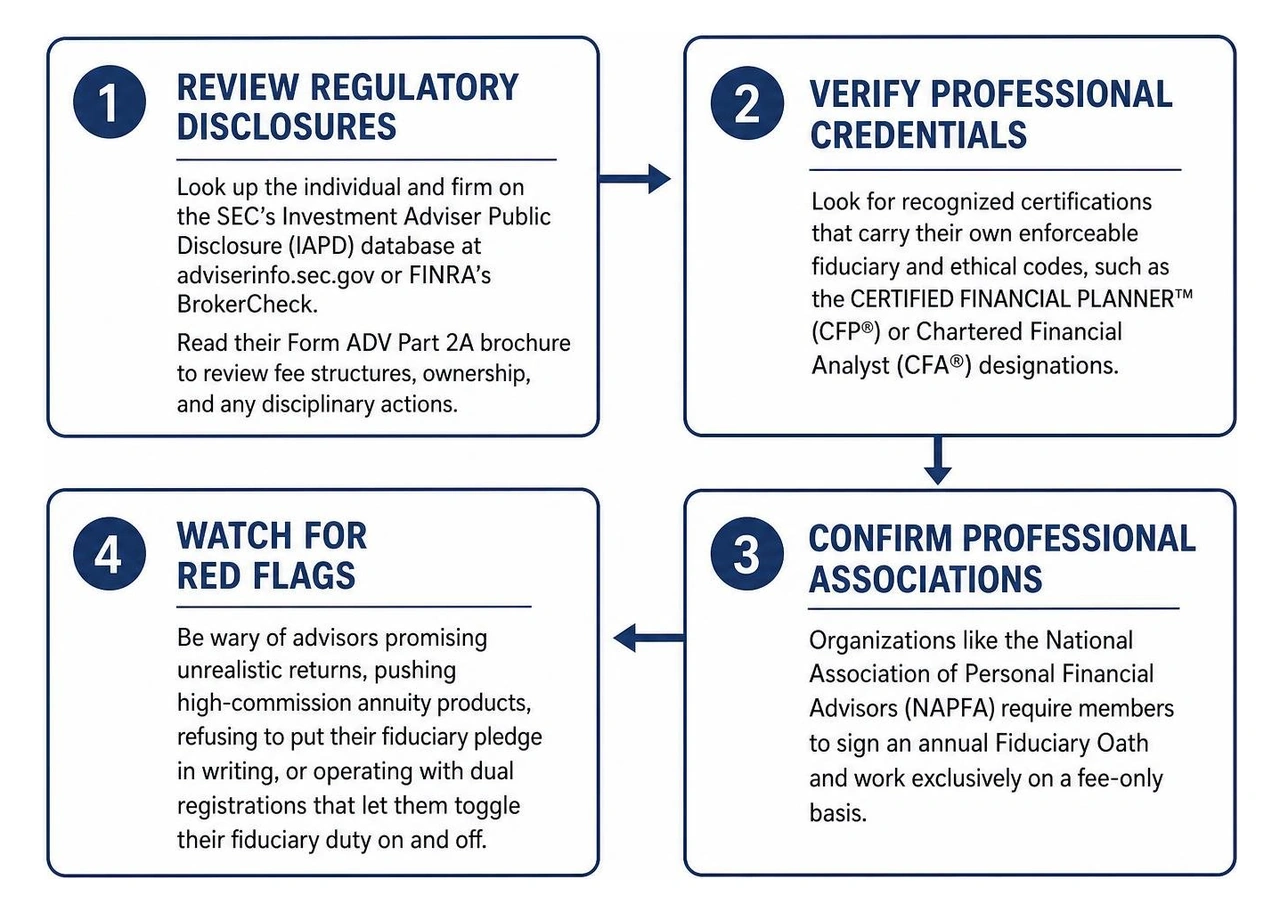
When interviewing prospective financial planners in Charlotte, use this question checklist:
To learn more about our commitment to putting clients first, read about our founder's transition to independent fiduciary advice and why our firm was built around transparency.
Search the advisor's name and firm on the SEC's IAPD website (adviserinfo.sec.gov). A pure fiduciary will be registered as an Investment Adviser Representative (IAR) with a Registered Investment Advisor (RIA) firm and will not hold broker-dealer or insurance sales licenses that generate commissions. You can also request a signed Fiduciary Oath in writing.
"Fee-only" advisors are compensated exclusively by client fees and accept no commissions from financial products. "Fee-based" advisors charge advisory fees but are also licensed to earn commissions from selling products like life insurance, annuities, or mutual funds. This dual registration can create hidden conflicts of interest.
North Carolina taxes individual taxable income at a flat rate, which applies to standard distributions from traditional IRAs and 401(k) accounts. However, the state does not tax Social Security retirement benefits. A local fiduciary helps you balance taxable, tax-deferred, and tax-free (Roth) distributions to manage brackets and avoid unnecessary state tax drag.
Navigating the financial landscape requires clarity, discipline, and an advisor whose incentives align perfectly with your success. By partnering with an independent, fee-only fiduciary, you gain customized wealth management, proactive tax minimization, and objective investment advice tailored to life in the Queen City.
If you are ready to secure your family's financial roadmap with data-driven, commission-free guidance, claim your free financial assessment with our team at NoDa Wealth today.
Educational Purposes Only. Content on this blog is for general educational and informational purposes only. It is not investment, tax, accounting, or legal advice, and it is not a recommendation or solicitation to buy or sell any security or to adopt any investment strategy. Past performance does not guarantee future results. Investing involves risk, including the possible loss of principal.
NoDa Wealth Management, LLC ("NoDa Wealth") is an investment adviser registered with the State of North Carolina. Advisory services are offered only where NoDa Wealth and its representatives are properly registered or exempt from registration. Readers should consult their own financial, tax, and legal advisors regarding their specific situation before making any decisions. For important disclosures, see the site footer and Form ADV.
Feeling overwhelmed? Let’s simplify things! Schedule your Free Assessment for an easy, 20-minute chat to help you tackle life’s transitions.
Enjoy a hassle-free conversation that puts your needs front and center!
)%20(3).avif)
