Find the Best Financial Advisor in Charlotte NC for Your Goals

Investing
September 28, 2026

Find the best financial advisor in Charlotte NC for your goals with our guide to fiduciary standards, credentials, and services.


Find a Financial Advisor in Charlotte NC Who Fits Your Goals

The best financial advisor in Charlotte NC is one whose fees, fiduciary duty, credentials, and planning specialty match your life. Start by looking for a professional who can help with your highest-priority goal, whether that is retirement, investing, college savings, estate planning, or managing a major job change.

For a busy professional or family, focus on these three checks first:

  1. Ask how they are paid. Fee-only advisors do not earn commissions from investment or insurance product sales.
  2. Confirm their fiduciary role. Ask when they must put your interests ahead of their own and request the answer in writing.
  3. Match expertise to your needs. CFP(R) professionals can provide broad planning; CPA and CFA credentials may be especially useful for complex tax or investment questions.

Charlotte offers a deep pool of planners, from independent fee-only firms to advisors at national wealth-management companies. Many serve clients across retirement planning, investment management, estate coordination, education funding, and business succession planning. The right choice is less about the biggest name and more about clear advice, understandable fees, and a process you can sustain.

I am Evan Luongo, and the next sections will help you compare advisor types and choose a planning relationship that makes your financial life simpler.
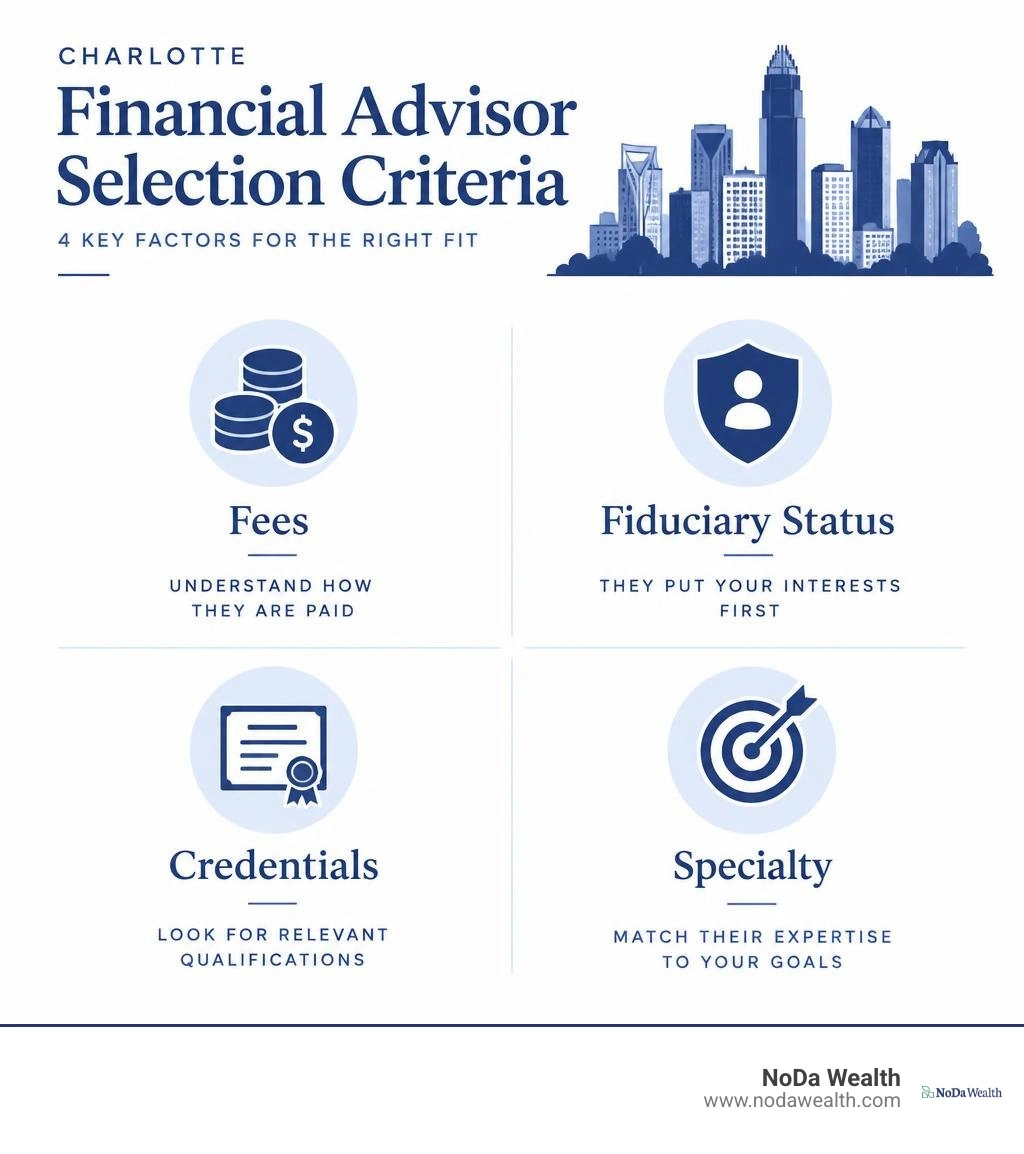
Charlotte financial advisor selection criteria: fees, fiduciary status, credentials, and specialty infographic

Types of Financial Advisors and Compensation Models

Navigating the financial landscape in the Queen City begins with understanding how advisors are compensated. The way a planner earns their revenue directly influences the advice you receive, the products they recommend, and whether any hidden incentives exist behind the scenes.

In broad terms, wealth advisors operate under one of three primary compensation models:

  1. Fee-Only Advisors: These professionals are paid directly and solely by their clients. Their compensation can come in the form of a percentage of assets under management (AUM), a flat annual or monthly retainer, or an hourly rate. Crucially, fee-only planners are prohibited from accepting commissions, sales loads, referral kickbacks, or product incentives from mutual funds, insurance companies, or brokerage platforms. This model minimizes potential conflicts of interest.
  2. Commission-Based Brokers: Advisors in this category receive their revenue primarily or entirely through transaction commissions and sales charges. When you buy an annuity, a specific mutual fund, or a permanent life insurance policy, the advisor receives a payout from the product issuer. While these advisors can execute trades and provide valuable services, the incentive structure naturally favors frequent trading or high-commission products.
  3. Fee-Based (Fee and Commission) Advisors: Fee-based professionals combine both worlds. They may charge you a management fee for managing your investment portfolio, but they also maintain dual registration, allowing them to sell commission-generating insurance policies or proprietary funds. This dual role can make it challenging to discern when an advisor is acting as an objective consultant versus a salesperson.
FeatureFee-Only Advisory ModelCommission-Based ModelFee-Based (Dual-Registered)
Primary Revenue SourceDirect client fees (AUM, flat fee, hourly)Product sales commissions & loadsClient fees plus product commissions
Fiduciary Duty100% of the time across all servicesSuitability standard / Best interest at saleFiduciary during advice; broker during sale
Product IncentivesNone; zero third-party kickbacksHigh; payout tied to product selectionModerate to high on select products
TransparencyClear, itemized invoicingEmbedded within product expense ratiosMixed; fees disclosed, commissions varied

Fiduciary Standards for a Financial Advisor in Charlotte NC

A true fiduciary has a legal duty of care and loyalty to place the client's interests above their own at all times. In financial planning, this standard is enforced through the U.S. Securities and Exchange Commission (SEC) under the Investment Advisers Act of 1940 and the Employee Retirement Income Security Act (ERISA) for qualified retirement plans.
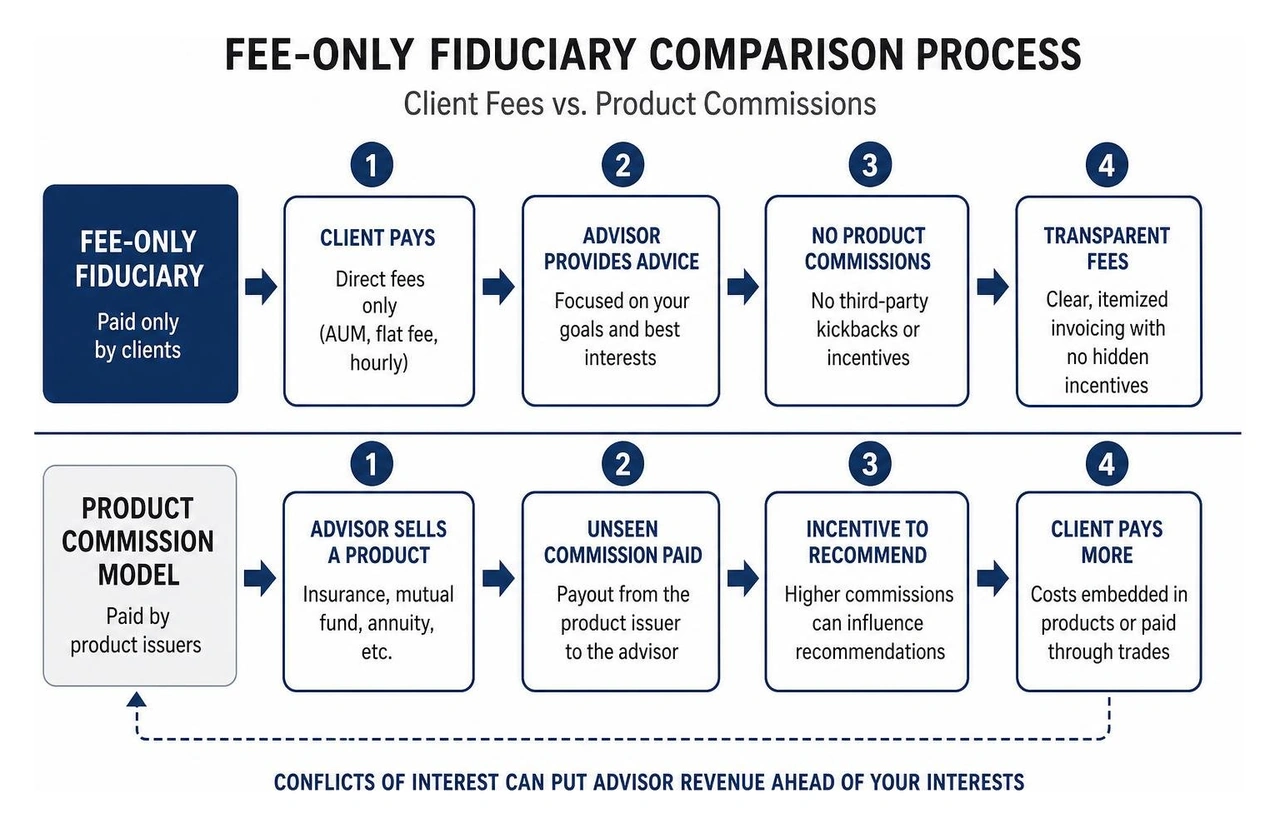
Fee-only fiduciary comparison process showing client fees versus product commissions

Unlike standard suitability rules—which merely require an investment to be "suitable" for your profile even if a more expensive option pays the broker a higher commission—a fiduciary must eliminate or fully disclose any material conflicts of interest. When we work with clients, we emphasize transparent services and fee structures so that every family knows exactly what they are paying and what value they receive in return.

Essential Professional Credentials to Look For

Professional credentials demonstrate a planner's technical competency, rigorous testing, and commitment to ongoing ethical education. Over 30 financial planners operate within the greater Charlotte region, spanning Uptown, SouthPark, Ballantyne, and Lake Norman, and many hold top industry designations.

When you search for a financial advisor in Charlotte NC, prioritize these key credentials:

  • CFP® (Certified Financial Planner): Administered by the CFP Board, this gold standard covers comprehensive cash flow, retirement modeling, tax planning, insurance analysis, and estate coordination. All CFP® professionals are bound by a fiduciary oath.
  • CPA / PFS (Certified Public Accountant / Personal Financial Specialist): CPAs who hold the PFS credential specialize in deep tax analysis, corporate stock option modeling, and business accounting integrated with personal wealth.
  • CFA® (Chartered Financial Analyst): A globally recognized charter focused on advanced portfolio management, equity analysis, and institutional-level risk management.
  • ChFC® (Chartered Financial Consultant): A comprehensive planning designation administered by The American College, covering advanced practical applications in retirement and business planning.

Core Wealth Management Services for Charlotte Residents

Financial advisor reviewing wealth plan and portfolio options

Charlotte’s booming economy—driven by banking, healthcare, energy, and tech—creates unique financial situations. A qualified financial planner does far more than pick stocks or build an asset allocation model; they coordinate all moving parts of your financial life into a cohesive strategy.

  • Comprehensive Cash Flow and Budget Planning: Aligning high earning potential with intentional savings rates, debt management, and liquidity buffers.
  • Investment Management: Constructing diversified, cost-effective portfolios designed to balance growth and risk across market cycles.
  • Education Funding: Implementing tax-advantaged 529 savings plans to fund private schooling or collegiate goals for children.
  • Estate Planning Coordination: Structuring wills, revocable living trusts, and healthcare directives alongside estate attorneys to protect family assets.
  • Business Succession and Executive Benefits: Advising corporate leaders and entrepreneurs on deferred compensation, non-qualified plans, and exit planning.

Retirement Planning and Tax Strategies

Retirement planning is not just about accumulating a nest egg; it is about keeping what you have earned through smart distribution design. With North Carolina's flat individual income tax rate, local retirees must optimize state and federal tax brackets carefully.

Key strategies include:

  • Strategic Roth Conversions: Converting pre-tax traditional IRA balances into Roth IRAs during lower-income bridge years before Required Minimum Distributions (RMDs) begin.
  • Asset Location Strategy: Placing tax-inefficient assets like bonds in pre-tax accounts while housing high-growth equities in tax-free Roth accounts.
  • Social Security Optimization: Timing benefit claims between ages 62 and 70 to maximize lifetime household payouts.
  • Tax-Efficient Withdrawal Sequencing: Drawing strategically across taxable brokerage, tax-deferred, and Roth accounts to minimize annual capital gains and ordinary income taxes.

To see how these strategies function in practice, explore our real-world wealth planning case studies.

Major Life Transitions and Milestone Planning

Wealth plans must adapt when life changes. Charlotte professionals often face critical financial milestones that require quick, decisive planning:

  • Executive Stock Options & RSUs: Managing vesting schedules, 83(b) elections, and concentration risk from corporate equity compensation.
  • Relocation and Real Estate: Navigating the Charlotte housing market, coordinating home sales, and managing mortgage debt alongside long-term investment goals.
  • Career Transitions & Business Exits: Managing 401(k) rollovers, severance packages, and sudden liquidity events after selling a private enterprise.

5 Steps to Select the Right Financial Advisor in Charlotte NC

Checklist for interviewing prospective wealth advisors

Selecting an advisor is a significant long-term decision. Follow this five-step roadmap to make a confident choice:

  1. Define Your Primary Goals: Clarify whether you need retirement decumulation, college planning, complex tax strategies, or basic portfolio management.
  2. Filter by Compensation Model: Narrow your search to fee-only fiduciaries if you want to eliminate commission-driven sales tactics.
  3. Verify Licenses and Credentials: Check for designations like the CFP®, CPA, or CFA® to confirm foundational expertise.
  4. Determine Meeting Preferences: Decide whether you prefer in-person meetings around Charlotte (such as Uptown or SouthPark) or the convenience of a modern virtual planning relationship.
  5. Interview Prospective Planners: Conduct structured introductory calls to assess communication style, investment philosophy, and cultural fit.

Essential Questions to Ask Potential Wealth Managers

  • Are you a fiduciary 100% of the time, and will you sign a written fiduciary pledge?
  • How are you and your firm compensated? Do you receive any third-party commissions or incentives?
  • What professional credentials (CFP®, CFA, CPA) do you hold?
  • What is your core investment philosophy regarding active versus passive management?
  • How frequently will we meet, and what is your ongoing communication schedule?

How to Vet a Financial Advisor in Charlotte NC

Before signing an advisory agreement, always conduct thorough due diligence using public regulatory records:

  • FINRA BrokerCheck: Look up individual advisors to check their employment history, regulatory actions, customer complaints, and past arbitrations.
  • SEC Investment Adviser Public Disclosure (IAPD): Download the firm's Form ADV Part 2A Brochure. This disclosure document outlines fee schedules, business practices, disciplinary history, and any potential conflicts of interest.

For more guidance on vetting advisory practices and understanding regulatory requirements, check out our financial planning insights and educational guides.

Evaluating Advisor Niche and Client Experience

The ideal advisor understands your specific life stage. If you are a busy corporate leader, a tech entrepreneur, or a physician, your time is limited. You need proactive advisors who offer structured reviews, data-driven planning software, clear action items, and transparent reporting. Find out more about our client-first philosophy and how we build tailored wealth strategies for working families.

Frequently Asked Questions About Charlotte Financial Advisors

How much does a wealth advisor typically charge in Charlotte?

Advisory fees vary depending on the service model. For assets under management (AUM), typical annual fees range between 0.50% and 1.25%, with rates decreasing as asset levels rise. Flat-fee advisors generally charge an annual retainer ranging from $3,000 to $10,000+ depending on financial complexity, while hourly planners charge between $250 and $450 per hour.

What is the difference between a wealth manager and a financial planner?

While the terms are often used interchangeably, a financial planner traditionally focuses on comprehensive life modeling—such as budgeting, cash flow, college funding, and insurance needs. A wealth manager generally provides holistic financial planning combined with active investment portfolio management and advanced estate or tax coordination for high-net-worth clients.

How do I verify if an advisor is a true fiduciary?

Ask the planner directly if their firm is an independent Registered Investment Advisor (RIA) and request a written fiduciary oath. Additionally, review the firm’s Form ADV Part 2A on the SEC website; Item 5 will explicitly detail their fee structures and confirm whether they accept commissions or sales incentives.

Conclusion

Building long-term wealth and protecting your family's future requires intentional planning and objective guidance. By partnering with a dedicated, fee-only fiduciary planner who puts your best interests first, you can navigate complex tax laws, manage executive compensation, and approach retirement with clarity.

Take the first step toward financial confidence and schedule your free assessment with NoDa Wealth today.

Educational Purposes Only. Content on this blog is for general educational and informational purposes only. It is not investment, tax, accounting, or legal advice, and it is not a recommendation or solicitation to buy or sell any security or to adopt any investment strategy. Past performance does not guarantee future results. Investing involves risk, including the possible loss of principal.

‍

NoDa Wealth Management, LLC ("NoDa Wealth") is an investment adviser registered with the State of North Carolina. Advisory services are offered only where NoDa Wealth and its representatives are properly registered or exempt from registration. Readers should consult their own financial, tax, and legal advisors regarding their specific situation before making any decisions. For important disclosures, see the site footer and Form ADV.

Take the First Step - For Free

Feeling overwhelmed? Let’s simplify things! Schedule your Free Assessment for an easy, 20-minute chat to help you tackle life’s transitions.

Enjoy a hassle-free conversation that puts your needs front and center!

Financial plan example
NoDa Wealth Management is located at 2108 Electric Lane, Charlotte NC, 28205. Phone Number: (980) 206-0953.
‍

Advisory services offered through NoDa Wealth Management, LLC, an investment adviser registered with the state of North Carolina. Advisory services are only offered to clients or prospective clients where NoDa Wealth Management, LLC and its representatives are properly registered or exempt from registration. The information on this site is not intended as tax, accounting or legal advice, nor is it an offer or solicitation to buy or sell, or as an endorsement of any company, security, fund, or other offering. Information provided should not be solely relied upon for decision making. Please consult your legal, tax, or accounting professional regarding your specific situation. Investments involve risk and have the potential for complete loss. It should not be assumed that any recommendations made will necessarily be profitable. The information on this site is provided “AS IS” and without warranties either express or implied and the information may not be free from error. Your use of the information provided is at your sole risk.
>