Financial Coach vs Advisor: Which Charlotte Expert Do You Need?
Find out if you need a financial coach in Charlotte, NC for budgeting and debt help or a fiduciary advisor for investments and wealth planning.



Find out if you need a financial coach in Charlotte, NC for budgeting and debt help or a fiduciary advisor for investments and wealth planning.
If you're looking for a financial coach in Charlotte, NC, start with the problem you want to solve. A coach can help you build a spending plan, pay down debt, and stick to better money habits. Ask about their experience, fees, and how often you'll meet before you hire them.
If you also need investment, tax, and estate guidance, look for a financial advisor whose services cover those needs. NoDa Wealth offers fee-only, fiduciary financial planning and wealth management for busy professionals in Charlotte.
I'm Evan Luongo, and I'll help you decide which kind of support fits your goals.
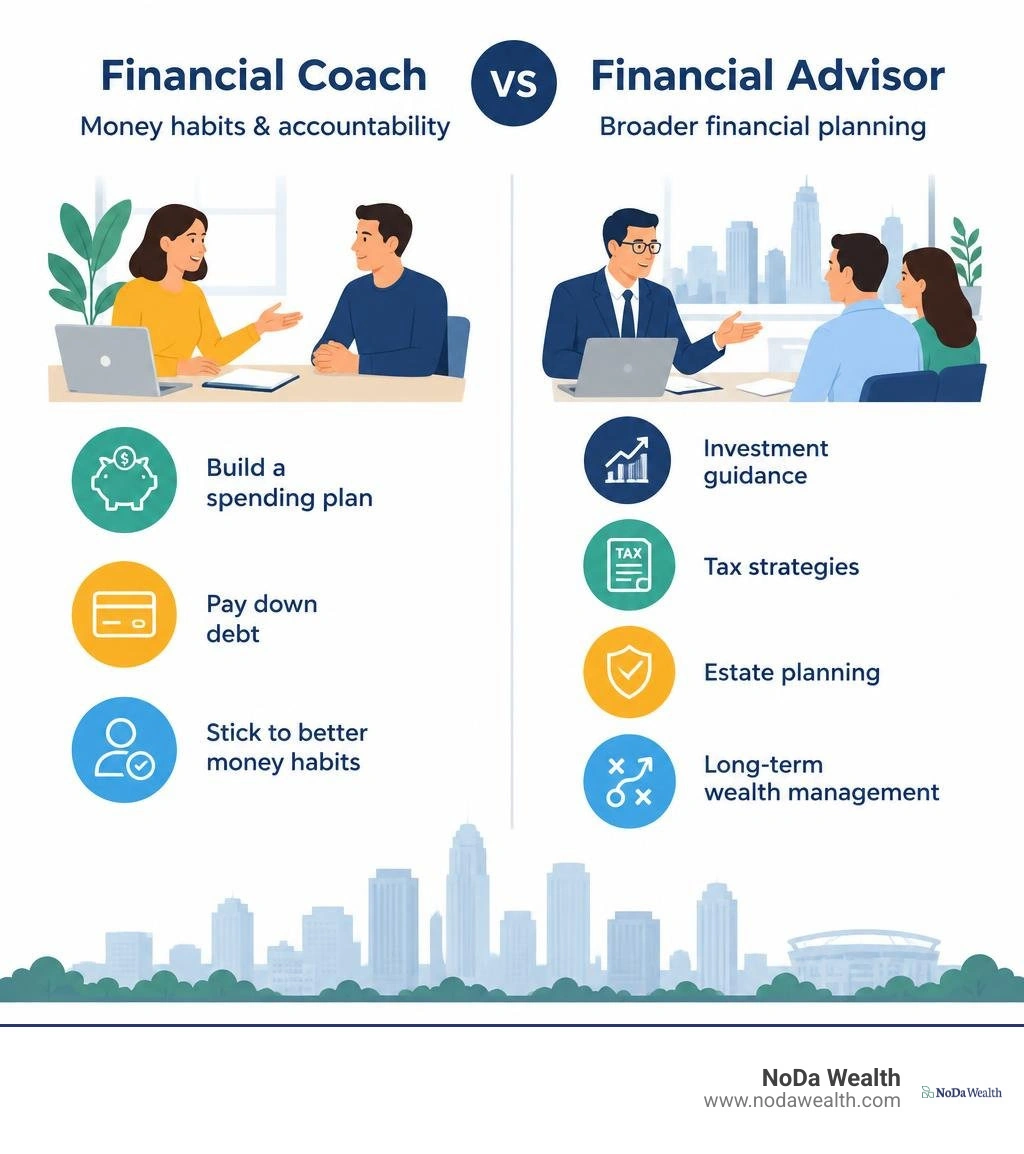
Financial coach charlotte nc terms simplified:
A financial coach is a mentor who focuses on the behavioral side of personal finance. Rather than managing complex investment portfolios or executing intricate tax-loss harvesting strategies, a coach works with you on day-to-day money habits, spending awareness, and foundational financial literacy.
Think of a financial coach as a personal trainer for your wallet. If you know you should be working out, but you walk into the gym and stare blankly at the machines, a trainer gives you a structured workout routine and keeps you accountable. Similarly, if you know you need to save money but find your paycheck disappearing into dining out in South End, a financial coach helps you build a workable spending plan and identify emotional triggers around spending.
Financial coaches emphasize education, empowerment, and behavior modification. They help you examine your relationship with money, eliminate high-interest consumer debt, establish a reliable emergency fund, and set up clear financial systems.
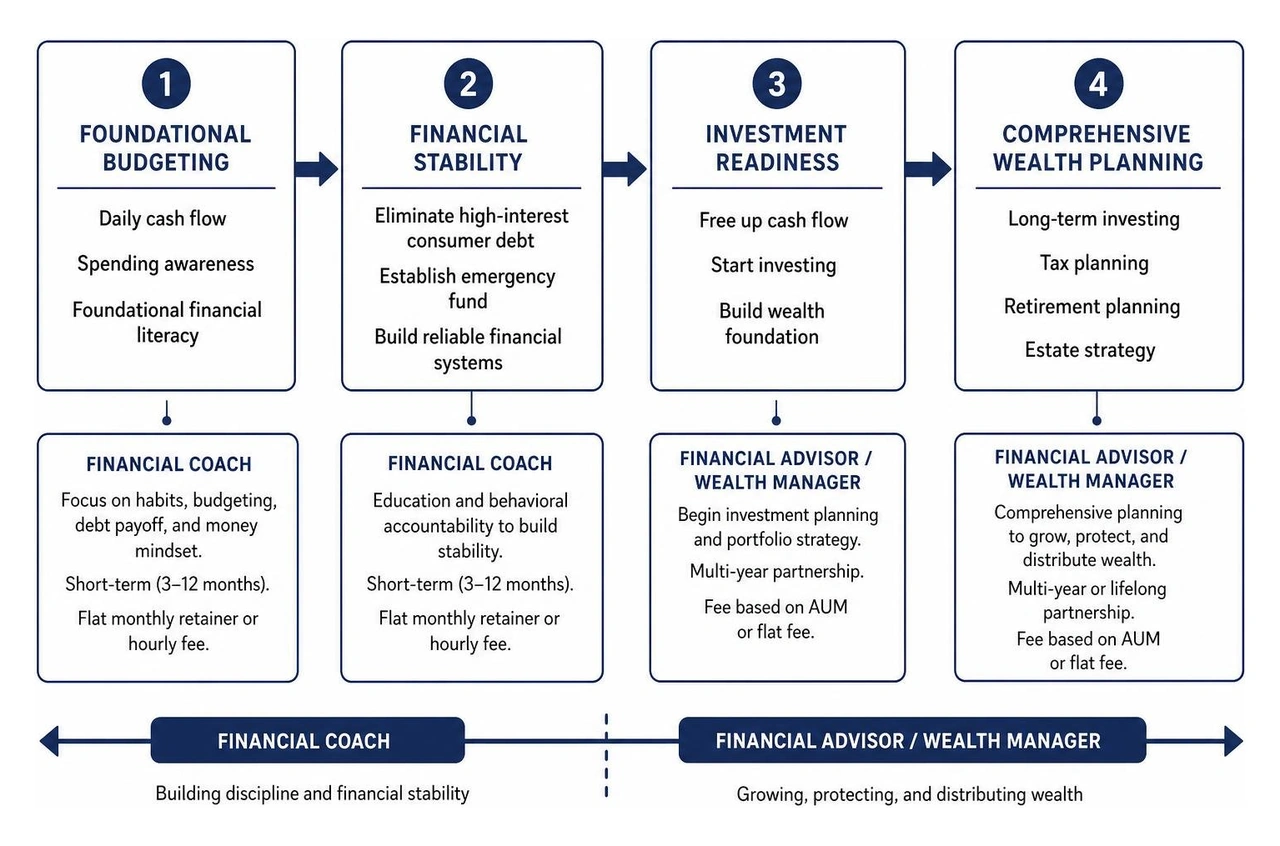
| Feature | Financial Coach | Financial Advisor / Wealth Manager |
|---|---|---|
| Primary Focus | Daily cash flow, budgeting, debt payoff, money mindset | Long-term investing, tax planning, retirement, estate strategy |
| Typical Engagement | Short-term (3 to 12 months) | Multi-year or lifelong partnership |
| Investment Management | Does not manage assets or execute trades | Actively manages and rebalances portfolios |
| Regulatory Licensing | None required (Certifications like AFC® available) | Series 65/66, CFP®, RIA registration |
| Standard Pricing | Flat monthly retainer or hourly fee | Percentage of Assets Under Management (AUM) or flat fee |
| Ideal Starting Point | Building cash reserves and establishing financial discipline | Growing, protecting, and distributing accumulated wealth |
Reviewing standard services and fees upfront helps clarify which professional model matches your current balance sheet.
While both professionals want you to succeed financially, their regulatory standards, scopes of practice, and daily toolkits are fundamentally different.
To understand how legal standards protect your long-term capital, explore our fiduciary advisor charlotte guide 2026.
A financial coach provides hands-on, structured assistance to help you regain control over your monthly numbers. Key services include:
Financial coaching is designed for individuals and couples who earn a steady income but struggle to translate those earnings into tangible financial stability.

Unlike traditional wealth management, which commonly charges an annual percentage of assets under management (AUM), financial coaches typically structure their pricing through flat monthly retainers or fixed package fees.
The typical financial coaching engagement lasts between 6 and 12 months. This duration provides sufficient time to break long-standing spending habits, navigate several real-world budgeting cycles, and build a sustainable financial foundation. Once your systems run on autopilot and your debt is under control, you graduate from coaching.
For ongoing asset management and integrated tax planning beyond basic budgeting, you can explore working with an ongoing financial advisor in charlotte nc.
If private, one-on-one coaching does not fit your current budget, Charlotte offers several high-quality community resources and non-profit initiatives focused on financial literacy:
To get the most value out of your coaching sessions, preparation is essential. Walking into your first consultation with organized data allows your coach to pinpoint opportunities immediately.
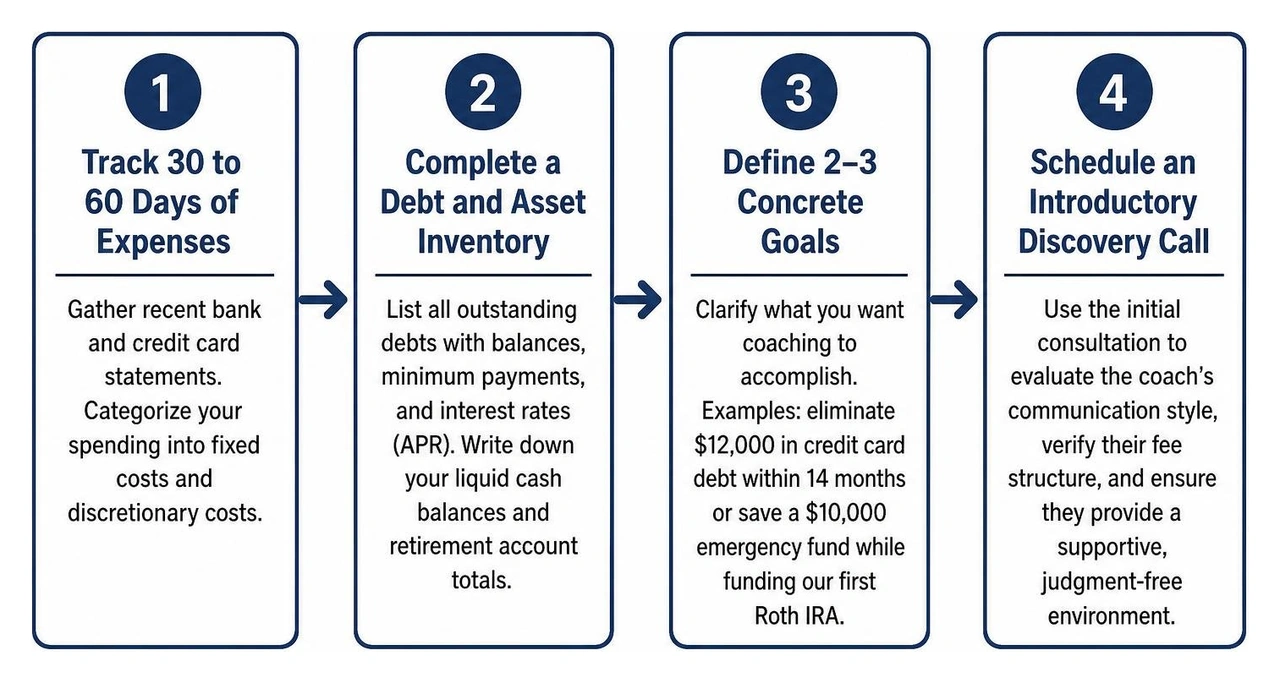
Financial coaching lays the structural foundation for your financial life. However, as your cash flow turns positive and your net worth expands, your financial needs evolve from behavioral habit-building to advanced wealth coordination.

You are likely ready to transition to a wealth manager when:
When your primary focus shifts to preserving capital and optimizing multi-account portfolios, partnering with a dedicated wealth manager charlotte nc provides the comprehensive strategy you need.
No. Financial coaches do not manage investment assets, execute trades, or recommend specific stocks, bonds, or mutual funds. They focus on foundational literacy, budgeting, and behavioral habits. If you need portfolio design and ongoing investment oversight, you should work with a licensed, fiduciary financial advisor.
Yes. Debt elimination is one of the core functions of financial coaching. A coach helps you organize your liabilities, choose between payoff methods like the debt snowball (paying smallest balances first) or debt avalanche (paying highest interest rates first), and reconstruct your monthly cash flow to free up extra payment funds.
Because financial coaching does not require a mandatory state or federal license, look for professionals who demonstrate rigorous training. Notable credentials include the Accredited Financial Counselor (AFC®) or Certified Financial Planner (CFP®). Above all, verify that the coach uses transparent, fee-only pricing with no hidden product sales or commissions. For more details on advisor standards, visit our faq page.
Both financial coaches and fiduciary financial advisors play vital roles in helping Charlotte residents take control of their economic futures. If you need day-to-day spending discipline, a roadmap out of debt, or supportive accountability to reset your money habits, a financial coach is an exceptional starting point.
When you are ready to coordinate investments, minimize lifelong taxes, and build a comprehensive long-term financial roadmap, NoDa Wealth is here to guide you. NoDa Wealth provides transparent, fee-only, fiduciary wealth planning for professionals across Charlotte.
Take the first step in planning your financial future by completing NoDa Wealth's free assessment today.
Educational Purposes Only. Content on this blog is for general educational and informational purposes only. It is not investment, tax, accounting, or legal advice, and it is not a recommendation or solicitation to buy or sell any security or to adopt any investment strategy. Past performance does not guarantee future results. Investing involves risk, including the possible loss of principal.
NoDa Wealth Management, LLC ("NoDa Wealth") is an investment adviser registered with the State of North Carolina. Advisory services are offered only where NoDa Wealth and its representatives are properly registered or exempt from registration. Readers should consult their own financial, tax, and legal advisors regarding their specific situation before making any decisions. For important disclosures, see the site footer and Form ADV.
Feeling overwhelmed? Let’s simplify things! Schedule your Free Assessment for an easy, 30-minute chat to help you tackle life’s transitions.
Enjoy a hassle-free conversation that puts your needs front and center!
)%20(3).avif)
