Understand ISO vs NSO Stock Options Before You Exercise
Learn the key differences between ISO and NSO options, including tax rules, exercise timing, and AMT traps, before you exercise.



Learn the key differences between ISO and NSO options, including tax rules, exercise timing, and AMT traps, before you exercise.
When comparing ISO NSO options, the core differences lie in recipient eligibility, employer entity requirements, transferability, and how corporate deductions apply under the tax code. These distinctions shape not only who can receive each option type but also how employers and employees plan around exercise timing, payroll obligations, and long-term tax outcomes.
Incentive Stock Options (ISOs) are statutory options governed by IRC Section 422. They are strictly reserved for direct W-2 employees of corporate entities. Non-Qualified Stock Options (NSOs), by contrast, are flexible non-statutory options that can be granted to anyone providing services—including employees, independent contractors, advisors, and board members. Because ISOs are limited to employees of corporations, many startups and established companies use NSOs to compensate a broader range of contributors without running afoul of statutory eligibility rules.
| Feature | Incentive Stock Options (ISO) | Non-Qualified Stock Options (NSO) |
|---|---|---|
| Eligible Recipients | Direct W-2 employees only | Employees, contractors, advisors, directors |
| Issuing Entity | Corporations (typically C-Corps) | Any legal structure (Corporation, LLC, etc.) |
| Governing Tax Code | IRC Section 422 | IRC Section 83 |
| Tax at Exercise | No regular income tax; potential AMT | Ordinary wage income + payroll taxes (FICA) |
| Tax at Sale | Long-Term Capital Gains (if holding met) | Capital gains on appreciation past exercise FMV |
| Employer Tax Deduction | None (unless disqualifying disposition) | Equal to employee ordinary income spread |
| Transferability | Non-transferable (except upon death) | Broadly transferable if plan permits |
| Statutory Cap | $100k annual exercisable cap at grant | No statutory limit |
Understanding these statutory option requirements is essential, as detailed in IRS guidance on incentive stock options. ISOs demand strict compliance to maintain their tax-advantaged status, whereas NSOs prioritize operational flexibility. For employees weighing an equity offer, the choice between ISO NSO options often comes down to whether the potential for long-term capital gains treatment outweighs the simplicity and predictability of ordinary income taxation at exercise.
Under IRC Section 422(d), the IRS enforces an aggregate fair market value (FMV) cap: an employee cannot have more than $100,000 worth of ISO shares first become exercisable in any single calendar year. This limit is designed to prevent high earners from using ISOs to defer unlimited amounts of compensation, and it applies regardless of how many separate grants an employee receives from the same employer.
This calculation is based on the fair market value of the stock on the grant date, not the exercise date. If your vesting schedule accelerates or an initial grant exceeds this threshold, any excess shares automatically convert to NSOs without requiring a new grant document. Employers typically track this limit through their equity administration platform, but employees should also monitor their own grants to avoid surprises at tax time.
For example, if you receive a grant of options valued at $160,000 at grant date that vests entirely in year one, the first $100,000 retains ISO tax treatment, while the remaining $60,000 is automatically treated as NSOs. This automatic conversion preserves the tax-advantaged status of the qualifying portion while ensuring the excess is taxed under the more flexible NSO rules.
When leaving an employer, statutory rules dictate how long your ISOs retain preferential status. Under IRC Section 422, an employee must exercise their ISOs within 90 days (3 months) following termination to keep ISO tax treatment. This deadline applies to both voluntary departures and involuntary terminations, and it begins on the last day of employment.
While many modern equity plans offer extended post-termination exercise windows (often spanning several years), holding the option unexercised past the 90-day mark automatically recharacterizes the option into an NSO for tax purposes upon eventual exercise. That means the spread at exercise will be taxed as ordinary income rather than potentially qualifying for long-term capital gains treatment. Employees who leave a company with valuable ISOs should carefully evaluate whether exercising within the 90-day window makes sense given their cash reserves, AMT exposure, and confidence in the company's future.
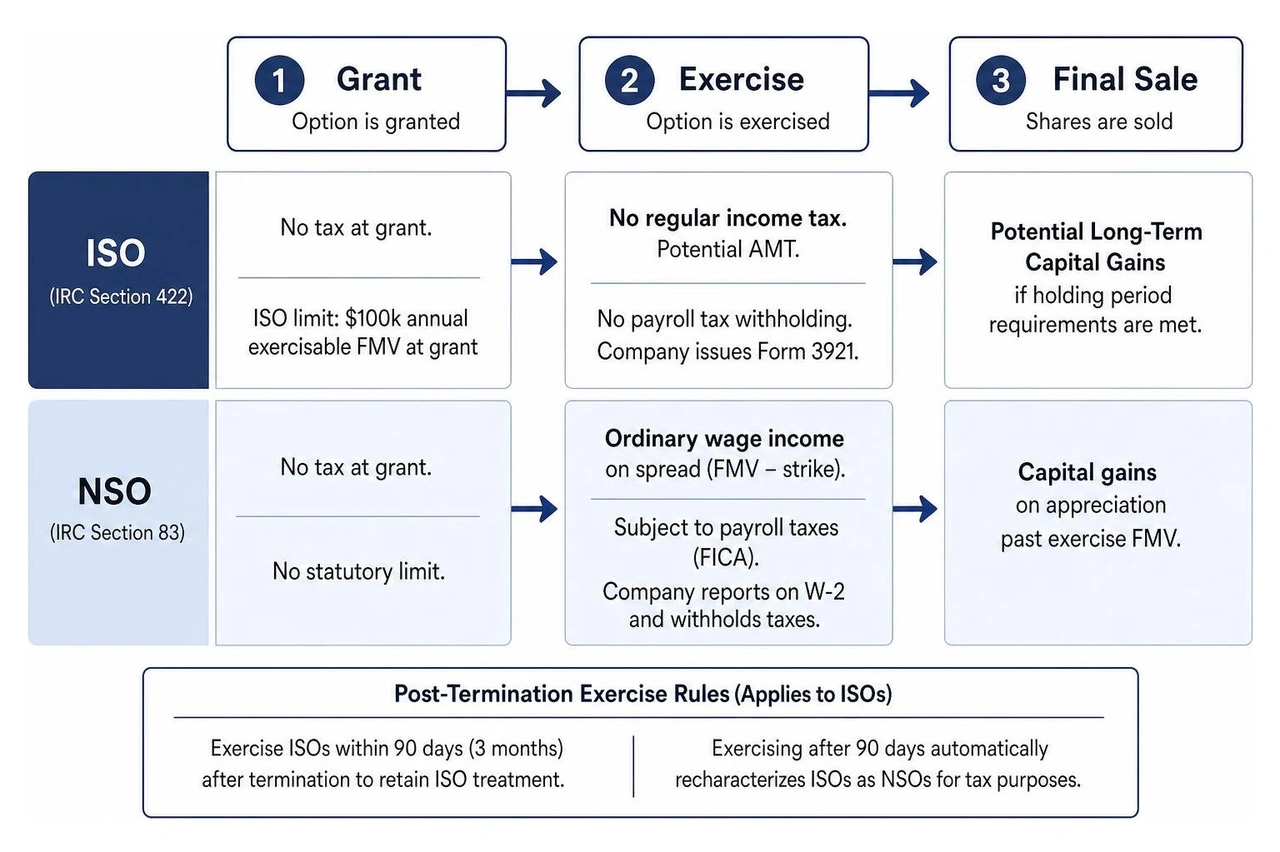
The true divergence between option types occurs across two key events: the exercise date and the final sale date. Understanding the timing of these taxable events is critical because the tax character of each transaction—ordinary income versus capital gains—can dramatically affect your total tax liability.
For NSOs, the spread between the strike price and the current fair market value (the "bargain element") is treated as ordinary wage income at exercise. This creates immediate equity plan tax withholding responsibilities for your employer, who reports the income and withholdings on your Form W-2. Because this income is subject to payroll taxes in addition to income taxes, the effective tax rate on an NSO exercise can be higher than many employees expect.
For ISOs, the exercise does not trigger ordinary income tax or payroll withholdings. Instead, the company issues Form 3921 documenting the transaction details, and the spread is included as an Alternative Minimum Tax (AMT) preference item. This means you may owe AMT even though no regular income tax is due at exercise, a distinction that catches many employees off guard.
When exercising NSOs, you owe federal income tax, state income tax, and mandatory FICA payroll taxes (Social Security and Medicare) on the entire spread. Companies typically apply a statutory supplemental withholding rate, but high earners frequently find this insufficient, leading to surprise liabilities at filing. For example, if your strike price is $1.00 and the fair market value at exercise is $5.00, the $4.00 spread per share is taxed as ordinary income in the year of exercise.
With ISOs, no regular income or payroll taxes are due at exercise. However, the spread between the strike price and exercise-date FMV is added directly to your Alternative Minimum Taxable Income (AMTI). This adjustment can push you into AMT territory, especially if you exercise a large number of options in a single year. The AMT calculation is separate from your regular tax calculation, and you pay whichever is higher.
To lock in the favorable long-term capital gains tax rates on ISO gains, you must achieve a qualifying disposition by meeting two simultaneous holding period requirements:
If you sell before meeting both conditions, the sale is a disqualifying disposition. In this scenario, the spread at exercise is reclassified as ordinary income, eliminating the core tax advantage of the ISO structure. The amount reclassified is generally the lesser of the spread at exercise or the gain on sale, and any additional gain is treated as capital gain. This rule ensures that employees cannot convert ordinary compensation into capital gains simply by holding shares for a short period.
Exercising ISOs without an immediate sale creates the risk of the "AMT Trap"—owing substantial cash taxes on illiquid shares that cannot yet be sold. This is especially dangerous for employees of pre-IPO companies, where the fair market value at exercise may be high but there is no public market to sell the shares and generate cash to pay the tax bill.
If your tentative minimum tax exceeds your regular tax liability, you pay the higher AMT amount. When you pay AMT, you generate an AMT credit carryforward that can offset regular tax in future years when your regular tax exceeds your tentative minimum tax. This credit can be valuable, but it may take years to fully utilize, and it does not help with the immediate cash flow problem of paying AMT on illiquid shares.
For taxpayers navigating these calculations in 2026, reference the current IRS Form 6251 guidance to model your specific exemption and phaseout levels. The AMT exemption and phaseout thresholds are adjusted annually for inflation, so using outdated figures can lead to significant miscalculations.

Navigating stock option decisions requires balancing tax exposure with personal liquidity. A well-designed exercise strategy considers not only current tax rates but also your expected future income, the company's growth trajectory, and your overall portfolio concentration. Because equity compensation can represent a significant portion of your net worth, the timing of exercise and sale decisions can have an outsized impact on your long-term financial security.
No. Stock options are not subject to double taxation. When you exercise an NSO, you pay ordinary income tax on the spread, establishing a new cost basis equal to the FMV at exercise. When you later sell the shares, you only pay capital gains tax on appreciation above that new basis. Similarly, for ISOs, the AMT paid at exercise adjusts your AMT basis and generates an AMT credit carryforward to prevent duplicate taxation. The tax code is designed to tax each dollar of economic gain only once, though the timing and character of that tax can vary depending on the option type and holding period.
You cannot manually elect to swap an ISO grant for an NSO. However, ISOs automatically convert to NSOs if they exceed the $100,000 annual vesting cap, if they are modified in a way that disqualifies them under Section 422, or if you exercise them more than 90 days after leaving your employer. This automatic conversion is not a penalty but rather a statutory mechanism to ensure that options that no longer meet ISO requirements are taxed under the more flexible NSO rules.
In 2026, shifts in AMT exemption amounts and phaseout thresholds make proactive modeling vital for high earners. When planning substantial ISO exercises, verify current parameters on IRS Form 6251 to estimate tentative minimum tax and identify optimal exercise timing. Because the AMT exemption phases out at higher income levels, employees with significant regular income may find that even a modest ISO exercise pushes them into AMT, making multi-year staging and careful timing essential.
Managing equity compensation requires aligning your tax posture, personal risk tolerance, and cash flow needs. The decision to exercise iso nso options is rarely a simple calculation; it involves projecting future tax liabilities, understanding AMT exposure, and evaluating whether the potential for long-term capital gains justifies the risk of holding concentrated stock positions. At NoDa Wealth, our fee-only, fiduciary advisors in Charlotte, NC, help busy professionals navigate multi-year exercise strategies, model AMT exposure, and build integrated wealth plans that account for both the tax efficiency and the liquidity needs of your equity compensation.
To model your specific options and build an exercise roadmap, schedule a free assessment with our team.
Educational Purposes Only. Content on this blog is for general educational and informational purposes only. It is not investment, tax, accounting, or legal advice, and it is not a recommendation or solicitation to buy or sell any security or to adopt any investment strategy. Past performance does not guarantee future results. Investing involves risk, including the possible loss of principal.
NoDa Wealth Management, LLC ("NoDa Wealth") is an investment adviser registered with the State of North Carolina. Advisory services are offered only where NoDa Wealth and its representatives are properly registered or exempt from registration. Readers should consult their own financial, tax, and legal advisors regarding their specific situation before making any decisions. For important disclosures, see the site footer and Form ADV.
Feeling overwhelmed? Let’s simplify things! Schedule your Free Assessment for an easy, 20-minute chat to help you tackle life’s transitions.
Enjoy a hassle-free conversation that puts your needs front and center!
)%20(3).avif)
