Optimize ESPP Cash Flow Management and Keep Your Household Budget Intact
Master ESPP cash flow management to protect your budget, balance payroll deductions, and avoid liquidity traps.



Master ESPP cash flow management to protect your budget, balance payroll deductions, and avoid liquidity traps.
ESPP cash flow management starts with treating payroll deductions like a fixed monthly bill. Before enrolling, choose a contribution rate that still leaves room for essentials, debt payments, savings, and surprise expenses. Then mark the offering start date, purchase date, expected share-sale date, and likely tax date on one calendar.
A practical approach:
ESPP deductions are generally made from after-tax pay, so every dollar contributed reduces your take-home pay by roughly a dollar. For example, contributing 15% of a $150,000 salary means putting $22,500 per year toward the plan, or about $865 less from each biweekly paycheck. The discount can be valuable, but it does not help with this week's grocery bill, mortgage payment, or childcare cost.
The goal is not to maximize the percentage you contribute. It is to capture the plan's benefit without creating a cash crunch or taking too much risk in the same company that already provides your income.
I am Evan Luongo, and this guide will help you fit your ESPP into a calmer, more durable household cash-flow plan.
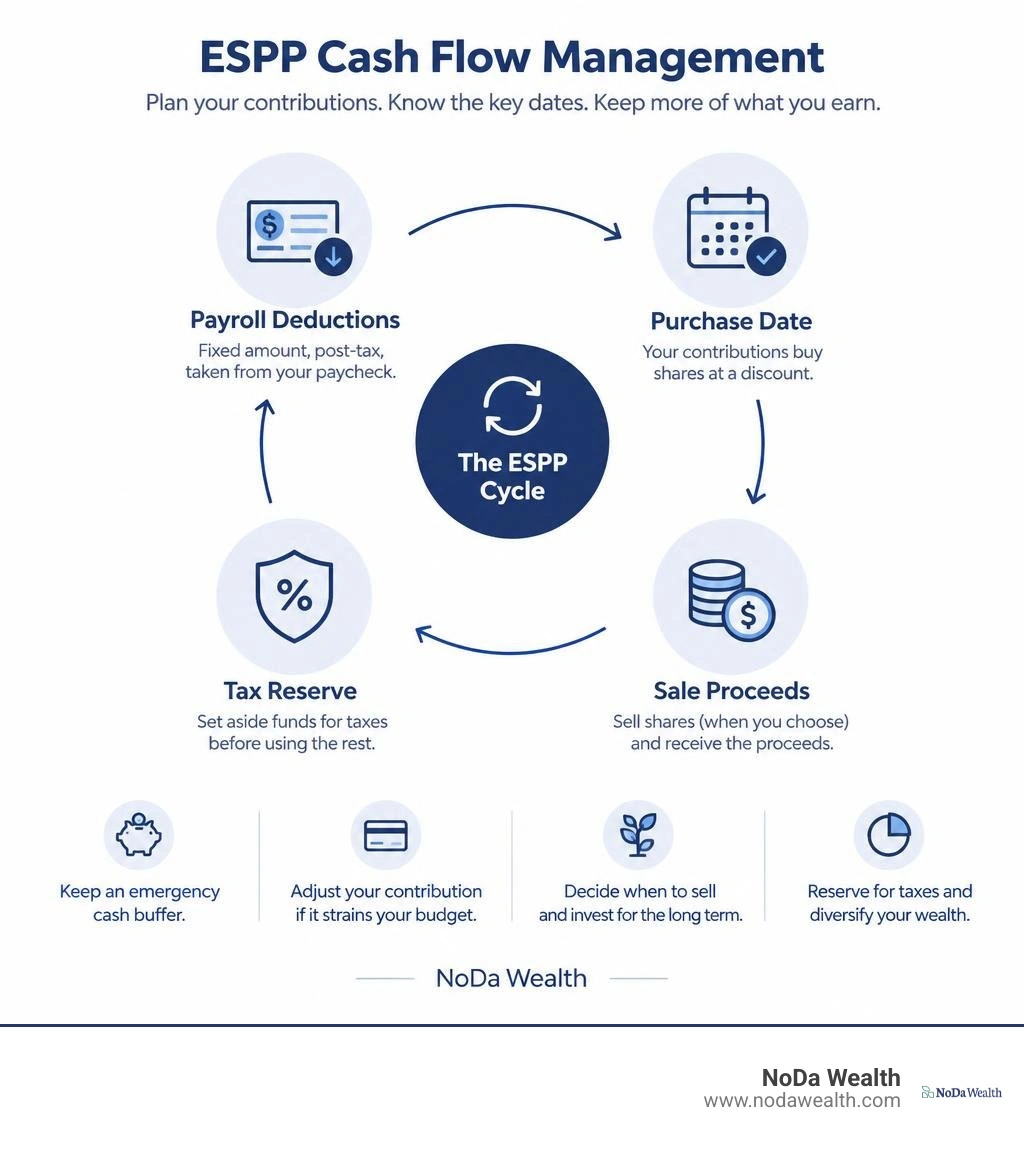
Participating in an Employee Stock Purchase Plan (ESPP) creates an immediate liquidity trade-off. In a typical qualified plan governed by Internal Revenue Code Section 423, contributions accumulate over an offering period (usually six months) via post-tax payroll deductions. Because these deductions come directly out of net pay, your household budget must absorb the reduction until the purchase date arrives.
Statutory limits also govern these programs: the IRS caps total purchases at $25,000 of fair market value per calendar year. While this limit sets an upper bound on participation, your actual cash flow constraint is usually far tighter. According to a 2023 survey by the National Association of Stock Plan Professionals, about 65% of publicly traded companies offering ESPPs report that less than half of their eligible workforce participates, primarily because employees cannot manage the reduction in take-home pay.

Understanding the administrative roadmap—from enrollment dates to purchase windows—is essential. You can explore the mechanics of grant tracking and accounting standards in this overview of ESPP accounting and lifecycle mechanics. To ensure your household runs smoothly during the contribution phase, we recommend building a flex budget that accounts for these automatic deductions without forcing you to rely on credit cards.
The financial engine behind Section 423 plans is the combination of purchase discounts and lookback provisions. Most competitive plans offer a 15% discount on the stock price. When combined with a lookback feature, the purchase price is calculated based on the lower of two prices: the stock price on the offering date (the first day of the period) or the purchase date (the last day).
Plans featuring a 15% discount and a lookback provision boast average employee participation rates of 44%, noticeably higher than plans offering minimal discounts or no lookback, according to the National Association of Stock Plan Professionals' 2023 ESPP survey. If your company's stock rises from $50 at the offering date to $70 on the purchase date, a 15% discount applied to the $50 price lets you buy shares at $42.50. Selling immediately at the $70 market price generates an instant pre-tax gain of $27.50 per share (a 64.7% return on invested capital).
Even if the stock falls from $50 to $40, the lookback applies the 15% discount to the lower $40 price, setting your purchase price at $34. This embedded downside protection provides an immediate 17.6% return on invested cash (a $6 gain on a $34 investment) upon purchase, assuming you execute an immediate sale.
Life rarely follows a neat six-month financial calendar. When an unexpected expense arises—such as a major medical bill or home repair—most ESPPs allow participants to adjust their payroll election, suspend ongoing deductions, or initiate a full mid-period withdrawal.
These escape hatches mean your ESPP contributions remain your money throughout the offering window, functioning as an accessible pool of emergency liquidity if household cash flows suddenly deteriorate.
Capturing an ESPP discount should never come at the expense of core financial stability. Before committing 10% to 15% of your pay to an equity plan, your household must secure its liquidity foundations. High-interest consumer debt, such as credit card balances carrying 20%+ APRs, will erode any 15% stock discount in short order.
Similarly, maintaining a three- to six-month emergency cash reserve ensures that everyday hiccups do not derail your equity strategy. Rather than letting unassigned cash sit idle, consider parking cash in high-yield savings or money market funds to earn safe baseline yield while serving as a financial cushion.
| ESPP Strategy | Paycheck Impact | Upfront Cash Required | Capital Risk During Offering | Liquidity Complexity |
|---|---|---|---|---|
| Self-Funded (Standard) | Full reduction (e.g., 10–15% after-tax) | High (funded entirely from current wages) | None (funds held in cash until purchase) | Low; automated through employer payroll |
| Cash-Reserve Funded | Full reduction offset by monthly savings transfers | Moderate (requires 6-month buffer in savings) | Low; cash reserve bridges monthly spending needs | Moderate; requires manual monthly transfers |
| Cashless Participation | Minimal to none | Zero upfront out-of-pocket payroll drain | Low; third-party financing funds the purchase | High; subject to plan availability and disqualifying tax rates |
For workers facing severe liquidity constraints, some employers offer cashless structures backed by third-party lenders. To evaluate the regulatory mechanics and structural trade-offs of these programs, review this guide on cashless ESPP structures and IRS rules.
Once you complete your first six-month offering cycle, you can transform your ESPP into a self-sustaining cash flow flywheel. In this framework, the proceeds from your first stock purchase fund your living expenses during the subsequent six-month period, eliminating ongoing cash flow strain.
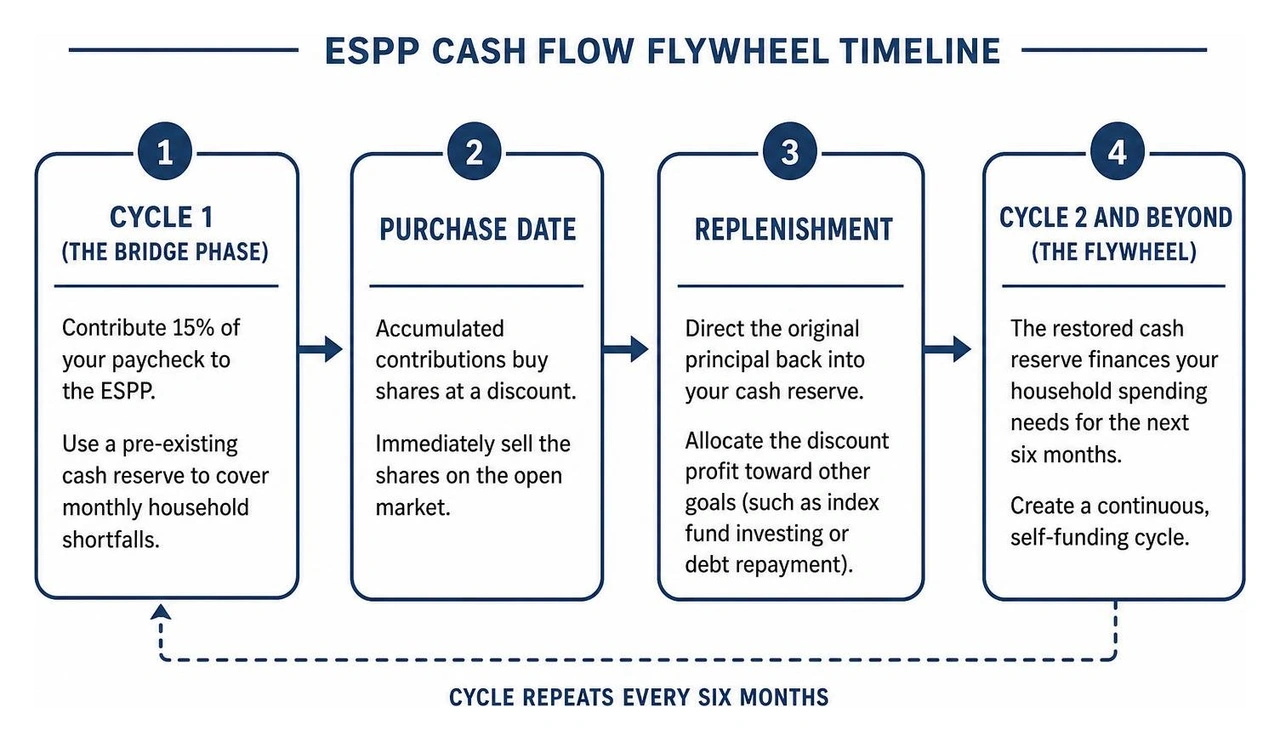
Managing this cadence alongside variable equity grants requires careful coordination. For a deeper look at harmonizing multiple equity components, see our guide on living off equity compensation.
Even high earners can stumble when integrating equity plans into their monthly routines. We regularly observe four common missteps:
When managing high earnings, balancing equity deductions with broad-market portfolio growth is paramount. For actionable allocation frameworks, check out our insights on investing high-income paychecks.
Participating in an ESPP is only half the equation; your exit strategy determines your actual net profit and risk exposure.

Under IRS rules, the sale of ESPP shares falls into one of two categories:
Industry data from the National Association of Stock Plan Professionals' 2023 ESPP survey shows that approximately one-third of all Section 423 shares are sold in a disqualifying disposition. While holding for a qualifying disposition provides tax savings, it requires bearing company-specific market risk for at least 12 to 24 months.
For most households, an immediate sale strategy provides the best balance of return and risk management. Selling shares on the purchase date eliminates the risk of a market drop wiping out your hard-earned discount.
Consider an employee who purchases shares at an effective price of $85 (market value $100). If they sell immediately, they secure a 17.6% pre-tax gain. If they choose to hold the shares for a year to seek qualifying tax treatment, a 20% drop in the company's stock price to $80 turns a profit into a net loss of $5 per share.
Because your salary, health insurance, and unvested equity are already tied to your employer, holding additional shares exposes your family to unnecessary concentration risk. Locking in the gain immediately and redirecting net proceeds toward a diversified portfolio protects your household balance sheet.
When you sell ESPP shares, your plan administrator will issue IRS Form 3922 (Transfer of Stock Acquired Through an Employee Stock Purchase Plan). This document outlines the fair market value on the grant date, the purchase date value, and the purchase price paid per share.
A frequent reporting error occurs on Form 1040 Schedule D: standard brokerage 1099-B forms often report your cost basis as the discounted purchase price rather than the full fair market value on the purchase date. If you fail to adjust the cost basis upward by the amount of ordinary income reported on your Form W-2, you will be double-taxed on the discount. Always verify your adjusted basis before filing your tax return.
ESPP contributions are deducted after taxes, which means every dollar you allocate reduces your take-home pay dollar-for-dollar. For an employee making $120,000 annually, a 10% contribution reduces net take-home pay by $1,000 per month (or roughly $461 biweekly). Your household budget must be adjusted downward by that exact amount throughout the six-month offering window.
We recommend a clear hierarchy of cash flow priorities:
If you leave your company, take an extended unpaid leave of absence, or withdraw from the plan before the scheduled purchase date, your accumulated payroll deductions are not used to buy stock. Instead, the total unpurchased cash balance is returned to you as an adjustment on your final paycheck or via direct deposit, with no penalties or tax consequences.
Maximizing an Employee Stock Purchase Plan does not require extreme budgeting or sacrificing peace of mind. By modeling payroll timing, establishing a self-sustaining cash-reserve flywheel, and selling shares immediately to manage concentration risk, you can capture valuable company discounts while keeping your monthly budget balanced and resilient.
At NoDa Wealth, our fee-only, fiduciary advisory team helps busy professionals integrate stock purchase plans, equity awards, and tax planning into clear, long-term wealth strategies. To review your compensation structure and build a personalized cash-flow plan, schedule your free financial assessment with us today.
Educational Purposes Only. Content on this blog is for general educational and informational purposes only. It is not investment, tax, accounting, or legal advice, and it is not a recommendation or solicitation to buy or sell any security or to adopt any investment strategy. Past performance does not guarantee future results. Investing involves risk, including the possible loss of principal.
NoDa Wealth Management, LLC ("NoDa Wealth") is an investment adviser registered with the State of North Carolina. Advisory services are offered only where NoDa Wealth and its representatives are properly registered or exempt from registration. Readers should consult their own financial, tax, and legal advisors regarding their specific situation before making any decisions. For important disclosures, see the site footer and Form ADV.
Feeling overwhelmed? Let’s simplify things! Schedule your Free Assessment for an easy, 30-minute chat to help you tackle life’s transitions.
Enjoy a hassle-free conversation that puts your needs front and center!
)%20(3).avif)
