Navigating Advisor Compensation Models with Confidence
Learn how a fee based CFP balances commissions and fiduciary duty. Explore compensation models, ethical standards, and key questions to ask.



Learn how a fee based CFP balances commissions and fiduciary duty. Explore compensation models, ethical standards, and key questions to ask.
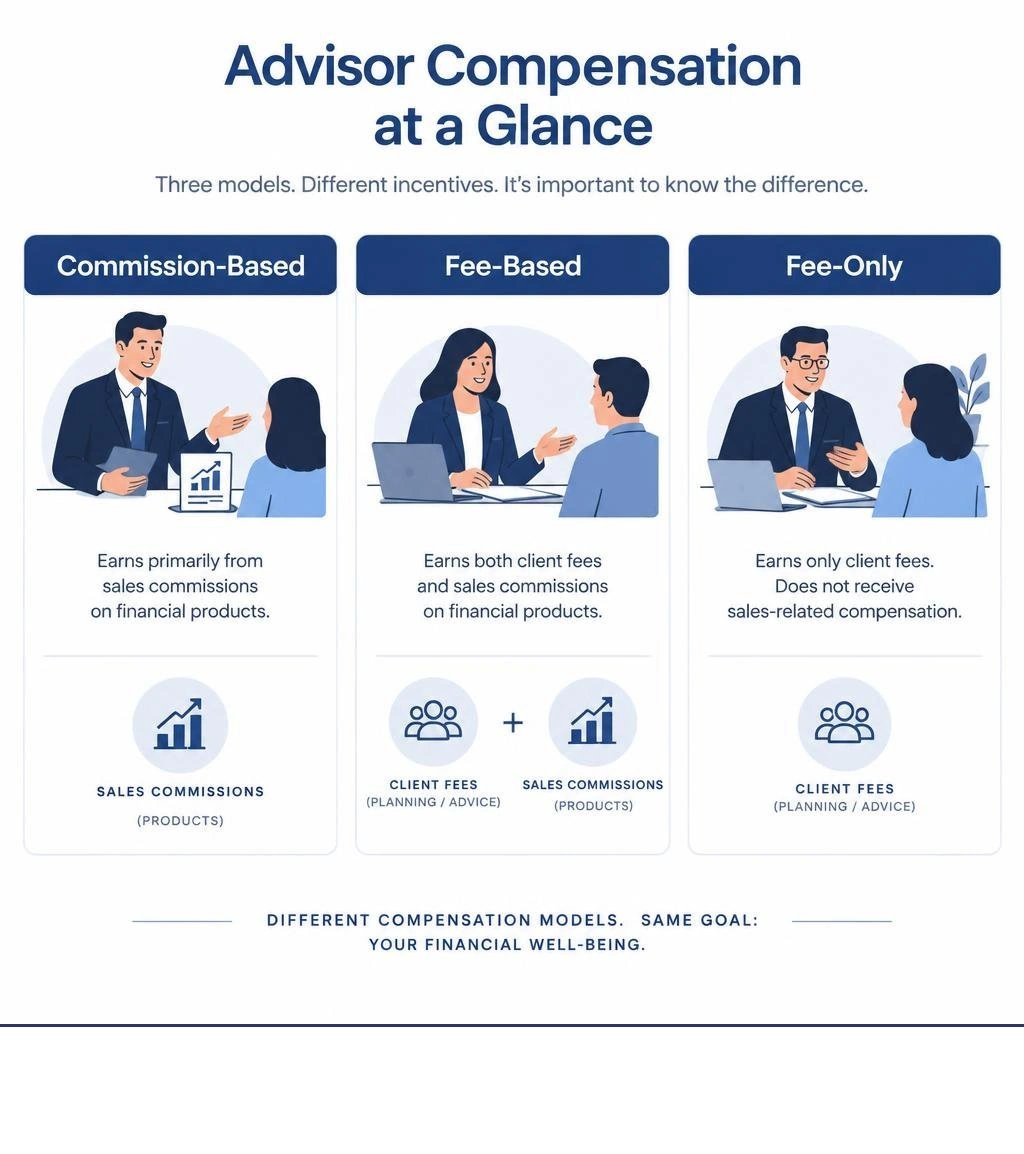
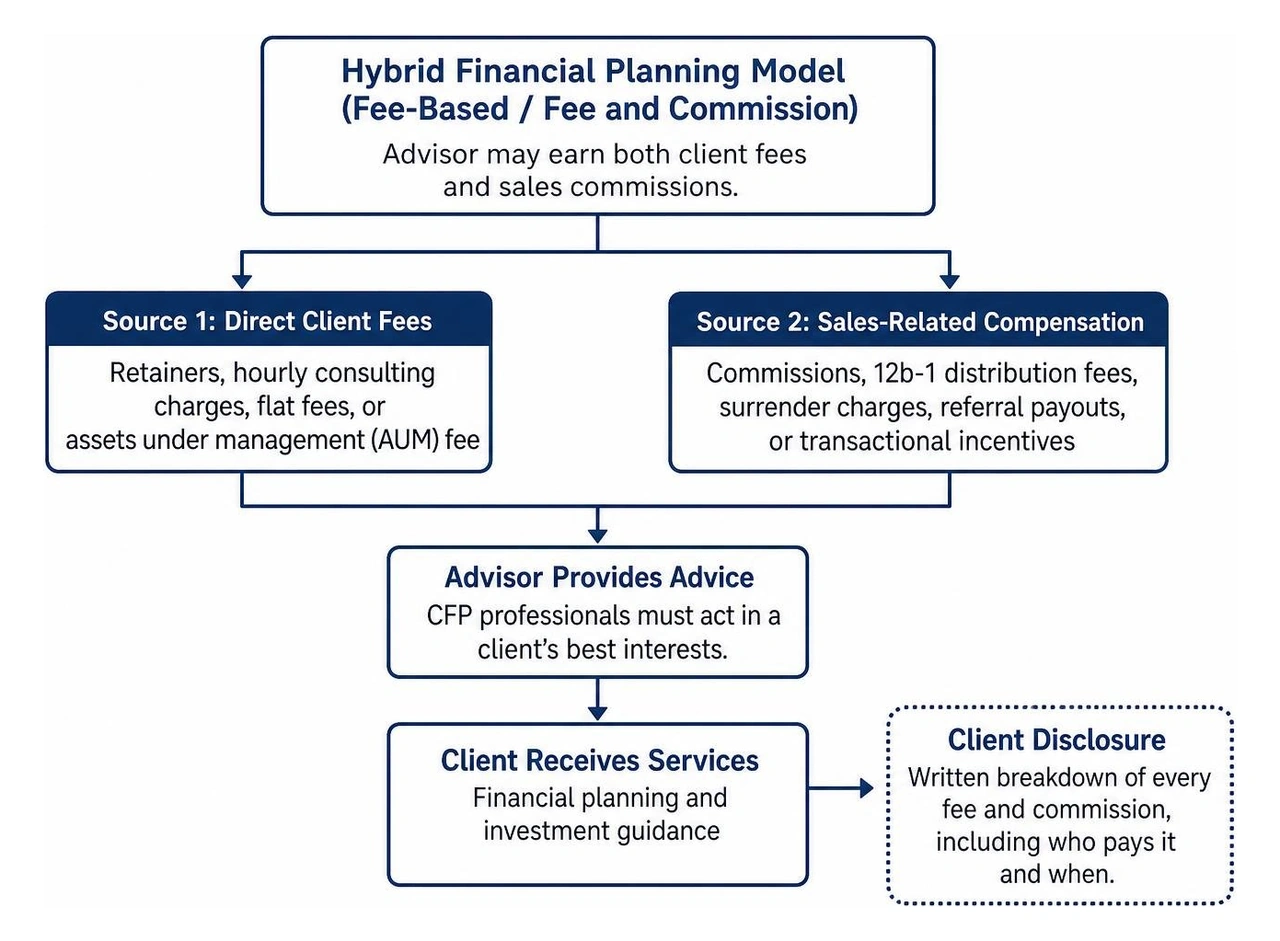
A fee-based CFP professional may earn both client fees and sales commissions. A fee-only CFP professional does not receive sales-related compensation for client services. The difference matters because a commission can give an advisor a financial reason to recommend one product over another. CFP Board calls fee-based compensation “fee and commission” and requires CFP professionals to act in a client’s best interests when giving financial advice. Read CFP Board’s compensation guidance.
Before hiring an advisor, ask for a written breakdown of every fee and commission, including who pays it and when. I’m Evan Luongo, and this guide will help you use those answers to compare advisors with confidence.
When evaluating financial professionals, terminology can easily cloud judgment. Many consumers assume that working with a Certified Financial Planner (CFP®) automatically guarantees that all advice is independent of product sales. While CFP Board enforces strict ethical guidelines, the business models used across the industry vary significantly.
A fee-based CFP professional operates under a hybrid compensation model. This structure allows the practitioner to bill clients directly for consulting, financial planning, or investment management, while simultaneously accepting third-party compensation when clients purchase specific financial products.
Under the rules established by CFP Board, "fee-based" is explicitly treated as equivalent to "fee and commission." It is not an entirely separate third category of unconflicted advice. Instead, it describes an environment where revenue originates from two distinct channels:
CFP Board also scrutinizes "Related Parties." If an advisor charges only a flat consulting fee but directs implementation to an affiliated insurance brokerage or corporate parent that earns a commission, the practice cannot claim to be independent of sales incentives. For a deeper breakdown of basic advisor payment mechanics, review the CFP Board guide on How to Pay a Financial Advisor | CFP - Let's Make a Plan.
The distinction between fee-based and fee-only is one of the most important dividing lines in financial planning. A fee-based advisor may receive both client-paid fees and sales-related compensation, such as commissions. A fee-only advisor is paid only by clients and does not receive commissions for product sales. That difference matters because compensation can shape incentives, conflicts, and how clearly advice aligns with the client’s best interests.
CFP Board's Code of Ethics and Standards of Conduct strictly limits who can use specific compensation labels. A professional may describe their practice as fee-only only when both the individual CFP® professional and their firm receive zero sales-related compensation in connection with any professional services provided to clients. If a single dollar of commission, revenue sharing, or 12b-1 distribution payments enters the business entity or a related entity, the service must be described as fee-based or commission-based.
| Compensation Model | Primary Revenue Source | Third-Party Commissions? | Potential Conflicts of Interest |
|---|---|---|---|
| Fee-Only | Client fees exclusively (AUM, hourly, flat, retainer) | No (prohibited by definition) | Low; primarily related to asset-gathering or billing hours |
| Fee-Based (Hybrid) | Client fees plus transactional commissions | Yes (insurance, mutual funds, annuities, brokerage products) | Moderate to High; dual incentives between advice and product sales |
| Commission-Based | Third-party product sales and transaction charges | Yes (sole source of revenue) | High; income relies entirely on trading and product distribution |
For individuals seeking fewer compensation-related conflicts, reviewing a dedicated fiduciary advisor Charlotte guide clarifies how fiduciary mandates work in practice across North Carolina.
Hybrid advisors leverage multiple billing mechanisms depending on the scope of work and the platforms they maintain:
Navigating these structures requires examining how each charge interacts with portfolio performance. Reviewing transparent services and fees helps investors benchmark what clearer, lower-conflict planning can look like.
A common misconception among consumers is that fee-based advisors are exempt from fiduciary requirements. Under CFP Board's current standards, any individual holding the CFP® mark is held to a fiduciary standard whenever providing financial advice.
This fiduciary obligation comprises three core elements:
However, a fee-based CFP professional frequently balances regulatory dual registration. When offering financial planning advice, they operate under the Investment Advisers Act of 1940 as an Investment Adviser Representative (fiduciary standard). When selling a commissionable product, they may act as a registered representative of a broker-dealer or an agent of an insurance company, where compensation incentives can challenge uncompromised loyalty.
Under CFP Board practice standards, the 7-step Financial Planning Process requires practitioners to understand personal circumstances, identify goals, analyze recommendations, develop proposals, implement strategies, and continuously monitor outcomes.
Throughout this lifecycle, hybrid models could introduce material conflicts of interest that require careful management:
The CFP Board framework for Disclosing and Accurately Representing Compensation to Clients | CFP Board establishes that merely avoiding illegal conduct is insufficient; professionals must clearly and proactively articulate where their incentives lie.
Transparency is enforced through mandatory regulatory filings and board-specific rules:
For career-focused individuals navigating complex equity packages, compensation models can shape plan objectivity. Exploring strategies through a financial advisor for professionals can help clarify whether compensation structures support long-term wealth preservation.

Choosing a fee-based planner involves weighing administrative convenience against potential compensation bias.
Working with an experienced wealth manager Charlotte NC helps local investors evaluate whether hybrid execution delivers genuine value or unnecessary friction.
Before signing an advisory agreement or transferring assets, conduct a structured interview to uncover all revenue sources. A qualified professional will welcome these questions and supply clear, written answers.
When interviewing a financial advisor in Charlotte NC, asking these targeted questions can help create clarity before assets are committed.
The fundamental difference lies in product commissions. A fee-only financial planner is compensated solely through direct client payments (AUM fees, flat fees, or hourly rates) and receives zero third-party commissions or kickbacks. A fee-based planner charges client fees but can also accept commissions or revenue-sharing from selling insurance policies, annuities, or brokerage investment products. For additional clarifications, browse common frequently asked questions regarding compensation structures.
Yes. A CFP® professional operating under a fee-based model must adhere to the CFP Board's fiduciary duty whenever providing financial advice. However, because they are permitted to accept sales-related compensation, they operate with inherent conflicts of interest that must be formally disclosed and managed.
You can verify an advisor's background by checking the SEC's Investment Adviser Public Disclosure (IAPD) website at adviserinfo.sec.gov, FINRA's BrokerCheck tool at brokercheck.finra.org, and the CFP Board verification registry at letsmakeaplan.org. These public databases display an advisor's registration status, licensing history, fee models, and any past regulatory disclosures or client complaints.
Selecting the right financial planner means looking past marketing terminology to evaluate underlying business models. While a fee-based CFP professional operates under ethical requirements from CFP Board, the dual presence of advisory fees and third-party commissions creates structural conflicts worth examining closely. Understanding how an advisor earns revenue can help you judge whether investment portfolios and wealth strategies are aligned with personal milestones.
For professionals and families seeking clear, data-driven financial guidance free from commissions, partnering with a fiduciary firm can bring more confidence to long-term decisions. Take the next step in your financial roadmap and schedule a free financial assessment to review your portfolio with greater clarity.
Educational Purposes Only. Content on this blog is for general educational and informational purposes only. It is not investment, tax, accounting, or legal advice, and it is not a recommendation or solicitation to buy or sell any security or to adopt any investment strategy. Past performance does not guarantee future results. Investing involves risk, including the possible loss of principal.
NoDa Wealth Management, LLC ("NoDa Wealth") is an investment adviser registered with the State of North Carolina. Advisory services are offered only where NoDa Wealth and its representatives are properly registered or exempt from registration. Readers should consult their own financial, tax, and legal advisors regarding their specific situation before making any decisions. For important disclosures, see the site footer and Form ADV.
Feeling overwhelmed? Let’s simplify things! Schedule your Free Assessment for an easy, 30-minute chat to help you tackle life’s transitions.
Enjoy a hassle-free conversation that puts your needs front and center!
)%20(3).avif)

