Slash Your Single Stock Risk Before Volatility Strikes
Slash concentrated stock risk with proven single stock risk management strategies for drawdowns, taxes, and volatility.



Slash concentrated stock risk with proven single stock risk management strategies for drawdowns, taxes, and volatility.
To slash single stock risk before volatility strikes, the core strategies are tax-aware programmatic liquidation, protective collars, exchange funds, and stock protection funds. Each approach reduces concentrated equity exposure while managing tax friction and preserving upside where possible. Holding a massive position in one company feels great on the way up. It represents hard work, career milestones, or early belief in a visionary enterprise. However, from a portfolio construction standpoint, concentrated equity introduces massive uncompensated risk. Unlike market risk (systematic risk), which offers an expected return premium for enduring macroeconomic swings, idiosyncratic risk—the company-specific risk tied to a single corporate entity—offers no expected excess return over the broad market over the long term.
When a single security makes up 20%, 50%, or 80% of your investable assets, you are exposed to extreme volatility drag. This mathematical reality means deep percentage drops require exponentially larger gains just to break even (a 50% loss requires a 100% gain to recover; a 70% loss demands a 233% rebound).
Empirical research on individual equities reveals that most individual stocks fail to beat a basic broad-market index over multi-year horizons. Idiosyncratic crash risk premia have risen noticeably across market cycles, meaning investors frequently pay an enormous hidden price for holding onto isolated corporate equities, as documented in academic analysis of idiosyncratic crash risk.
Long-term index performance often masks individual corporate failure. The broad market steadily trends upward over decades precisely because index construction weeds out dying companies and weights winning ones. When an individual company suffers a structural disruption, there is no automatic rebalancing mechanism to save your capital.
Data compiled across the Russell 3000 index shows that since 1980, roughly 40% of all constituents suffered a "catastrophic loss"—defined as a 70% decline from peak levels without ever regaining previous highs. Furthermore, historical factor performance demonstrates that top five-year winning stocks regularly underperform the median market stock over the subsequent 10 years.
Individual stocks suffer from severe downside skewness. Unlike market-wide selloffs where prices drop together and eventually recover as economic activity normalizes, single-stock drawdowns are frequently permanent consequences of technological obsolescence, regulatory fines, leadership failures, or severe margin compression.
Why do thoughtful investors and executives hold concentrated positions despite these numbers? Psychological hurdles often play a bigger role than raw mathematics:
Investors often look to Wall Street consensus for reassurance, yet historical data indicates that 80% of stocks that ultimately experienced catastrophic 70%+ permanent declines carried a consensus "Strong Buy" rating at their exact historical peak.
For corporate professionals, this concentration is compounded when new equity grants vest each year. If you have recently vested shares, make sure you understand the basics of avoiding double taxation on equity compensation to keep from overpaying state and federal authorities upon liquidation.
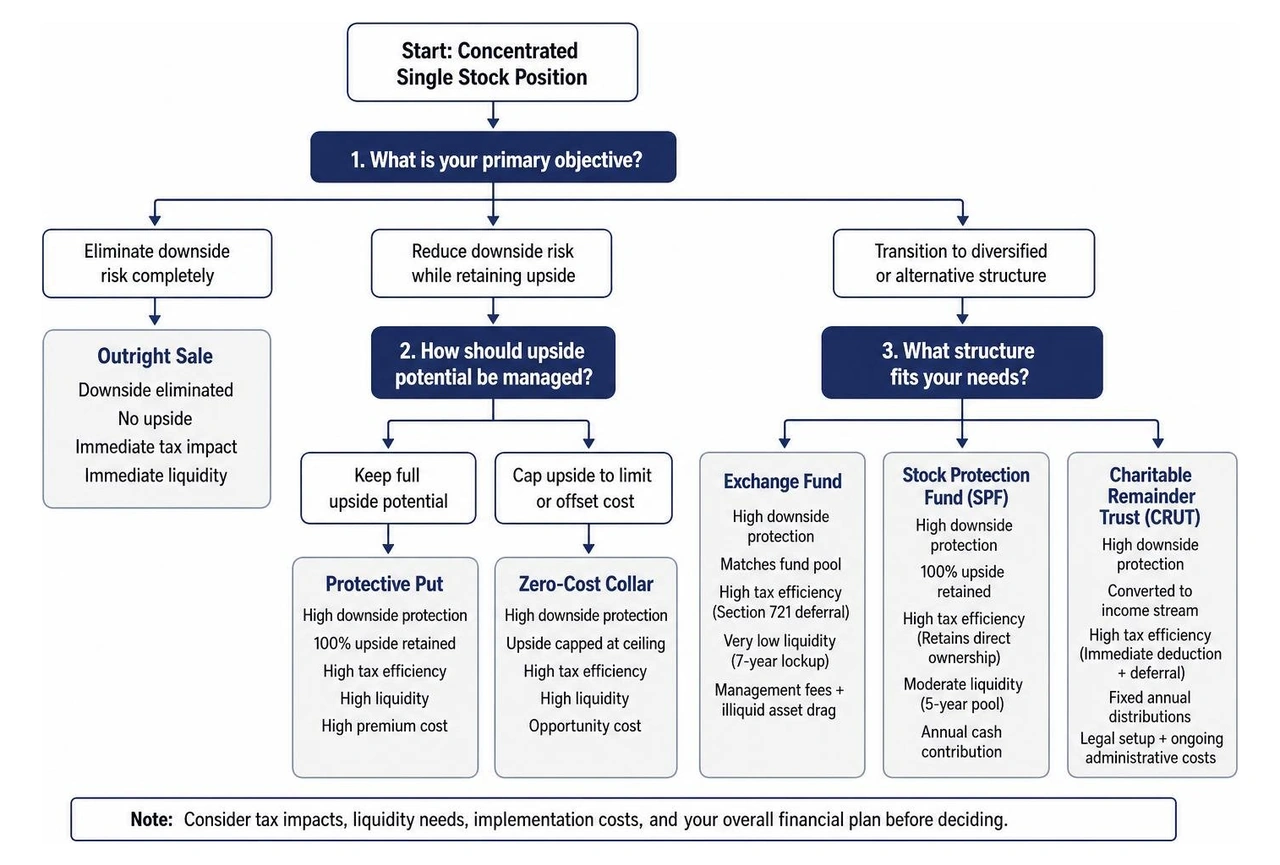
Effectively managing a concentrated position requires balancing tax friction, ongoing liquidity needs, implementation costs, and desired downside protection.
| Strategy | Downside Protection | Upside Potential | Tax Efficiency | Liquidity | Typical Cost / Drag |
|---|---|---|---|---|---|
| Outright Sale | 100% eliminated | None | Low (Immediate capital gains) | Immediate (T+1 cash) | Tax friction |
| Protective Put | High (Defined floor) | 100% retained | High (No immediate sale) | High (Standard options) | High annual premium drag |
| Zero-Cost Collar | High (Defined floor) | Capped at ceiling strike | High (Defers realization) | High (Standard options) | Opportunity cost of capped gains |
| Exchange Fund | High (Diversified pool) | Matches fund pool | High (Section 721 deferral) | Very Low (7-year lockup) | Management fees + illiquid asset drag |
| Stock Protection Fund (SPF) | High (Mutual cash pool) | 100% retained | High (Retains direct ownership) | Moderate (5-year pool) | Annual cash contribution |
| Charitable Remainder Trust (CRUT) | High (Sold inside trust) | Converted to income stream | High (Immediate deduction + deferral) | Fixed annual distributions | Legal setup + ongoing administrative costs |
Choosing among these strategies is rarely an all-or-nothing decision. For corporate executives and business owners, balancing these solutions alongside your broader financial life is critical. We walk through these real-world integration steps in our guide on planning around equity compensation.
Options overlays allow you to shape your return profile without triggering an immediate realization of capital gains.
Purchasing an out-of-the-money (OTM) put option establishes a strict floor below which your position cannot fall, while preserving 100% of the upside. The trade-off is cash drag: buying continuous put protection can cost 4% to 10%+ per year depending on the stock's implied volatility, which can quickly erode compounding wealth.
Selling call options against your shares generates immediate income (the option premium). This provides a minor buffer against small price drops equal to the premium received. However, covered calls provide no protection against catastrophic price drops and obligate you to sell your shares if the stock rises above the strike price.
A collar combines purchasing an OTM protective put with selling an OTM covered call. By sizing the strike prices so the premium collected from the call fully finances the put purchase, you create a zero-cost collar.
When options overlays do not fit, specialized private structures allow investors to mitigate risk through pooled structures.
An exchange fund is a private partnership where multiple investors contribute their low-basis, concentrated stocks into a single fund. Under Internal Revenue Code Section 721, contributing appreciated securities to a partnership in exchange for partnership units is generally not a taxable event.
A Stock Protection Fund operates on a risk-pooling model rather than an asset-swapping model:
Historical SPF implementations during major market stress periods—such as the 2006–2011 global financial crisis—demonstrated that 8 out of 20 fund members with negative returns received full 100% loss reimbursements, while the net annualized cost of protection for positive-return members was approximately 1.38% per annum.
If you possess charitably minded goals, a Charitable Remainder Unitrust (CRUT) offers a highly tax-advantaged path to exit an appreciated equity position:
When holding a low-basis stock, selling everything at once can trigger significant federal and state tax liabilities. For high earners, capital gains can face a 20% federal rate, a 3.8% Net Investment Income Tax (NIIT), and state income taxes. A disciplined, systematic liquidation process manages this tax friction while reducing risk.

A tax-aware transition framework pairs gradual, programmatic selling with strategic tax-loss harvesting:
If you are an executive receiving regular corporate grants, you can review our playbook on maximizing executive stock options to integrate your vesting schedules with your annual tax budget.
A common strategy proposed by wealth managers is building a "completion portfolio" through direct indexing. The concept is straightforward: you hold your concentrated position (e.g., Technology Stock A) and invest the remainder of your liquid cash into a custom index that deliberately excludes Technology Stock A and its immediate industry peers.
While completion portfolios sound appealing in theory, empirical data shows they have limited real-world effectiveness in hedging single-stock risk:
The Bottom Line: A completion portfolio cannot fix a heavy concentration problem. Real risk reduction requires lowering the actual percentage weight of the concentrated position.
Implementing single-stock hedging strategies requires careful adherence to IRS regulations and corporate governance policies. Missteps can lead to unexpected tax liabilities or compliance issues.
The IRS closely monitors options and derivative strategies used to hedge appreciated equities.
Under Section 1259, if an investor eliminates substantially all risk of loss and opportunity for gain on an appreciated financial position, the IRS deems the position "constructively sold." This triggers an immediate taxable capital gain as if the underlying shares were sold outright.
A straddle occurs when an investor holds offsetting positions that substantially diminish the risk of loss on an asset. Under Section 1092:
To receive preferential long-term capital gains tax rates on corporate dividends (rather than ordinary income rates), you must hold the underlying stock unhedged for at least 61 days within a 121-day window surrounding the ex-dividend date. Entering into a deep put option or a tight collar can diminish risk sufficiently to suspend this holding period clock, converting your dividend income into higher-taxed ordinary income.
For corporate officers, directors, and named insiders, trading company equity requires following strict corporate governance guidelines:
To protect a large position without triggering an immediate tax liability, you can implement an equity collar (buying an out-of-the-money put while selling an out-of-the-money call to finance the cost), contribute the shares to an exchange fund for diversified partnership units, or join a Stock Protection Fund (SPF). Each vehicle preserves capital gains tax deferral while establishing a defined floor under your equity.
In an exchange fund, you surrender your specific company shares to a private partnership pool, permanently exchanging them for a diversified portfolio basket that you can redeem after a mandatory 7-year holding period.
In a Stock Protection Fund (SPF), you retain direct ownership, voting rights, and qualified dividends of your stock. Instead of pooling shares, members pool cash contributions into an escrow fund that reimburses participants who experience stock drawdowns over a defined term (typically 5 years).
Internal Revenue Code Section 1259 dictates that if you enter into a transaction that eliminates virtually all downside risk and upside potential (such as a collar where the put and call strikes are set at virtually the same price), the IRS treats the position as constructively sold. This triggers an immediate capital gains tax event. To avoid this, option collars must be structured with adequate width between strike prices to ensure the investor retains meaningful market exposure.
Managing a concentrated single-stock position is not about being bearish on your company. It is about acknowledging the empirical reality of single-stock risk: over 40% of public equities experience permanent, unrecoverable drawdowns over time, and relying on long-only completion portfolios or analyst ratings provides little real protection.

At NoDa Wealth, we help busy professionals, corporate executives, and business owners in Charlotte, NC, and beyond protect what they have worked so hard to build. As fee-only fiduciary financial advisors, we provide transparent, data-driven, no-commission advice. We do not sell insurance products or proprietary funds; we create tailored, conflict-free plans designed around your family's financial security.
Our simple 3-step process helps you de-risk with confidence:
If you are ready to protect your wealth and replace concentration stress with clarity, take the first step today. Visit our personalized wealth assessment to review your single-stock position and build a plan tailored to your long-term goals.
Educational Purposes Only. Content on this blog is for general educational and informational purposes only. It is not investment, tax, accounting, or legal advice, and it is not a recommendation or solicitation to buy or sell any security or to adopt any investment strategy. Past performance does not guarantee future results. Investing involves risk, including the possible loss of principal.
NoDa Wealth Management, LLC ("NoDa Wealth") is an investment adviser registered with the State of North Carolina. Advisory services are offered only where NoDa Wealth and its representatives are properly registered or exempt from registration. Readers should consult their own financial, tax, and legal advisors regarding their specific situation before making any decisions. For important disclosures, see the site footer and Form ADV.
Feeling overwhelmed? Let’s simplify things! Schedule your Free Assessment for an easy, 20-minute chat to help you tackle life’s transitions.
Enjoy a hassle-free conversation that puts your needs front and center!
)%20(3).avif)
