Building Generational Prosperity One Milestone at a Time
Master 200k family wealth planning to build generational prosperity with actionable strategies for cash flow, investing, and risk management.



Master 200k family wealth planning to build generational prosperity with actionable strategies for cash flow, investing, and risk management.
Successful 200k family wealth planning requires automating a 15% to 25% savings rate, executing a tax-advantaged investment waterfall, and keeping fixed structural costs below 60% of net take-home pay. While a gross salary of $200,000 puts an earner in roughly the top 7% of individual wage earners nationwide, according to U.S. Census Bureau income tables, federal marginal tax brackets (24% for married couples filing jointly or 32% for single filers) and FICA payroll taxes significantly reduce monthly cash flow. Converting this income into enduring wealth demands managing real take-home pay and preventing lifestyle creep.
For most dual-income and single-earner households, a $200k gross annual income translates to a net take-home pay of between $10,000 and $11,667 per month. From this baseline, structural non-negotiables immediately claim their share:
When structural fixed costs cross 60% of take-home pay, even high-earning households find themselves trapped in "HENRY" territory (High Earner, Not Rich Yet). Wealth creation requires widening the gap between your real net income and your lifestyle overhead.
Where you live heavily shapes how far a six-figure salary stretches. State income tax structures, municipal levies, and local property assessment rates cause major discrepancies in real purchasing power across the country.
According to financial breakdowns of state-by-state take-home pay variance, an individual or family earning $200,000 experiences thousands of dollars in annual disposable income variation based solely on their state borders:
That $1,500 monthly spread between high-tax and zero-tax states equals $18,000 per year—capital that could otherwise fully fund two backdoor Roth IRAs and a family Health Savings Account (HSA). Factoring in local housing valuations, local sales taxes, and regional childcare rates ensures your wealth accumulation strategy is grounded in your local reality rather than theoretical national averages.
Lifestyle inflation is the silent destroyer of high-income wealth potential. As household earnings rise from $100,000 to $200,000, expenses tend to scale up symmetrically: trading reliable sedans for luxury SUVs, upgrading neighborhood zip codes, dining out at upscale restaurants, and enrolling children in expensive travel leagues. Because these upgrades feel earned, they rarely register as risks until cash flow tightens.
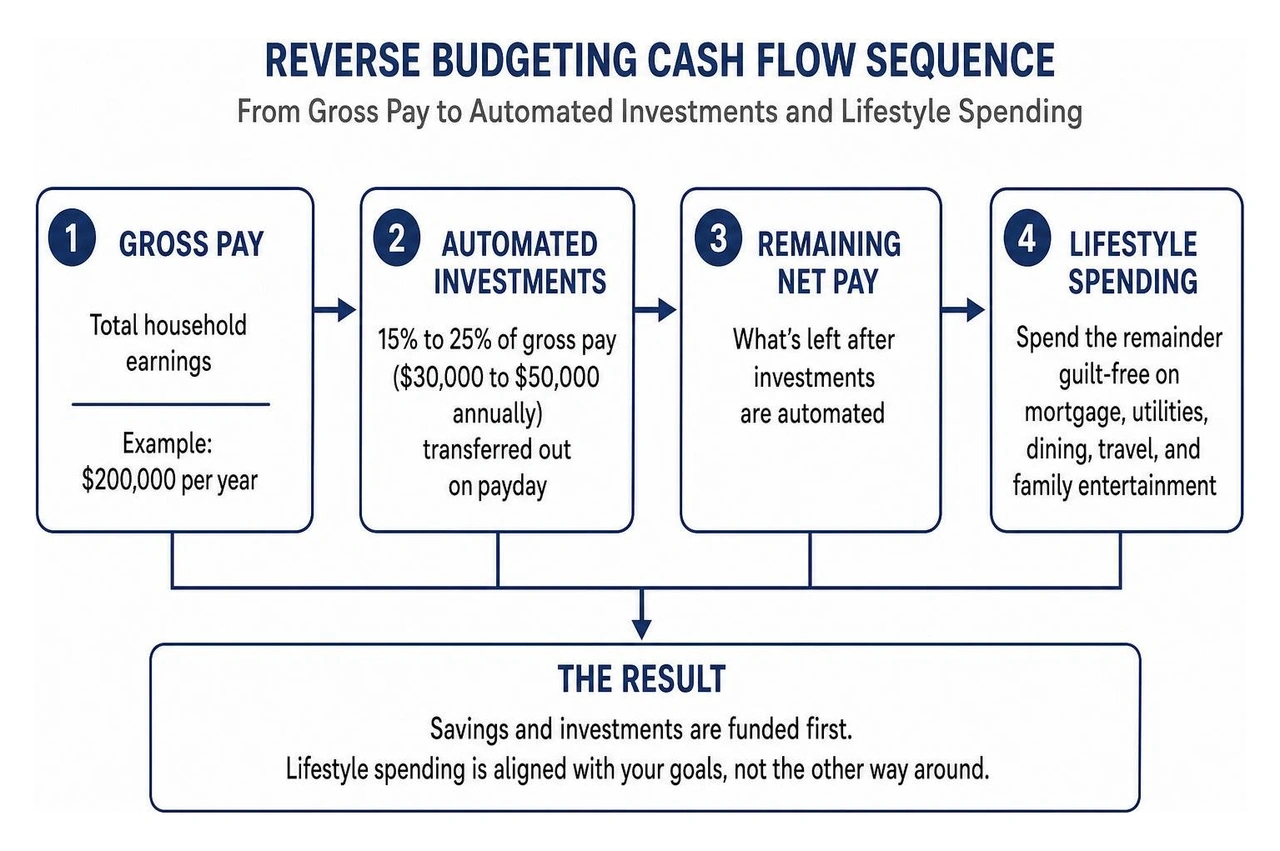
The antidote to lifestyle creep is not rigid austerity; it is structural design. We recommend implementing reverse budgeting:
By building a flexible household budget, you eliminate the reliance on willpower. When your long-term goals are automatically funded upfront, day-to-day spending decisions no longer threaten your family's financial independence.
Without a clear sequence, high earners often scatter extra cash across random assets—leaving cash idling in low-yield savings accounts or buying individual stocks without an underlying strategy. Maximizing wealth accumulation requires a disciplined investment waterfall that maximizes tax advantages before routing dollars into taxable accounts.
Taxes represent the single largest ongoing expense for a $200k family. Using statutory deductions strategically can yield more than $10,000 in annual tax savings while accelerating compound growth.
Follow this sequential priority order for tax-advantaged vehicles:
Once you fully fund your tax-advantaged accounts, direct any remaining monthly surplus into a non-retirement taxable brokerage account. A taxable brokerage account provides flexibility: funds are accessible prior to age 59½ without early withdrawal penalties, making it an ideal engine for mid-career goals, bridge funding for early retirement, or funding major real estate investments.
To optimize taxable wealth generation:
For households with surplus liquidity, investing six-figure compensation systematically creates an compounding balance that eventually out-earns ordinary labor income.
Evaluating financial progress requires comparing your balance sheet against objective milestones rather than neighborly impressions. Net worth—calculated as total assets minus total liabilities—serves as the ultimate scorecard for converting income into equity.
Data from the Federal Reserve's Survey of Consumer Finances highlights the wide divide between broad national medians and the targets needed for high earners aiming for sustained lifestyle preservation.
| Age Bracket | National Median Net Worth | National Average Net Worth | High-Earner Target ($200k Income) |
|---|---|---|---|
| Under 35 | $39,000 | $183,500 | $200,000 – $400,000 |
| 35 – 44 | $135,600 | $549,600 | $500,000 – $900,000 |
| 45 – 54 | $247,200 | $975,800 | $1,000,000 – $2,000,000 |
| 55 – 64 | $364,500 | $1,570,000 | $2,500,000 – $4,000,000 |
| 65+ | $409,900 | $1,790,000 | $4,000,000+ |
Consistently investing $52,000 annually at an assumed 8% compound annual return allows a family to accumulate $1 million in roughly 13 years, crossing $3 million inside 24 years. If you are tracking toward long-term independence, assessing early retirement readiness involves matching your target portfolio size against future spending needs rather than focusing solely on an arbitrary age threshold.
Accumulating assets without setting up defensive risk buffers leaves your family exposed to unexpected legal, medical, or occupational setbacks. Comprehensive wealth planning balances offensive asset growth with intentional defensive protection.

High earners require custom liquidity strategies. Because executive and specialized professional positions often take longer to replace during economic contractions, a standard three-month reserve may prove inadequate.
True generational planning ensures your assets transfer smoothly to heirs rather than being tied up in public probate court or diminished by estate administrative costs:
Using the conservative 28% front-end debt-to-income guideline, your total monthly housing obligation (principal, interest, property taxes, and homeowners insurance) should not exceed $4,667 per month (28% of a $16,667 monthly gross income).
Assuming prevailing mortgage interest rates around 6.5%, a 20% down payment, and average property tax rates, a household earning $200,000 can comfortably afford a home valued between $650,000 and $735,000 without overextending discretionary cash flow or sacrificing annual retirement contributions.
The most resilient family budgets are built entirely around fixed baseline salaries. Treat fluctuating corporate incentives, annual bonuses, Restricted Stock Units (RSUs), and profit-sharing distributions as secondary accelerators rather than dependable living capital.
When establishing your baseline standard of living, managing variable bonuses and equity compensation involves routing windfalls through a pre-planned allocation framework: allocating a portion to clear tax burdens, a portion to long-term investment priorities, a portion to targeted family goals (such as home renovations or 529 plans), and a fixed percentage to discretionary family travel.
This decision comes down to comparing your net after-tax borrowing costs against your expected long-term portfolio returns. If your existing mortgage carries a fixed rate locked below 4%, mathematically you gain higher expected returns by maintaining the debt and directing excess liquidity into diversified index funds or tax-advantaged accounts.
However, when dealing with modern mortgage rates at 6% or higher, risk-free interest savings compete closely with projected market yields. In our analysis evaluating mortgage prepayment versus market investing, blending strategies—such as making moderate principal prepayments alongside consistent monthly brokerage contributions—delivers both psychological peace of mind and compound equity growth.
Earning a six-figure income provides the raw fuel for financial independence, but long-term family wealth is ultimately determined by your savings systems, asset placement, tax optimization, and asset protection. By automating your investment waterfall, mitigating lifestyle creep, maintaining appropriate liability coverage, and establishing clear estate directives, you transform an attractive top-line salary into enduring generational prosperity.
At NoDa Wealth, our fee-only, fiduciary financial planners guide busy professionals through transparent, data-driven wealth management. We help high earners eliminate guesswork with our streamlined 3-step planning process, custom-tailored to your unique family milestones.
Take the first step in optimizing your household wealth roadmap by scheduling your complimentary fiduciary financial assessment with our team today.
The information provided in this article is intended for educational purposes only and should not be construed as personalized financial advice. Please consult with a qualified financial advisor or tax professional regarding your unique situation before taking any action.
Feeling overwhelmed? Let’s simplify things! Schedule your Free Assessment for an easy, 20-minute chat to help you tackle life’s transitions.
Enjoy a hassle-free conversation that puts your needs front and center!
)%20(3).avif)
