Exercising NSO Stock Options Explained Clearly
Learn how to exercise NSO stock options tax-efficiently, including bargain element rules, withholding gaps, and post-termination strategies.



Learn how to exercise NSO stock options tax-efficiently, including bargain element rules, withholding gaps, and post-termination strategies.
To exercise NSO stock options, first confirm how many options have vested and check the current fair market value, your company's stock price for public companies or the latest Section 409A valuation for private companies. Then choose an exercise method: a cashless exercise sells shares immediately to cover costs, while a cash exercise requires paying the strike price out of pocket. Either way, the spread between fair market value and your strike price is taxed as ordinary income in the year of exercise, so plan for withholding before you proceed.
Equity compensation comes in multiple flavors, but Non-Qualified Stock Options (NSOs), also known as non-statutory stock options, are by far the most common option grant found at public corporations, late-stage private companies, and private-equity-backed firms.
Unlike Incentive Stock Options (ISOs), which are strictly governed by IRC Section 422 and reserved exclusively for common-law employees, NSOs offer companies immense design flexibility. They can be granted to employees, independent contractors, advisors, outside board directors, and consultants.
The lack of statutory restrictions means NSOs do not have to comply with the strict rules that limit ISOs:
| Feature | Non-Qualified Stock Options (NSOs) | Incentive Stock Options (ISOs) |
|---|---|---|
| Eligible Recipients | Employees, contractors, directors, advisors | Common-law employees only |
| Tax at Grant | None (if strike price equals FMV) | None |
| Tax at Exercise | Ordinary income + FICA on the spread | No regular income tax; spread triggers AMT preference |
| Tax at Sale | Capital gains (cost basis = FMV at exercise) | Long-term capital gains if holding rules met; ordinary income if disqualifying |
| FICA / Payroll Taxes | Yes (Medicare, Social Security up to cap) | No |
| $100k Annual Vesting Cap | No limit | Yes ($100k grant-value limit per year) |
| Employer Tax Deduction | Yes, equal to the exercise spread | None (unless disqualifying disposition occurs) |
When you decide to exercise your options, the IRS treats the transaction as two distinct economic events:
Navigating this dual structure requires proactive planning. If you are a corporate leader or professional, integrating these mechanics with your broader portfolio is essential. For instance, maximizing your stock options and 401(k) ensures that your compensation events work in harmony with your tax-sheltered savings rather than pushing you blindly into higher tax brackets.
The taxable amount at exercise is known as the bargain element (or spread):
Bargain element = (fair market value at exercise - strike price) x shares exercised
This spread is subject to federal ordinary income taxes, state income taxes, and payroll taxes (FICA). In 2026, the federal tax environment includes:
For high earners already in top brackets, the combined federal liability on an NSO exercise spread frequently exceeds 40% before accounting for state income taxes.
Once you exercise, your tax cost basis in the shares becomes the Fair Market Value (FMV) on the date of exercise, not the strike price you paid out of pocket.
The holding period for capital gains starts the day after exercise. If you eventually sell the stock:
Tracking your stepped-up basis is crucial. A common mistake among professionals is reporting the strike price as their cost basis on Form 8949 during a future sale, which results in paying tax on the exercise spread a second time. Taking the right steps for preventing double taxation on equity compensation protects your hard-earned gains.
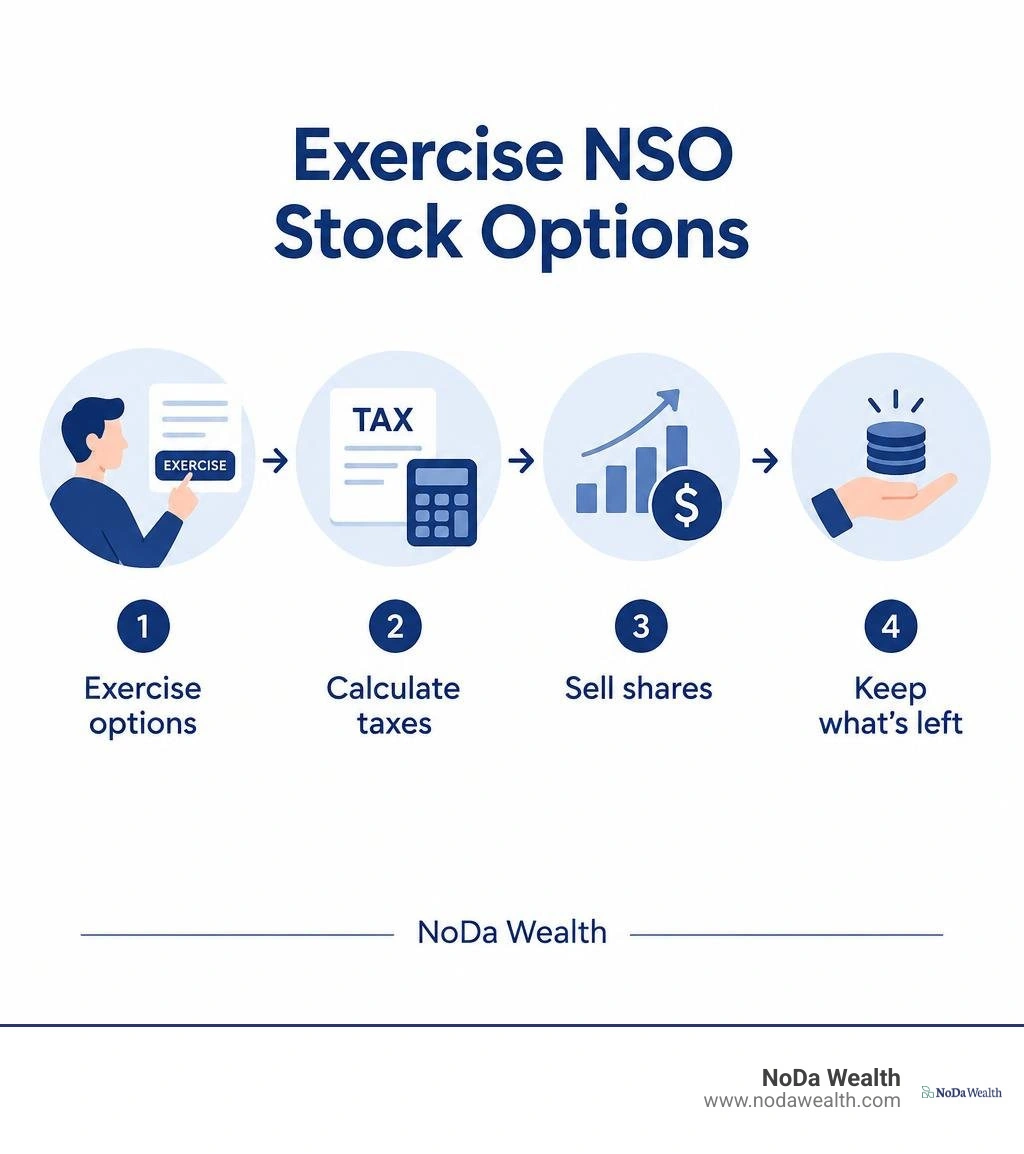
Deciding to exercise non-qualified stock options involves evaluating both legal parameters and personal cash flow. Before initiating an exercise through your company's equity portal (such as Carta, Shareworks, or E*TRADE), verify the following items:
Strategically timing your exercise allows you to optimize tax brackets and manage your liquidity. Coordinating these exercises with a broader blueprint for investing a high-income paycheck helps prevent surplus equity gains from sitting unallocated in low-yield cash accounts.
When executing an option exercise, you generally have two main paths:
Multi-Year Tranching: If you hold a large block of vested, in-the-money NSOs, exercising all of them in one calendar year can push more income into the 37% federal bracket. Spreading exercises across two or three tax years may help keep portions of the taxable spread in lower marginal brackets.
Targeting Low-Income Years: If you expect a sabbatical, career transition, or lower bonus year, exercising NSOs during that window may reduce the tax rate applied to the spread. Remember: the bargain element at exercise is still ordinary income, even if the shares later qualify for capital gains treatment.
Coordination with RSUs and Bonuses: Align option exercises with RSU vesting dates and annual bonus payments. Layering an NSO exercise on top of a large RSU vest in November or December can create tax bracket creep. Implementing rules for managing equity compensation and cash flow provides a disciplined rhythm for balancing variable equity windfalls against everyday spending needs.
Pre-IPO Early Exercise: At early-stage private companies, exercising NSOs when the 409A value is low can reduce the immediate ordinary income spread. If you exercise unvested shares, pay close attention to the 83(b) election deadline. Without a valid 83(b) election, the tax and holding-period treatment may be tied to vesting rather than the exercise date.
Qualified Small Business Stock (QSBS): If your company qualifies under IRC Section 1202, post-exercise gains may be eligible for federal capital gains exclusion. QSBS does not exclude the NSO spread taxed as ordinary income at exercise. For stock acquired on or before July 4, 2025, the old rule generally required a more-than-5-year holding period and capped the exclusion at the greater of $10 million or 10 times basis. For stock acquired after July 4, 2025, the rules are more generous: 50% exclusion after 3 years, 75% after 4 years, and 100% after 5 years, with a higher cap of the greater of $15 million, indexed after 2026, or 10 times basis. Because NSO basis is usually the fair market value at exercise, the 10-times-basis limit can be larger than expected. The company must also be a qualifying C corporation, meet the active business rules, stay under the applicable gross assets limit, and avoid excluded fields such as health, law, consulting, and financial services. State treatment varies, and some states, including California, do not follow the federal QSBS exclusion.
The standard equity incentive plan typically gives departing employees a 90-day post-termination exercise window to exercise vested stock options. If you leave your employer and fail to exercise before this window closes, your vested options are forfeited back to the company.
While ISOs legally lose their tax status after 90 days, companies have the flexibility to grant extended post-termination exercise windows (e.g., 1 to 7 years) for NSOs. Always review your specific grant agreement before giving notice, and consider negotiating an extended exercise window as part of any departure or severance package.
Stock options are considered compensation earned over the entire vesting period. If you lived or worked in more than one state between the grant date and the vesting date, your NSO income is generally subject to state tax allocation formulas.
States allocate taxable compensation based on the ratio of days worked in that state during the vesting schedule. If you relocated, your former state may still claim tax revenue on a portion of the spread when you exercise. Ensure your payroll department and CPA calculate these multi-state allocations correctly to claim appropriate resident tax credits and avoid double state taxation.
Yes. When you exercise an NSO, the bargain element is treated as earned W-2 income on the exercise date. You owe federal ordinary income tax, state income tax, and FICA payroll taxes in the tax year of exercise, regardless of whether you sell the stock or hold it in your portfolio.
Employers are generally required to withhold federal income taxes on supplemental wages at a statutory flat rate of 22% (or 37% on supplemental wages exceeding $1 million in a calendar year). If your total taxable income places you in the 32%, 35%, or 37% marginal brackets, the 22% statutory withholding will fall short, creating an unexpected tax bill. You may need to make estimated quarterly tax payments to avoid IRS underpayment penalties.
When you leave an employer, your post-termination exercise window dictates how long you have to buy your vested shares—typically 90 days, though some company plans offer longer periods. Any unvested options are immediately cancelled on your last day of employment, and vested options that remain unexercised when the window expires are permanently forfeited.
Navigating non-qualified stock options requires balancing tax bracket timing, cash flow requirements, and portfolio concentration risk. At NoDa Wealth, we provide fee-only, fiduciary financial planning and wealth management for busy professionals. We operate with transparent, no-commission advice and utilize a simple 3-step process to help you optimize equity compensation alongside your broader tax, investment, and estate goals.
If you are preparing to exercise company options or want to minimize your upcoming tax exposure, request our free equity compensation assessment to evaluate your grants and build a clear financial roadmap.
Educational Purposes Only. Content on this blog is for general educational and informational purposes only. It is not investment, tax, accounting, or legal advice, and it is not a recommendation or solicitation to buy or sell any security or to adopt any investment strategy. Past performance does not guarantee future results. Investing involves risk, including the possible loss of principal.
NoDa Wealth Management, LLC ("NoDa Wealth") is an investment adviser registered with the State of North Carolina. Advisory services are offered only where NoDa Wealth and its representatives are properly registered or exempt from registration. Readers should consult their own financial, tax, and legal advisors regarding their specific situation before making any decisions. For important disclosures, see the site footer and Form ADV.
Feeling overwhelmed? Let’s simplify things! Schedule your Free Assessment for an easy, 30-minute chat to help you tackle life’s transitions.
Enjoy a hassle-free conversation that puts your needs front and center!
)%20(3).avif)
