How Should You Build a $200k Income Fund Allocation Today?

Investing
September 12, 2026

Turn $200k into steady monthly income with a strategic 200k income fund allocation across dividend stocks, bonds, and REITs for reliable cash flow.


Build a 200k Allocation That Balances Cash Flow and Growth

A practical 200k allocation starts by separating money you need soon from money that can stay invested. Keep short-term spending and emergency reserves in cash-like accounts, use high-quality bonds or Treasuries for steadier income, and use diversified stock and real estate funds for long-term growth.

I’m Evan Luongo, and this guide will show how to tailor that balance to your timeline, tax situation, and need for monthly cash flow.

Infographic showing cash, bonds, stocks, and REITs in a 200k income allocation infographic

Core Frameworks for a 200k Income Fund Allocation

Allocating capital is never a one-size-fits-all exercise. When designing a portfolio, we must balance two competing forces: your need for immediate liquidity and your portfolio's ability to outpace inflation. If you tilt entirely toward yield, you risk capital erosion. If you tilt entirely toward capital growth, you may face cash shortfalls during market downturns.

To determine the right baseline structure, investors often reference resources like SmartAsset's guide on generating monthly income from $200k. At NoDa Wealth, our fiduciary approach focuses on structuring your portfolio around explicit timelines and liability matching rather than chasing arbitrary returns.

Portfolio asset allocation models by risk tolerance

Designing a Conservative $200k Total-Return Allocation for Portfolio Income

If your primary objective is dependable income and capital preservation—perhaps supplementing semi-retirement cash flow or funding a sabbatical—your allocation should emphasize total return, using lower-volatility assets and planned withdrawals instead of chasing yield.

A conservative total-return framework might look like this:

  • 15% Cash & Equivalents ($30,000): Liquid reserves for near-term spending needs and portfolio stability. Understanding high yield savings vs money market funds can help you keep cash accessible without ignoring interest and safety trade-offs.
  • 30% Short-Duration Bonds ($60,000): High-quality, short-duration bond exposure designed to reduce interest-rate sensitivity while supporting liquidity and stability.
  • 15% Inflation-Protected Bonds ($30,000): Treasury Inflation-Protected Securities or similar inflation-aware bond exposure to help preserve purchasing power over time.
  • 40% Marketwide Equities ($80,000): Low-cost, tax-efficient, broadly diversified stock funds used for long-term total return. Instead of buying stocks for dividend yield, this approach treats the portfolio as one engine and “slices off” return for income as needed.

This structure prioritizes total return first, then creates income by systematically drawing from a diversified mix of short-duration, inflation-aware bonds and low-cost, tax-efficient marketwide equities, with REIT exposure kept modest.

Structuring a Growth-Focused 200k Allocation for High Earners

If you’re a high-earning professional who doesn’t need portfolio distributions for living expenses today, the allocation can prioritize total return, tax efficiency, and compounding. Income can come later by systematically selling from a diversified portfolio instead of chasing dividends or headline yield.

A growth-focused total-return income model may start with an 80/20 portfolio:

  • Cash Reserve (Outside the 80/20): Held separately for near-term expenses, not as a tactical investment sleeve.
  • 20% Core Fixed Income ($40,000): Core bond funds with moderate duration, plus inflation-aware exposure for stability.
  • 78% Marketwide Equities ($156,800): Low-cost, tax-efficient U.S. and international equity funds focused on total return.
  • 2% REIT Exposure ($3,200): Limited to 2% of the equity allocation, used only as a small diversifier.

For high earners, long-term wealth building starts with opportunity cost. For example, balancing debt payoff against market investing can clarify whether surplus cash should reduce liabilities or stay invested. Rather than chasing yield, consider an evidence-based total-return approach: low-cost, tax-efficient marketwide equities, short-duration bonds, inflation protection, and disciplined withdrawals for income.

Portfolio Deployment: Lump Sum Allocation vs. Salary Cash Flow Management

How you deploy capital matters just as much as what you buy. When deploying a $200,000 lump sum (such as from a business sale, inheritance, or equity liquidation), investors face a choice: Lump-Sum (LS) or Dollar-Cost Averaging (DCA).
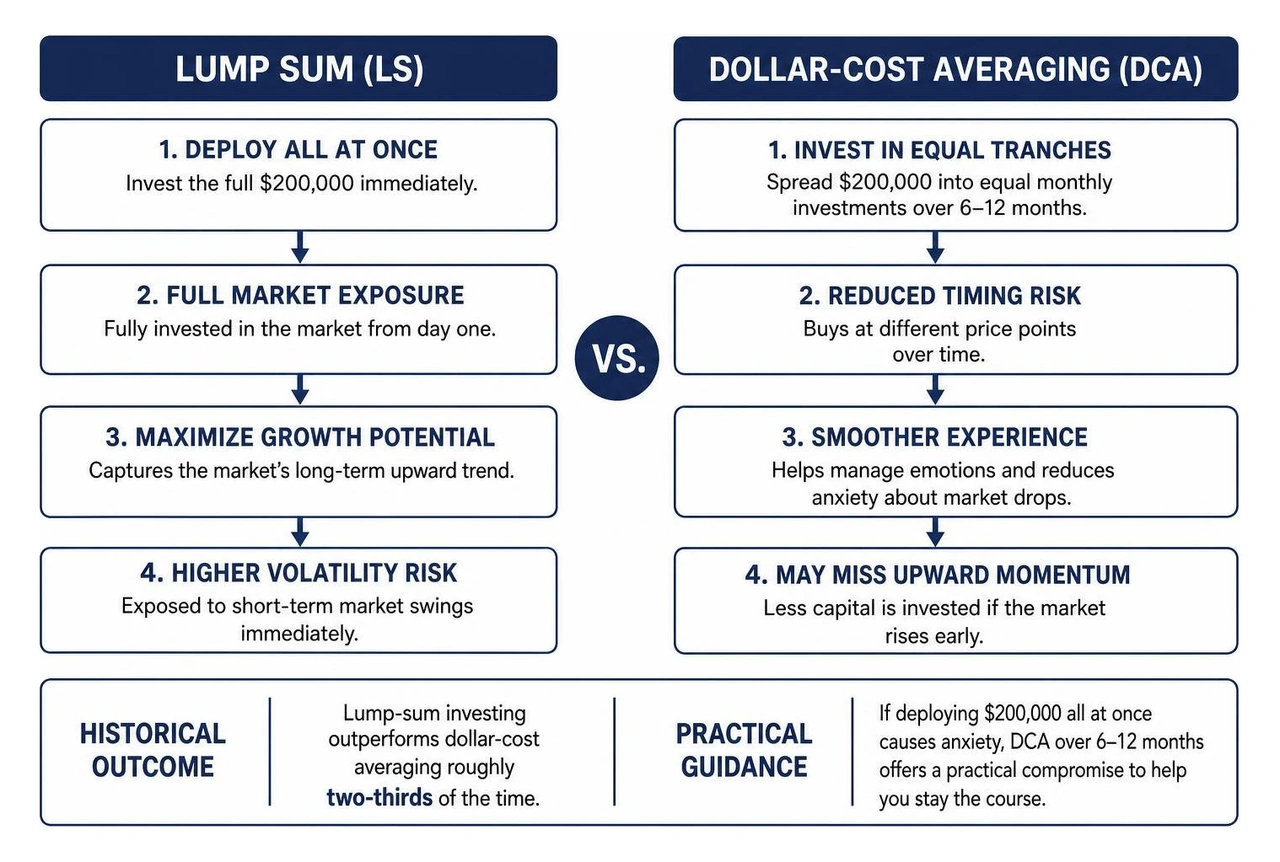
Lump sum versus dollar cost averaging comparison

Decades of market data demonstrate that lump-sum investing outperforms dollar-cost averaging roughly two-thirds of the time because markets have historically trended upward over long horizons. However, human psychology does not operate in a vacuum. If deploying $200,000 all at once causes anxiety about a market drop, deploying the capital in equal monthly tranches over 6 to 12 months provides a practical compromise that helps you stay the course.

Managing Ongoing High Cash Flow from a $200k Salary

A $200,000 annual income places a single earner in roughly the 93rd percentile nationally. In Charlotte, NC, where North Carolina levies a flat state income tax rate alongside federal income and FICA taxes, a $200,000 gross salary translates to roughly $11,500 to $12,200 in monthly take-home pay depending on pre-tax deductions.

A disciplined approach to cash flow prevents lifestyle creep from eating away at high earnings:

  • The Adjusted 50/30/20 Rule: Standard budgeting frameworks recommend 50% for Needs, 30% for Wants, and 20% for Savings. For high earners, keeping baseline needs below 40% allows savings rates to expand to 30%–40% ($4,000 to $5,000+ monthly).
  • Systematic Cash-Flow Management: Learning how to build a flex budget allows high earners to maintain lifestyle comfort without losing tracking discipline.
  • Bonus and Equity Smoothing: Professionals receiving performance compensation should review our guide on how to live off equity compensation or bonuses without losing your sanity to avoid inflating fixed baseline expenses on variable income streams.

Milestone Projections Toward Financial Independence

When a $200,000 salary earner systematically saves and invests, compound interest delivers remarkable results over time.

For illustration only, investing $52,000 per year and earning an average 8% annual return could reach the $1,000,000 milestone in roughly 13 years and exceed $3,000,000 in about 24 years, before taxes, fees, inflation, and market volatility. A 4% withdrawal guideline on that balance would equal about $120,000 per year, but it is not guaranteed income. When mapping out this timeline, it is equally important to start evaluating financial readiness for early retirement across both financial and personal dimensions.

Tax-Efficient Account Placement and Asset Location

Asset allocation determines what you own, but asset location determines what you get to keep after taxes. Placing tax-inefficient assets in the wrong accounts can cost tens of thousands of dollars in unnecessary tax drag over your investing career.
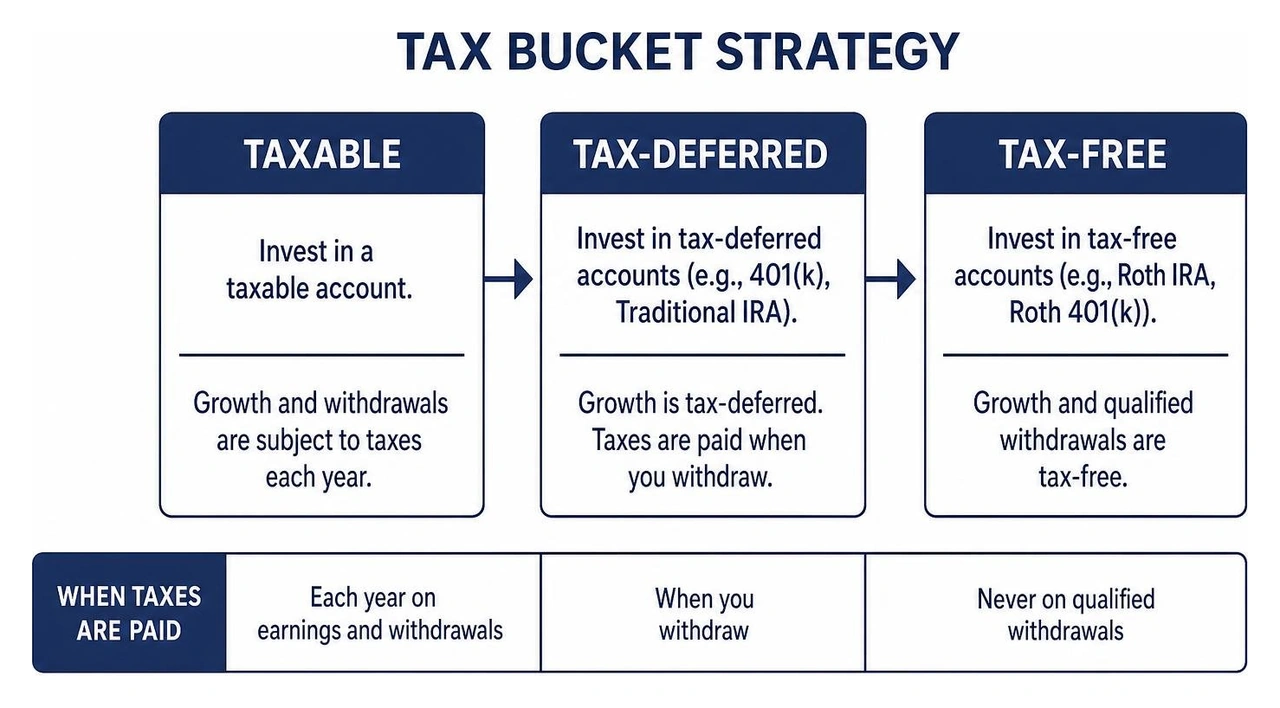
Tax bucket strategy: Taxable, Tax-Deferred, and Tax-Free

Maximizing Tax-Advantaged Buckets

To maximize the efficiency of your savings, channel money through tax-advantaged accounts in a deliberate order:

  1. Employer 401(k) Match: Capture 100% of any employer matching funds first.
  2. Health Savings Account (HSA): If enrolled in a high-deductible health plan, max out your HSA. It offers a triple-tax advantage: contributions are tax-deductible, growth is tax-free, and withdrawals for qualified medical expenses are tax-free.
  3. 401(k) / Retirement Plans: Maximize annual elective deferrals. Determining whether to choose traditional pre-tax or post-tax contributions requires evaluating Roth vs Traditional 401(k) tax trade-offs based on your current tax bracket versus your expected retirement bracket.
  4. Backdoor Roth IRA: High earners exceeding direct Roth IRA income phaseouts can make non-deductible traditional IRA contributions and promptly convert them into a Roth IRA.
  5. Equity Compensation Strategies: Professionals in corporate roles benefit from navigating 401(k) and equity compensation strategies to manage company concentration risk while funding diversified accounts.

Taxable Brokerage Strategies and Rebalancing

Once your tax-advantaged buckets are fully funded, excess cash flow should flow into a taxable brokerage account:

  • Asset Placement Rules: Hold broad equity index funds (which generate more qualified dividends and low turnover) in taxable accounts. Place ordinary-income assets (like corporate bonds and REITs) inside tax-deferred accounts such as Traditional IRAs or 401(k)s.
  • Tax-Loss Harvesting: Systematically realize capital losses during market corrections to offset realized capital gains plus up to $3,000 of ordinary income each year.
  • Account Protections: That the Securities Investor Protection Corporation (SIPC) protects brokerage account assets up to $500,000 (including a $250,000 limit for uninvested cash claims) per institution. As your assets grow, monitoring these thresholds ensures peace of mind.

Frequently Asked Questions About $200k Portfolios

Is it better to invest $200k all at once or spread it out over time?

Statistically, lump-sum investing outperforms dollar-cost averaging around 66% of the time because markets rise more often than they fall. However, if committing the full $200,000 immediately causes emotional hesitation, deploying the capital over a defined 6- to 12-month schedule helps reduce the risk of buyer's remorse during short-term volatility.

What are the biggest mistakes to avoid with a $200k portfolio?

  • Mistaking Payouts for Income: Buying investments for high distributions instead of building a total-return portfolio and taking income thoughtfully.
  • Ignoring Bond Risk: Reaching for long-duration or low-quality bonds rather than using short-duration and inflation-protected fixed income where appropriate.
  • Overcomplicating Stocks: Picking dividend stocks, sectors, or themes instead of low-cost, tax-efficient, marketwide equity funds.
  • Letting Lifestyle Creep Win: Spending every raise instead of automating disciplined contributions and planned portfolio withdrawals.

Conclusion

Building income from a $200,000 portfolio or a $200,000 salary is not about chasing yield. It starts with a total-return plan, low-cost diversification, smart tax location, and a disciplined process for turning growth into spendable cash flow.

At NoDa Wealth, we provide fee-only, fiduciary wealth management and financial planning for busy professionals in Charlotte, NC, and across the country. We operate on transparent, data-driven advice with no product commissions—helping you optimize your investments, protect your capital, and build sustainable wealth.

Take control of your portfolio today: schedule a free financial assessment to optimize your portfolio allocation with our fiduciary advisory team.

Take the First Step - For Free

Feeling overwhelmed? Let’s simplify things! Schedule your Free Assessment for an easy, 20-minute chat to help you tackle life’s transitions.

Enjoy a hassle-free conversation that puts your needs front and center!

Financial plan example
NoDa Wealth Management is located at 2108 Electric Lane, Charlotte NC, 28205. Phone Number: (980) 206-0953.
‍

Advisory services offered through NoDa Wealth Management, LLC, an investment adviser registered with the state of North Carolina. Advisory services are only offered to clients or prospective clients where NoDa Wealth Management, LLC and its representatives are properly registered or exempt from registration. The information on this site is not intended as tax, accounting or legal advice, nor is it an offer or solicitation to buy or sell, or as an endorsement of any company, security, fund, or other offering. Information provided should not be solely relied upon for decision making. Please consult your legal, tax, or accounting professional regarding your specific situation. Investments involve risk and have the potential for complete loss. It should not be assumed that any recommendations made will necessarily be profitable. The information on this site is provided “AS IS” and without warranties either express or implied and the information may not be free from error. Your use of the information provided is at your sole risk.