Model Your ISO Exercise Cash Flow Before Triggering Alternative Minimum Tax
Model your ISO exercise cash flow before triggering AMT. Learn to calculate strike costs, tax exposure, and avoid penalties.


Model your ISO exercise cash flow before triggering AMT. Learn to calculate strike costs, tax exposure, and avoid penalties.
To model your ISO exercise cash flow, combine three out-of-pocket costs: the strike price purchase, the incremental federal Alternative Minimum Tax (AMT) triggered by the exercise-date spread, and any state tax reserves. Then compare that total against your AMT safe harbor threshold—the bargain element you can absorb before tentative minimum tax exceeds regular tax—to decide how many shares to exercise and hold in a given year. This approach helps you avoid a six-figure tax bill on "phantom wealth" that you cannot pay with company shares.
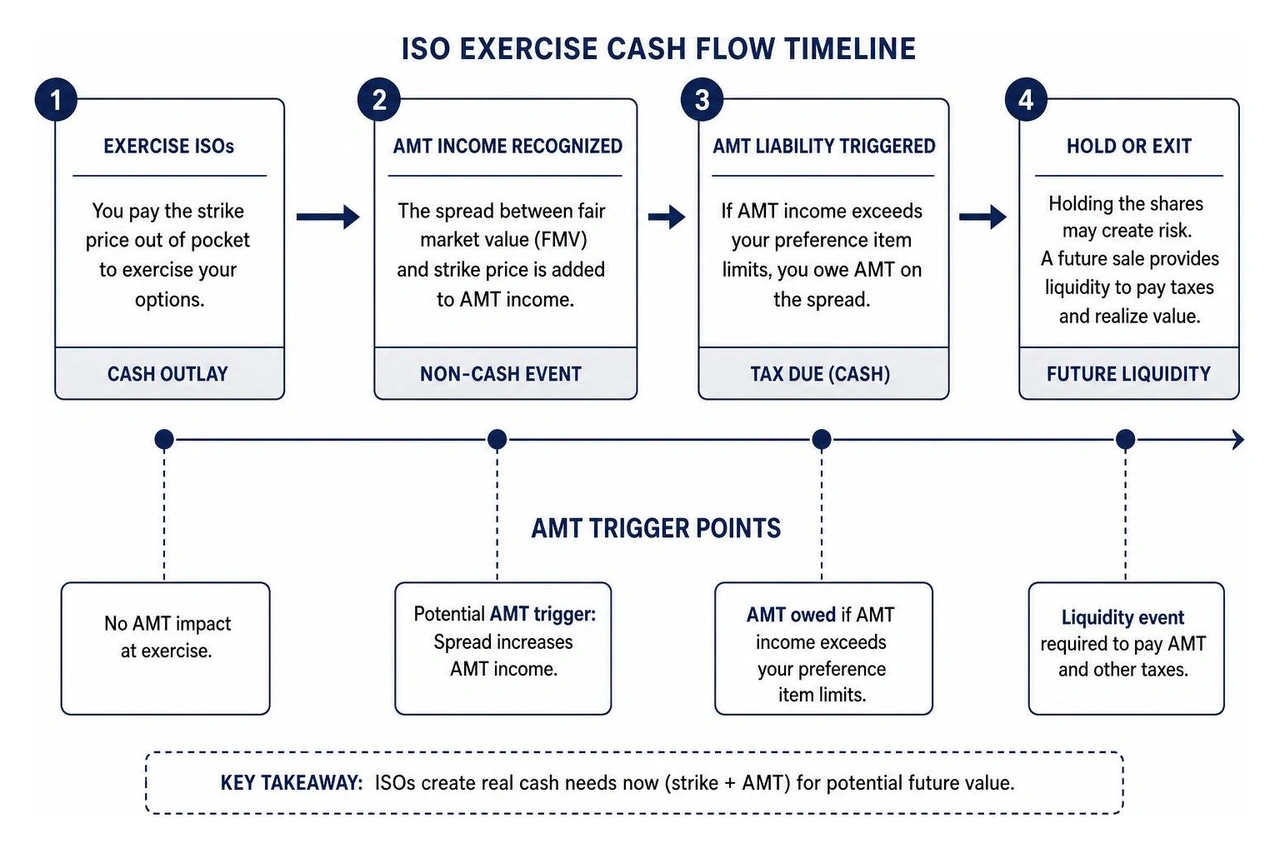
Stock options make up a huge total net worth of the average startup employee. Yet, while equity compensation has created tremendous life-changing wealth, it also creates severe liquidity challenges. If you hold incentive stock options (ISOs), navigating the intersection of strike costs and the Alternative Minimum Tax (AMT) requires precision. I will walk you through how to model your out-of-pocket costs, evaluate holding risks, and craft a multi-year exercise strategy.
To understand how an exercise impacts your bank account, you first need to examine the core statutory mechanics. When evaluating ISO vs NSO options, the main attraction of an ISO is tax deferral: unlike Non-Qualified Stock Options (NSOs), exercising an ISO triggers no regular federal income tax or payroll taxes (FICA or Medicare) at the time of purchase.
However, Congress created a parallel tax system known as the Alternative Minimum Tax to ensure high earners with substantial preferential deductions or exclusions still pay income taxes. Under the tax code, exercising and holding an ISO generates a substantial tax adjustment that flows directly onto IRS Form 6251.
| Exercise Strategy | Upfront Cash Required | AMT Preference Triggered? | Income Tax Classification at Exercise | Subsequent Sale Tax Treatment |
|---|---|---|---|---|
| Cash Exercise & Hold | 100% of strike price | Yes (Full spread on all shares) | No regular tax | Long-Term Capital Gains (if holding rules met) |
| Sell-to-Cover | $0 (Funded via sold shares) | Yes (On retained shares only) | Ordinary income on sold shares; none on retained | Mixed: Ordinary income on sold, LTCG on retained |
| Cashless Same-Day Sale | $0 (Net cash payout) | No (AMT adjustment eliminated) | Ordinary compensation income on entire spread | Short-term capital gain/loss on post-exercise movement |
The statutory trigger for AMT is found in Internal Revenue Code (IRC) §56(b)(3). When you exercise an ISO and hold the underlying stock past the end of the tax year, the "spread", defined as the Fair Market Value (FMV) on the exercise date minus your grant strike price, is treated as an AMT preference item.
AMT preference (bargain element) = (FMV at exercise - strike price) multiplied by shares exercised
For the 2026 tax year, the federal AMT exemption amounts (per IRS Rev. Proc. 2025-32) are:
Under current tax rules, the AMT exemption begins phasing out at a 50% rate once Alternative Minimum Taxable Income (AMTI) exceeds $500,000 for single filers and $1,000,000 for married couples. Once your AMT base is established, the federal AMT tax rate applies at 26% on the first $244,500 of AMT income above the exemption, and 28% on all amounts above $244,500.
When you execute an option exercise, your execution method dictates your immediate cash requirements:
That if you leave your employer, you generally face a strict 90-day post-termination exercise window before vested ISOs expire or convert into NSOs, accelerating the urgency of these cash decisions.
Accurate cash flow forecasting requires looking beyond the basic strike price. When we evaluate an option grant, we stress-test the true all-in cash requirement before pulling the trigger.
Your aggregate exercise cash need consists of three distinct pillars:
Total cash outlay = strike price purchase + incremental federal AMT + state tax reserves
To see the cash need, consider an employee exercising 10,000 ISOs at a $5 strike price when the exercise-date FMV is $40:
When dealing with substantial option pools, learning how to live off equity compensation or bonuses without losing your sanity requires segregating these tax obligations into dedicated high-yield reserves rather than absorbing them into everyday household spending. Tools like the Stock Option Exercise Tax and Cash Calculator 2026 can help run preliminary figures, but an integrated financial plan is essential to prevent liquidity traps.
Exercising options at a private venture-backed startup is vastly different from exercising at a publicly traded company.
At a private startup, shares cannot be freely sold on an exchange to cover taxes. The exercise spread is calculated based on the board-approved 409A valuation. If your company experiences rapid growth, the 409A price may rise steeply while the stock remains illiquid.
Conversely, market conditions can shift quickly; industry data reported by venture capital and equity management platforms shows that 24% of startups reduced their fair market valuations during recent down cycles. If you exercise private ISOs using third-party non-recourse exercise financing or cash savings, you run the risk of locking capital into an asset that may take years to reach an initial public offering (IPO) or acquisition. Public companies, on the other hand, offer immediate liquidity (outside of standard 180-day post-IPO lockup windows), enabling structured sell-to-cover orders. You can test your scenario mechanics using an interactive Stock Option Exercise Calculator before committing capital.
Exercising stock options should rarely be treated as an all-or-nothing event. By spreading exercises across calendar years, you can optimize your tax brackets and systematically recover credits over time.
The Safe Exercise Zone (or "AMT Crossover Point") represents the exact number of ISO shares you can exercise and hold within a calendar tax year without triggering a single dollar of net AMT liability.

This safe harbor exists because you only pay AMT when your Tentative Minimum Tax (TMT) exceeds your Regular Income Tax. If you have a solid W-2 income, your regular tax provides a built-in "cushion."
For a married couple filing jointly with typical dual-income earnings, that cushion often allows between $150,000 and $250,000 of bargain element per year without generating incremental AMT. By adopting a multi-year tranche exercise strategy, you can exercise up to your safe harbor threshold annually, avoiding out-of-pocket tax bills entirely. Additionally, the statutory annual limit for ISO grants becoming exercisable for the first time in any calendar year is capped at $100,000 of grant-date FMV; any excess is automatically reclassified as NSOs.
When you pay AMT on an ISO exercise, that money is not necessarily gone forever. Because an ISO exercise is considered a "timing difference" rather than an absolute exclusion item, the AMT you pay generates a Minimum Tax Credit (MTC) via IRS Form 8801.
In subsequent tax years, whenever your regular income tax exceeds your tentative minimum tax, you can apply your Form 8801 credit to offset regular tax dollar-for-dollar.
While the credit can eventually be recovered, it is rarely quick. Recovering a $500,000+ AMT liability typically takes 5 to 10 years, depending on your forward income trajectory, deductions, and broader equity vesting events.
If your company is an early-stage startup organized as a domestic C-Corporation with gross assets under $50 million, your shares may qualify as Qualified Small Business Stock (QSBS) under IRC Section 1202.
Holding QSBS shares for at least 5 years allows you to exclude up to 100% of the capital gain upon sale (up to a $10 million cap or 10 times your adjusted basis). However, the crucial QSBS holding clock does not start when your options vest; it begins only on the date of legal exercise.
Exercising early, especially when the 409A valuation is low, allows you to start the 5-year QSBS holding clock while keeping the IRC §56(b)(3) bargain element minimal. While an IRC §83(b) election is vital when early-exercising unvested shares, it is not applicable to standard exercises of already-vested options.
The single most dangerous scenario in equity compensation is the "Down Market AMT Trap." This occurs when you exercise and hold shares during a period of high valuation, only to watch the share price plummet before you sell the stock.
Consider this real-world trap:
If you do not plan ahead, you could be forced to liquidate your entire portfolio simply to satisfy the IRS tax liability. This underscores the necessity of disciplined single stock risk management to prevent over-concentration in volatile company shares.
To qualify for long-term capital gains tax treatment on ISOs, you must meet two statutory holding periods:

If you hold through those windows, your gain is taxed at preferential capital gains rates (15% or 20%, plus the 3.8% Net Investment Income Tax for high earners). However, if your stock drops significantly within the same calendar year you exercised, you can execute a strategic disqualifying disposition.
Under IRC §422(c)(2), if you sell your exercised shares on or before December 31 of the exercise year, the ISO status is disqualified. This action completely erases the IRC §56(b)(3) AMT preference item. Instead, the transaction converts to ordinary income capped at your actual realized gain (Sale Price minus Strike Price). If you sell at $10 after exercising at $5, you only pay ordinary income tax on a $5 gain, eliminating the $35-per-share phantom tax liability.
If the stock drops within the same calendar year as your exercise, you can execute a same-year disqualifying disposition by selling the shares prior to December 31. This caps your taxable income at the actual realized profit over the strike price and eliminates the phantom AMT preference adjustment. If the calendar year closes and you still hold the shares, your AMT liability is permanently locked in based on the exercise-date FMV, regardless of where the stock trades the following spring.
The average recovery horizon for substantial ISO AMT credits ranges between 5 to 10 years. The speed of recovery depends entirely on the gap between your regular income tax and tentative minimum tax in future years. High-income years with substantial regular salary or capital gains accelerate credit utilization, while years with heavy deductions or lower earnings slow it down.
No. Employers are not required—and generally not permitted—to withhold federal income tax, AMT, or FICA taxes on pure ISO exercises and holds. Because zero withholding occurs at exercise, you must calculate your projected AMT and make quarterly estimated tax payments via IRS Form 1040-ES to avoid underpayment penalties when filing in April.
Exercising incentive stock options without a clear cash flow plan can turn an exciting financial milestone into an unexpected tax burden. Managing your options requires looking at strike costs, AMT thresholds, state tax liabilities, and credit recovery timelines as an integrated whole.
At NoDa Wealth, we deliver transparent, data-driven, fee-only fiduciary financial planning to help you make informed decisions about your equity compensation. Based in Charlotte, NC, we guide professionals through our simple 3-step process to optimize cash flow, manage concentrated equity risk, and build enduring wealth.
Ready to take control of your stock options? Schedule a free financial assessment with NoDa Wealth today.
Educational Purposes Only. Content on this blog is for general educational and informational purposes only. It is not investment, tax, accounting, or legal advice, and it is not a recommendation or solicitation to buy or sell any security or to adopt any investment strategy. Past performance does not guarantee future results. Investing involves risk, including the possible loss of principal.
NoDa Wealth Management, LLC ("NoDa Wealth") is an investment adviser registered with the State of North Carolina. Advisory services are offered only where NoDa Wealth and its representatives are properly registered or exempt from registration. Readers should consult their own financial, tax, and legal advisors regarding their specific situation before making any decisions. For important disclosures, see the site footer and Form ADV.
Feeling overwhelmed? Let’s simplify things! Schedule your Free Assessment for an easy, 30-minute chat to help you tackle life’s transitions.
Enjoy a hassle-free conversation that puts your needs front and center!
)%20(3).avif)
