Detailed Guide to Stock Options Tax Rules & Implications
Learn stock options tax rules for ISOs and NSOs, including AMT, withholding, and reporting, to plan smarter for 2026.


Learn stock options tax rules for ISOs and NSOs, including AMT, withholding, and reporting, to plan smarter for 2026.
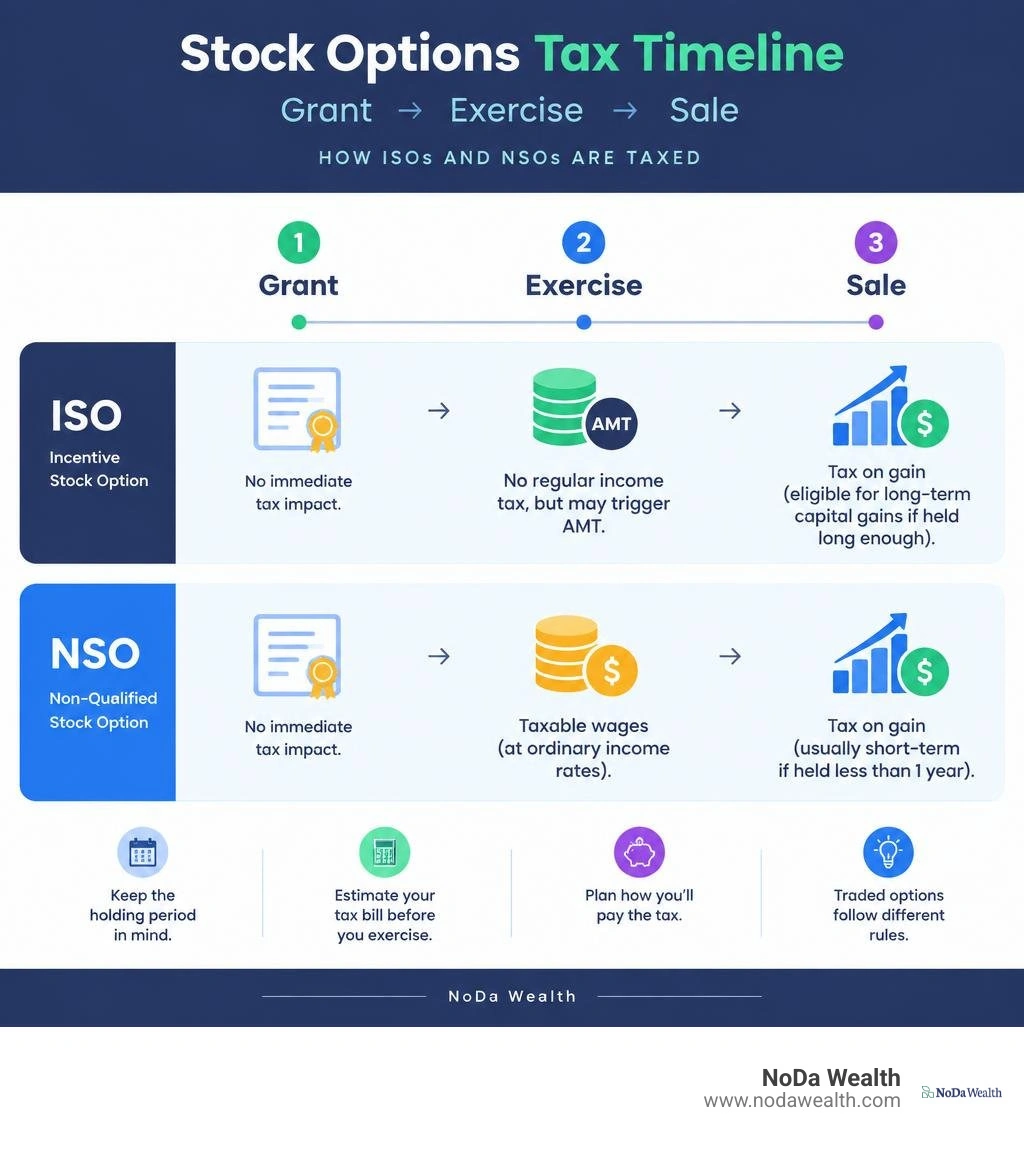
The tax bill depends on the type of option and what you do with it. Employer-granted non-qualified stock options (NSOs) generally create taxable wages when you exercise them. Incentive stock options (ISOs) generally do not create regular income tax at exercise, but the gain at that point may trigger the alternative minimum tax (AMT). When you sell the shares, you may owe tax on the gain. The holding period matters, especially for ISOs. IRS guidance on stock options explains these core rules.
Before you exercise, check whether your grant is an ISO or NSO, estimate the tax, and plan how you will pay it. Traded options follow different rules.
I'm Evan Luongo, and I'll help you make sense of those rules from grant through sale.
Equity compensation has become a cornerstone of modern wealth building, yet navigating a complex stock options tax bill can quickly turn exciting financial milestones into overwhelming stress. Industry surveys consistently show that a meaningful share of plan participants report higher-than-expected tax bills after exercising or selling shares, and some have let past stock option grants expire because they could not afford the associated taxes. Many participants also say they are unsure whom to ask at work about their equity tax liabilities.
As we look at the financial landscape in October 2026, proper equity tax planning is indispensable. Whether you are managing executive grants at a major enterprise or building wealth at a fast-growing venture, understanding the mechanics of your options ensures you keep more of what you earn.
Employee equity awards fall into two statutory buckets: Incentive Stock Options (ISOs) and Non-Qualified Stock Options (NSOs). The foundational difference lies in how and when the IRS treats your paper gains as taxable events.

A taxable event occurs across three potential milestones: grant, exercise, and final sale.
Understanding the structural distinction between ISO vs NSO options is crucial for selecting the right execution strategy. The core tax mechanisms for both types compare as follows:
| Option Attribute | Incentive Stock Options (ISOs) | Non-Qualified Stock Options (NSOs) |
|---|---|---|
| Tax at Grant | None | None (unless readily determinable FMV) |
| Tax at Exercise | No regular income tax; AMT preference item | Ordinary income tax on spread + FICA/payroll taxes |
| Employer Withholding at Exercise | None required | Mandatory federal, state, and payroll withholding |
| Tax at Sale (Qualifying) | Long-term capital gains on entire growth | Capital gains on growth above exercise-date FMV |
| Tax at Sale (Disqualifying) | Ordinary income on spread; capital gains on rest | Standard capital gains (short-term or long-term) |
| Statutory Eligibility | Employees only | Employees, contractors, board directors |
Incentive Stock Options offer significant tax advantages by allowing employees to defer regular income taxation until the final sale of stock. However, exercising ISOs and holding the shares introduces the Alternative Minimum Tax (AMT).

When you exercise an ISO, the bargain element is treated as an adjustment on Form 6251 to calculate your Alternative Minimum Taxable Income (AMTI). If your AMTI exceeds the statutory exemptions, you must pay AMT in addition to your regular tax liability.
For the 2026 tax year, the individual AMT exemption thresholds are:
To secure favorable long-term capital gains tax rates on your entire gain (the difference between the sale price and your original strike price), you must satisfy two holding period hurdles:
For 2026, long-term capital gains rates remain exceptionally favorable: the 0% rate applies up to $49,450 for single filers, and the 15% rate applies up to $545,500.
If you sell your ISO shares before meeting both holding periods, you trigger a disqualifying disposition. In this scenario, the discount at exercise is recharacterized as ordinary income for regular tax purposes in the year of sale, while any remaining gain is treated as short-term or long-term capital gain. A disqualifying disposition executed in the same calendar year as your exercise eliminates the AMT adjustment entirely, which can serve as a vital defensive measure if the company's stock price plummets post-exercise.
Two critical statutory rules govern ISOs:
When you pay AMT upon exercising an ISO, you establish a separate "AMT cost basis" for your shares and generate an AMT credit. You can track and claim this credit in future years using Form 8801 whenever your regular tax liability exceeds your tentative minimum tax.
Non-Qualified Stock Options are simpler in design but carry an upfront tax cost. When you exercise an NSO, the spread between the exercise price and the fair market value is classified as supplemental wage compensation.
For example, if you exercise 2,000 NSO shares at a $5 strike price when the stock is trading at $20:
Your employer is legally obligated to withhold federal income taxes (typically at the 22% supplemental rate, or 37% for amounts over $1 million), state taxes, Medicare (1.45% plus 0.9% additional Medicare tax if applicable), and Social Security tax up to the annual wage base. This compensation income is reported on your Form W-2 in Box 1, Box 3, Box 5, and specifically broken out in Box 12 under Code V.
When you subsequently sell these shares, your adjusted regular tax cost basis is the fair market value on the exercise date ($20 per share in the example above), not the $5 strike price. It is critical to ensure that you adjust your basis on Form 8949 to reflect this compensation income. As we often discuss with equity compensation recipients, learning how to avoid double taxation on equity compensation is essential because brokerages frequently report only the strike price on Form 1099-B, accidentally duplicating your taxable gain.
Unlike employee equity grants, exchange-traded open-market options operate under distinct trading tax regulations governed by IRC Section 1001, Section 1091, and Section 1256.

For individual equity options (contracts written on single-company shares or broad ETFs like SPY or QQQ):
Options traders must also watch out for the wash sale rule under IRC Section 1091. If you close an equity option at a loss and open a "substantially identical" contract or buy underlying shares within a 61-day window (30 days before to 30 days after the loss date), the loss is disallowed and added to the cost basis of the new position.
Active traders often trade broad-based index options (such as SPX, NDX, RUT, or VIX) rather than individual equity options due to the substantial tax advantages provided under Section 1256 of the Internal Revenue Code.
Section 1256 contracts receive a statutory 60/40 blended tax rate:
This favorable tax split applies regardless of how long you hold the contract—even if held for just a single day. Furthermore, Section 1256 contracts are marked-to-market on December 31, meaning all open positions are treated as if closed at fair market value on the final trading day of the year. Gains and losses are reported on Form 6781 and are completely exempt from standard wash sale rules.
Managing an equity compensation package demands proactive wealth architecture. Implementing intentional timing strategies can save tens of thousands of dollars in lifetime taxes.
Key planning techniques include:
Proper tax reporting requires coordinating several distinct IRS forms to avoid double taxation and IRS inquiries.
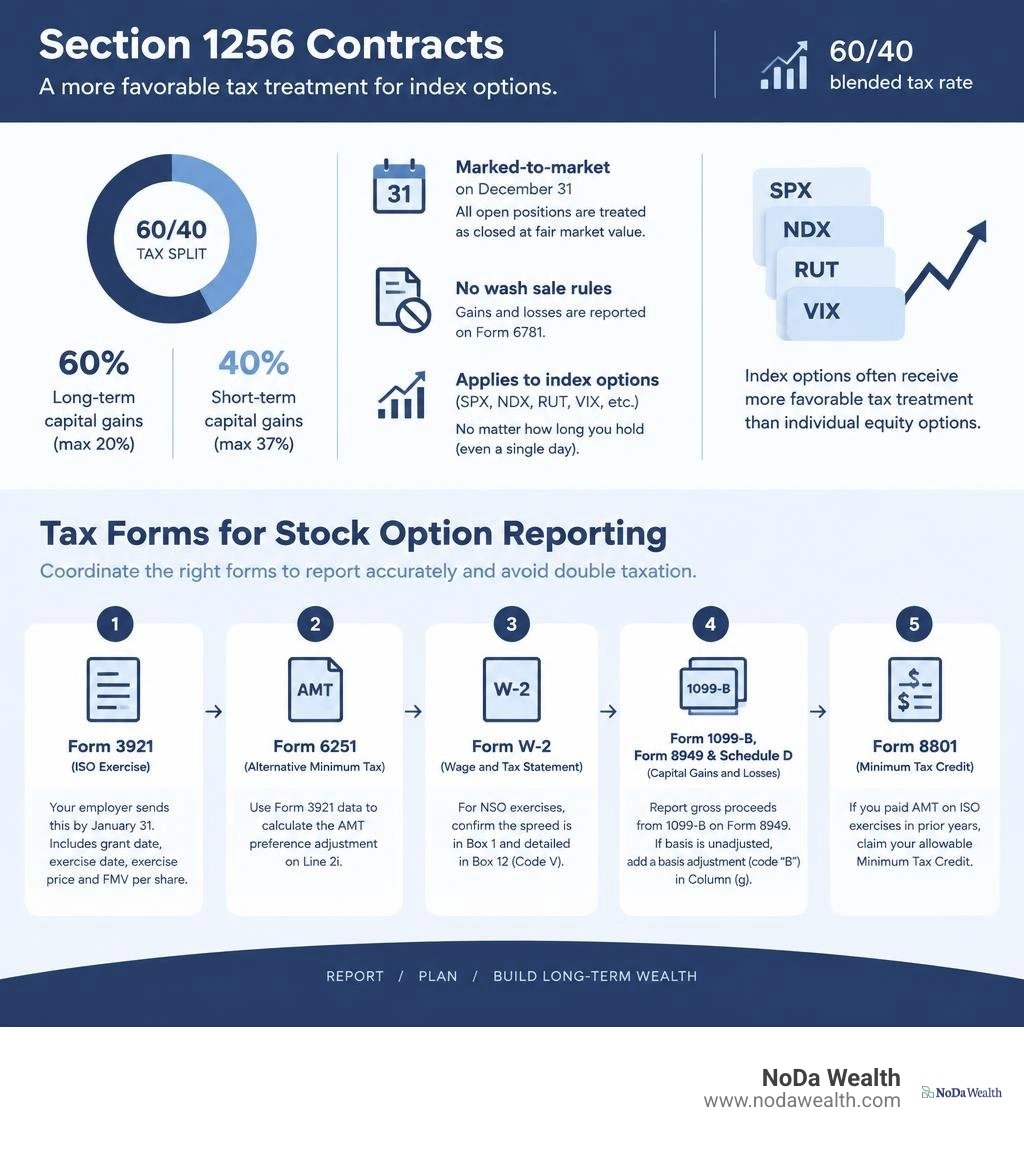
Under standard tax rules, stock options are never taxed at grant. NSOs are taxed at exercise as ordinary wage income on the spread, and again at sale on any subsequent capital appreciation. ISOs are not subject to regular income tax at exercise but may trigger AMT liability; they are formally taxed under capital gains rules when the underlying shares are sold.
A disqualifying disposition occurs if you sell ISO shares within two years of the grant date or within one year of the exercise date. Doing so eliminates qualifying long-term capital gains treatment on the initial discount. Instead, the spread at exercise (or the total gain, if lower) is taxed as ordinary compensation income in the year of sale, and any remaining profit is taxed as short-term or long-term capital gain based on how long you held the stock post-exercise.
Under federal tax law, an ISO retains its statutory tax-favored status only if exercised while employed or within 90 days (three months) following termination of employment (extended to one year in cases of permanent disability). If exercised after the 90-day window, the award is automatically reclassified and taxed as an NSO.
Equity compensation is an exceptional wealth accelerator, but unlocking its full value requires navigating complex rules around AMT thresholds, holding periods, cost basis tracking, and multi-year tax filings. Without a clear plan, unexpected tax liabilities can quickly erode your hard-earned gains.
At NoDa Wealth, we help professionals design data-driven, fee-only strategies tailored to their unique equity plans. If you are preparing to exercise equity or manage concentrated shares, schedule a free assessment with our fee-only team to optimize your tax position and protect your financial future.
Educational Purposes Only. Content on this blog is for general educational and informational purposes only. It is not investment, tax, accounting, or legal advice, and it is not a recommendation or solicitation to buy or sell any security or to adopt any investment strategy. Past performance does not guarantee future results. Investing involves risk, including the possible loss of principal.
NoDa Wealth Management, LLC ("NoDa Wealth") is an investment adviser registered with the State of North Carolina. Advisory services are offered only where NoDa Wealth and its representatives are properly registered or exempt from registration. Readers should consult their own financial, tax, and legal advisors regarding their specific situation before making any decisions. For important disclosures, see the site footer and Form ADV.
Feeling overwhelmed? Let’s simplify things! Schedule your Free Assessment for an easy, 30-minute chat to help you tackle life’s transitions.
Enjoy a hassle-free conversation that puts your needs front and center!
)%20(3).avif)
