Form 1099 Stock Option Reporting Rules Explained Simply
Learn how to report a 1099 for stock option exercise, avoid double taxation, and fix cost basis on Form 8949.



Learn how to report a 1099 for stock option exercise, avoid double taxation, and fix cost basis on Form 8949.
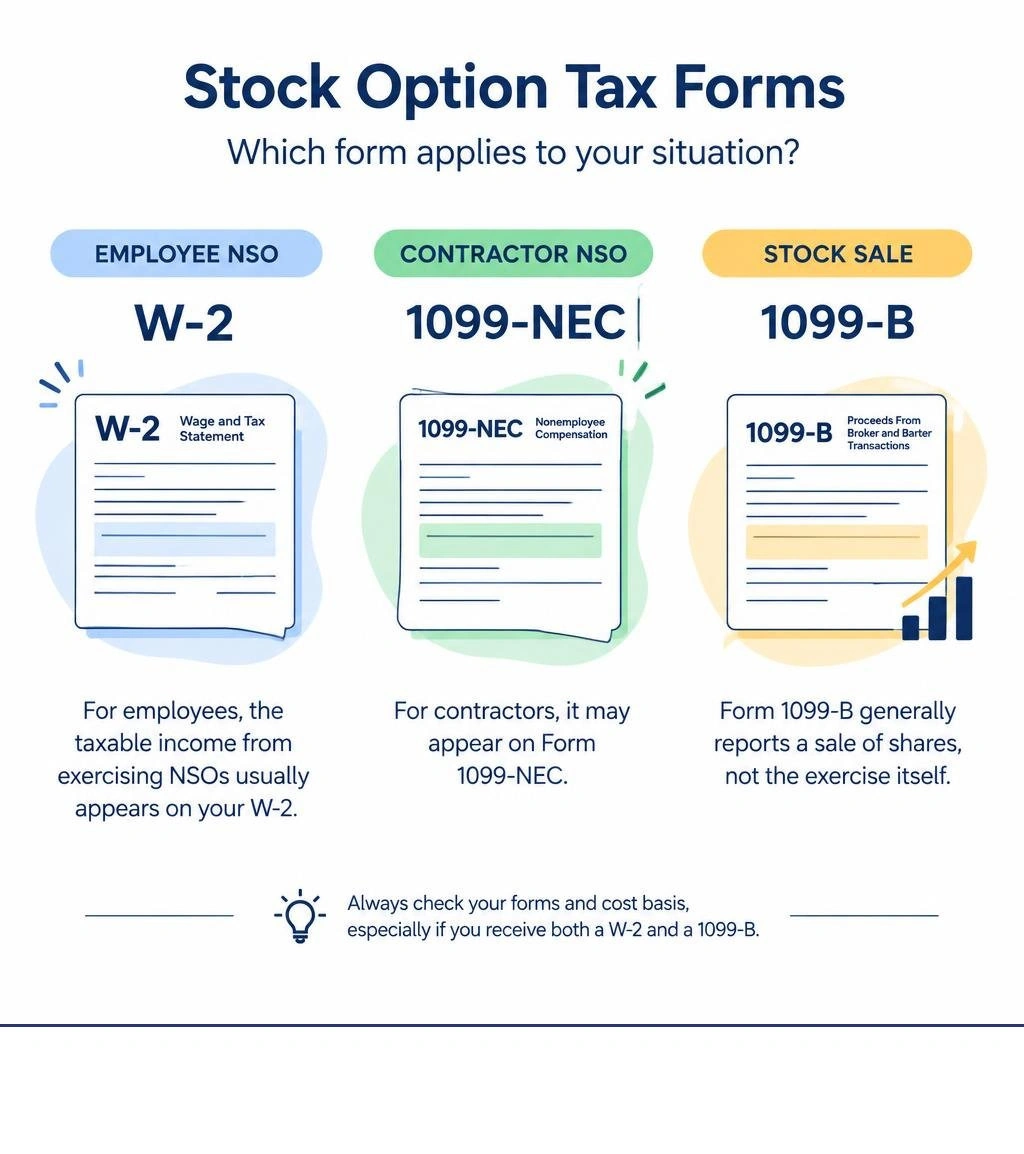
A 1099 for a stock option exercise is not automatic. If you're an employee exercising nonqualified stock options, the taxable income usually appears on your W-2. If you're a contractor, it may appear on Form 1099-NEC. Form 1099-B generally reports a sale of shares, not the exercise itself.
If you receive both a W-2 and a 1099-B, check the sale's cost basis before filing. The broker's figures may not include income already reported on your W-2, which could cause you to overstate your gain. Some qualifying same-day exercises and sales are exempt from Form 1099-B reporting under IRS Revenue Procedure 2002-50.
I'm Evan Luongo, and I'll help you sort out which forms to expect and what to check.
Learn more about 1099 for stock option exercise:
The paperwork you receive depends on two distinct factors: your worker classification (employee versus independent contractor) and whether you simply exercised an option or also sold the underlying shares.
When someone exercises a Nonqualified Stock Option (NSO), the difference between the fair market value (FMV) of the shares on the exercise date and the strike price (the grant price) is known as the exercise spread or bargain element. Under Section 83 of the Internal Revenue Code, this spread represents compensation income earned by performing services.
For Employees: Your employer generally includes the NSO exercise spread in wages on Form W-2: Box 1 for federal wages, Boxes 3 and 5 for Social Security and Medicare wages when applicable, and Box 16 for state wages. Any withholding appears in Boxes 2, 4, 6, and 17 as applicable. The spread also appears in Box 12 with Code V as an informational entry.
For Non-Employees / Independent Contractors: Because there is no employer-employee relationship, payroll withholding usually does not apply. Instead, the company issuing the equity generally reports the NSO exercise spread as nonemployee compensation in Box 1 of Form 1099-NEC. If backup withholding applies, that withholding is reported in Box 4.
Crucially, Form 1099-B is not triggered by the exercise itself. It is generated by a brokerage firm only when underlying shares are subsequently sold or disposed of.
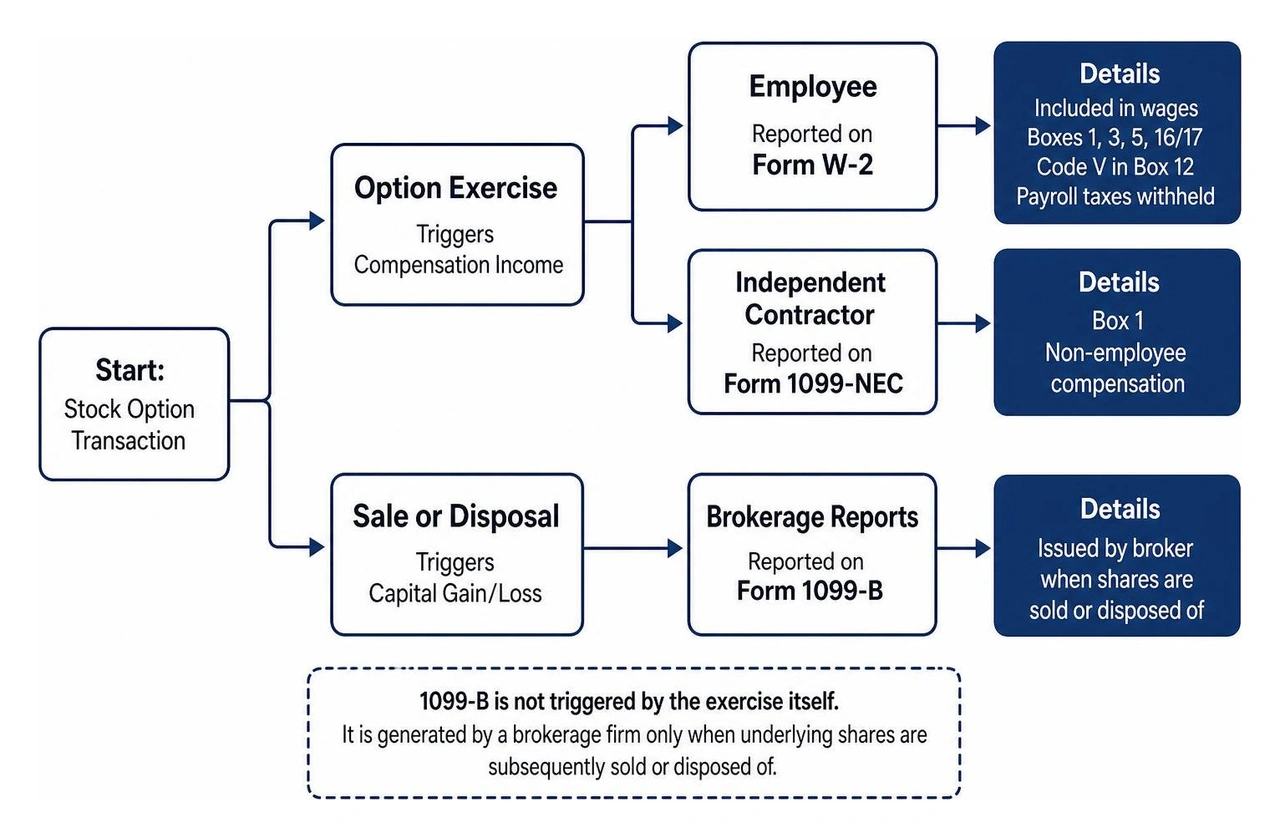
Understanding the distinction between compensation reporting and transaction proceeds helps prevent costly double-reporting errors.
When you review your stock options tax documents each January, make sure to categorize your tax documents by their reporting source:
If you exercise options and immediately sell the shares in a single market order (a cashless exercise), you might receive both a W-2/1099-NEC reflecting the compensation spread and a Form 1099-B detailing the gross sale. Reconciling these documents correctly ensures you do not inadvertently pay capital gains taxes on income that was already taxed as ordinary compensation.
Independent contractors, advisors, and corporate board members frequently receive equity awards in exchange for their professional services. When contractors decide to exercise NSO stock options, the tax treatment differs significantly from standard employee payroll.
When a contractor exercises an NSO:
Contractors report this 1099-NEC revenue on Schedule C (Form 1040) as gross self-employment business income. Consequently, the exercise spread is subject to ordinary income tax rates as well as self-employment tax (Social Security and Medicare under the Self-Employment Contributions Act). Contractors should plan estimated quarterly tax payments ahead of time to avoid IRS underpayment penalties.
The Internal Revenue Code establishes two primary categories of employee stock options: Nonqualified Stock Options (governed by IRC Section 83) and Incentive Stock Options (governed by IRC Sections 421 through 424). Understanding the nuances between ISO vs NSO options is essential for accurate year-end tax filing.
| Feature / Attribute | Nonqualified Stock Options (NSOs) | Incentive Stock Options (ISOs) |
|---|---|---|
| Taxable Event at Exercise | Yes, ordinary compensation income | No regular tax; spread is an Alternative Minimum Tax (AMT) preference item |
| Form Issued upon Exercise | Form W-2 (Box 12, Code V) or Form 1099-NEC | Form 3921 (Information return for ISO exercises) |
| Payroll Tax Withholding | Mandatory for employees (FICA & Medicare) | Exempt from FICA, Medicare, and income tax withholding |
| Disqualifying Disposition | Not applicable (already taxed at exercise) | Triggers compensation income on Form W-2 in the year of sale |
| Form Issued upon Share Sale | Form 1099-B | Form 1099-B |
For employees, NSO exercises are generally treated as supplemental wages. The exercise spread is typically included in Form W-2 Box 1, Box 3 up to the Social Security wage base, and Box 5. It may also appear in Box 12 with Code V. State and local reporting, when applicable, usually uses Box 16 for state wages and Box 18 for local wages, with related withholding in Boxes 17 and 19.
Employers also record this value in Box 12 using Code V ("Income from the exercise of nonstatutory stock option(s)").
Crucial Note on Box 12, Code V: Code V is an informational breakdown. It shows how much of your total wages in Box 1 came specifically from option exercises. Tax software uses this code to identify your compensation basis, but entering it does not double your gross income unless entered improperly into manual wage lines.
Federal supplemental income tax withholding rules require employers to withhold at a flat 22% rate for supplemental wages up to $1 million within a calendar year, jumping to 37% for supplemental wages exceeding that threshold.
Incentive Stock Options (ISOs) offer potential tax advantages, but their tax reporting paths can be complex.
When an employee exercises an ISO and holds the stock, no ordinary income is recognized for regular tax purposes. However, the spread (FMV minus strike price) is an adjustment item used to calculate the Alternative Minimum Tax (AMT) on Form 6251.
To provide the documentation required for this calculation, corporations must file Form 3921 (Exercise of an Incentive Stock Option Under Section 422(b)) with the IRS and deliver Copy B to the employee by January 31 following the calendar year of exercise.
Form 3921 records:
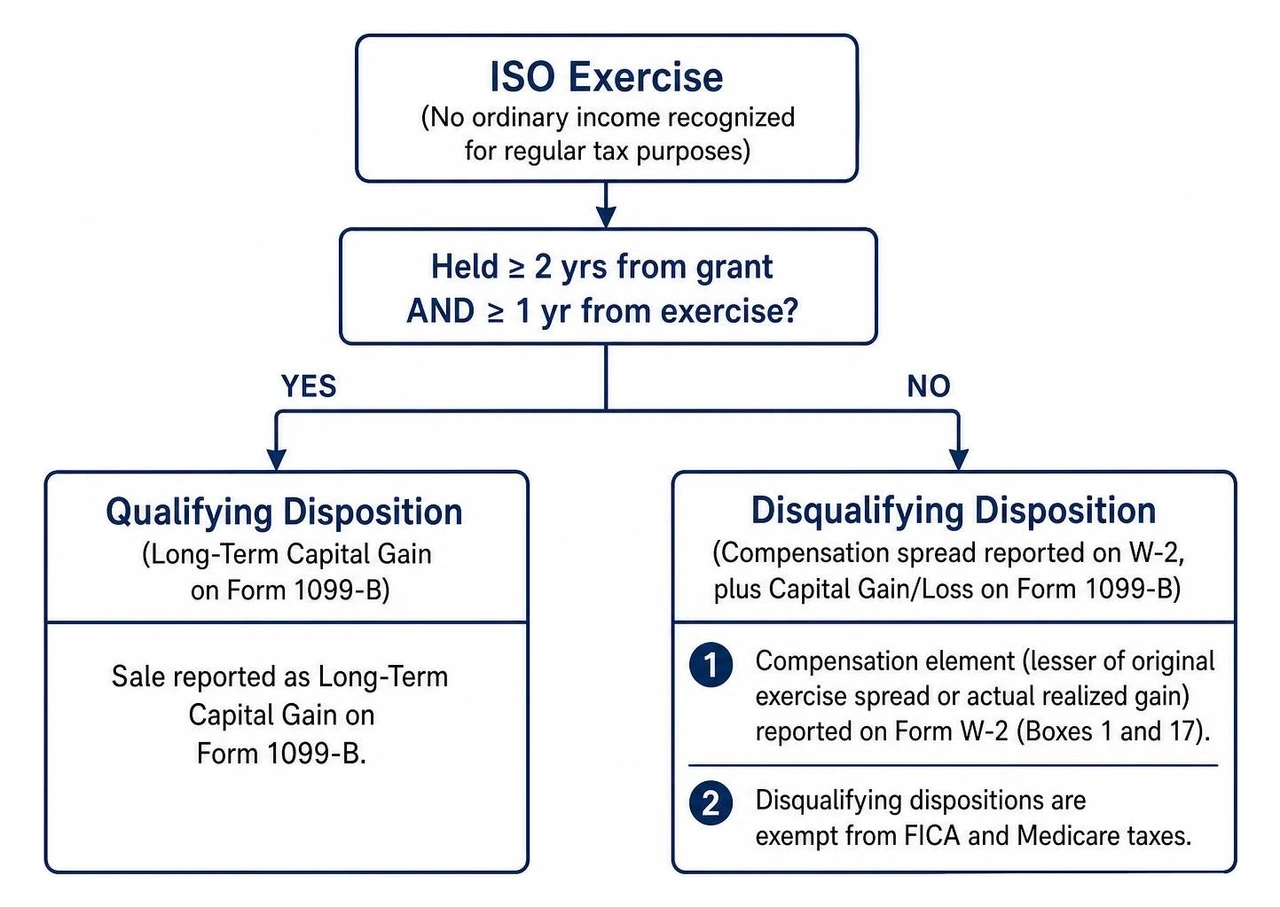
If shares acquired through an ISO are sold before meeting the statutory holding periods—specifically at least two years from the grant date and at least one year from the exercise date—the sale is classified as a disqualifying disposition.
In a disqualifying disposition:
Maintaining balanced cash flow during these transitions is critical; you can read more about managing capital during exercises in this guide to ISO exercise cash flow planning.
One of the most frequent and costly mistakes taxpayers make when reporting stock sales involves unadjusted cost basis entries on Form 1099-B.

When an investor sells shares acquired via equity compensation, the brokerage firm issues Form 1099-B detailing:
For equity compensation awards, federal brokerage regulations generally restrict brokers from adjusting Box 1e to include the compensation spread already recognized on the employee's Form W-2 or 1099-NEC. As highlighted by equity reporting analysts in guidance on Cost Basis for Equity Awards on Form 1099-B, Box 1e will typically display only the strike price paid, leaving the basis tracking incomplete unless corrected by the taxpayer.
If an employee exercises 1,000 NSO shares at a strike price of $5 per share when the market price (FMV) is $30 per share:
If the employee subsequently sells those shares for $35 per share ($35,000 total proceeds), the actual capital gain is $5,000 ($35,000 proceeds − $30,000 adjusted tax basis).
However, the broker’s Form 1099-B will often show:
If the taxpayer enters the Form 1099-B directly into tax software without adjusting the cost basis, the software will calculate a taxable capital gain of $30,000. Because the taxpayer already paid ordinary income tax on the $25,000 spread via payroll, failing to adjust the basis results in paying taxes twice on the exact same $25,000 of income! Reviewing employee share options tax rules before filing can protect you from this pitfall.
To fix an unadjusted cost basis without triggering an IRS discrepancy notice, use Form 8949 (Sales and Other Dispositions of Capital Assets) before summarizing the results on Schedule D.
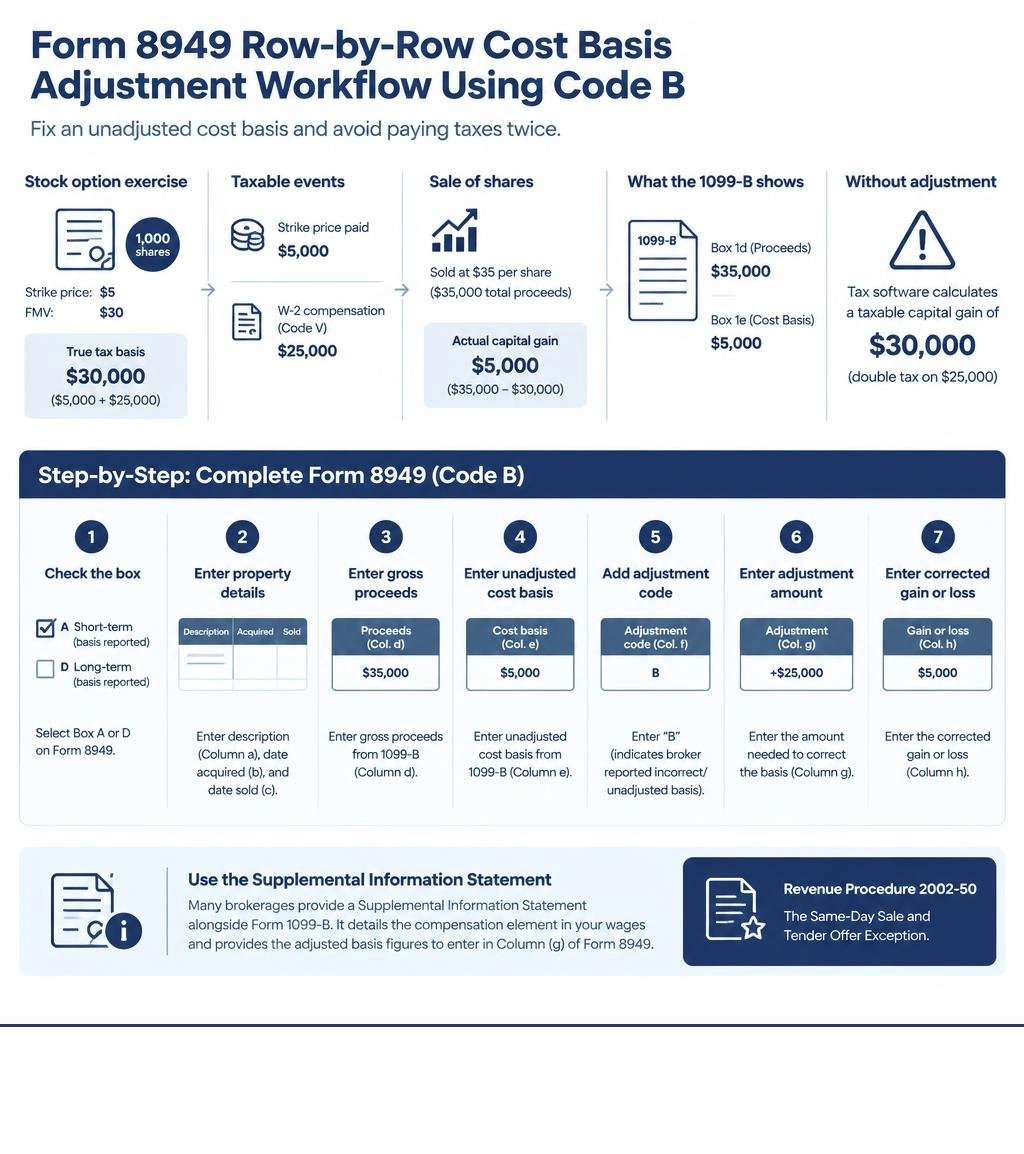
Many major brokerages provide a Supplemental Information Statement alongside Form 1099-B. While this supplemental sheet is not submitted to the IRS by the broker, it details the exact compensation element included in your wages and provides the adjusted basis figures to enter into Column (g) of Form 8949.
Taxpayers who participate in a same-day cashless exercise and sale often wonder why they did not receive a Form 1099-B from their brokerage firm or equity platform. The answer lies in administrative relief provided by the IRS under Revenue Procedure 2002-50.

Under Rev. Proc. 2002-50, a broker is exempt from issuing Form 1099-B for stock sales if all of the following requirements are met:
When these conditions are met, the entire financial gain is taxed as compensation income via payroll, eliminating the need to report capital gains or reconcile mismatched cost basis figures on Form 8949.
Revenue Procedure 2002-50 is widely utilized during private tech company liquidity programs and tender offers managed by third-party equity administrators.
In a structured tender offer:
This approach saves employees from the complicated task of reporting zero-gain sales across multiple forms while eliminating the risk of accidental double taxation.
Companies and brokerages must adhere to strict filing deadlines and compliance rules when managing equity compensation transactions:
For information returns required to be filed in 2026, the IRS can assess penalties under IRC Sections 6721 and 6722 for late, incorrect, or omitted forms. Penalties generally fall into tiers of $60, $130, or $340 per return, depending on how late the correction is made. Intentional disregard can raise the penalty to at least $680 per return, or 10% of the aggregate transaction amount when that rule applies. Employers should also keep accurate Section 83 equity records to support proper withholding and reporting.
If your Form 1099-B displays an unadjusted cost basis (showing only what you paid for the exercise), both forms are technically reporting the compensation spread. To prevent double taxation, complete Form 8949. Enter the Form 1099-B unadjusted basis in Column (e), enter Code B in Column (f), and list the compensation spread as an adjustment in Column (g). This adjusts your cost basis to reflect its true value and ensures you only pay capital gains tax on gains realized after the exercise.
No. An exercise-and-hold transaction is not a taxable sale and does not trigger Form 1099-B. For NSO exercises, the ordinary income spread will appear on your Form W-2 (or Form 1099-NEC for contractors). For ISO exercises, you will receive Form 3921 to calculate any potential Alternative Minimum Tax adjustments on Form 6251. You will only receive a Form 1099-B when you eventually sell the shares.
When brokerage commissions and transaction fees are incurred during a same-day exercise and sale, they reduce your net sale proceeds or increase your cost basis. Under Revenue Procedure 2002-50, if a broker does not issue a Form 1099-B, they must provide a detailed settlement statement showing gross proceeds minus commissions. If a Form 1099-B is issued, trading fees are generally factored into the net proceeds shown in Box 1d or added to the basis in Box 1e, resulting in a small short-term capital loss equal to the transaction fees.
Navigating the tax reporting rules for stock option exercises requires careful coordination across multiple tax documents, including Forms W-2, 1099-NEC, 1099-B, 3921, and 8949. Understanding how compensation income integrates with capital gains reporting is key to protecting your financial returns and avoiding unnecessary double taxation.
NoDa Wealth provides fee-only, fiduciary financial planning and wealth management for busy professionals. Located in Charlotte, NC, the firm provides transparent, data-driven, commission-free guidance across equity compensation, investment strategies, cash flow management, and tax planning.
To review your equity compensation strategy and ensure your tax reporting is aligned with your long-term financial goals, schedule a free assessment for equity compensation today.
Educational Purposes Only. Content on this blog is for general educational and informational purposes only. It is not investment, tax, accounting, or legal advice, and it is not a recommendation or solicitation to buy or sell any security or to adopt any investment strategy. Past performance does not guarantee future results. Investing involves risk, including the possible loss of principal.
NoDa Wealth Management, LLC ("NoDa Wealth") is an investment adviser registered with the State of North Carolina. Advisory services are offered only where NoDa Wealth and its representatives are properly registered or exempt from registration. Readers should consult their own financial, tax, and legal advisors regarding their specific situation before making any decisions. For important disclosures, see the site footer and Form ADV.
Feeling overwhelmed? Let’s simplify things! Schedule your Free Assessment for an easy, 30-minute chat to help you tackle life’s transitions.
Enjoy a hassle-free conversation that puts your needs front and center!
)%20(3).avif)
