Demystifying Employee Share Options Tax from Grant to Sale
Navigate employee share options tax from grant to sale, covering ISOs, NSOs, AMT, and strategic exercise methods to avoid costly surprises.


Navigate employee share options tax from grant to sale, covering ISOs, NSOs, AMT, and strategic exercise methods to avoid costly surprises.
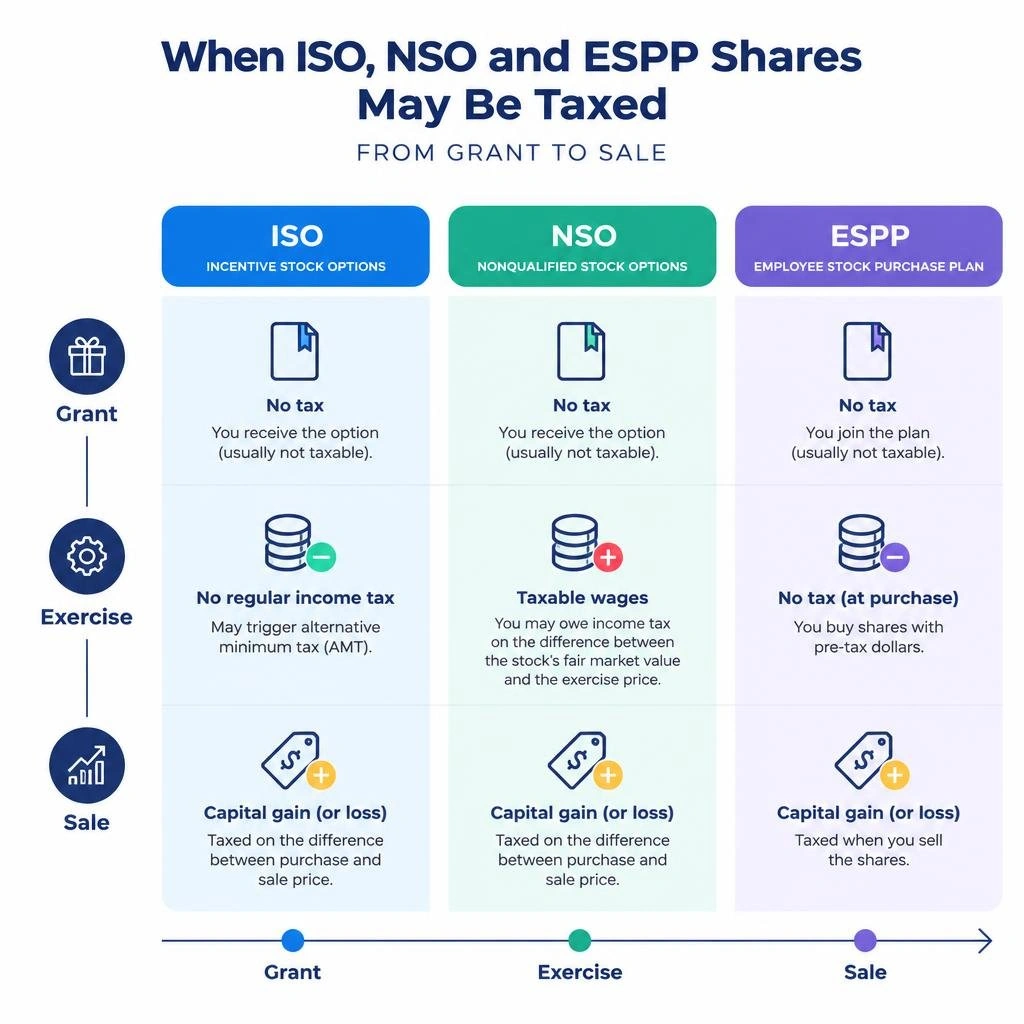
In the U.S., employee share options tax depends on the type of equity and what you do with it. Nonqualified stock options (NSOs) usually create taxable wages when you exercise them. Incentive stock options (ISOs) generally do not create regular income tax at exercise, but they can trigger alternative minimum tax. Shares bought through a qualifying employee stock purchase plan (ESPP) are generally taxed when you sell them. A later sale can also create a capital gain or loss. The IRS explains these differences.
The hard part is that exercising options can create a tax bill before you sell any shares. Knowing your option type, exercise cost, and sale date helps you plan for that bill instead of being surprised by it.
I'm Evan Luongo, and I'll help you follow the tax rules from grant to sale.
Helpful guides on employee share options tax:
Equity compensation can be a powerful way to build meaningful wealth, but it is also one of the easiest workplace benefits to misunderstand. The tax bill often shows up at exercise or sale, right when employees are making high-stakes decisions about cash flow, risk, and timing. Without a clear plan, options can become more stressful than valuable.
Much of this friction stems from an education gap: equity awards often arrive with unfamiliar terms, tight exercise windows, and tax rules that change from grant to exercise to sale. When employees are unsure whom to ask, small misunderstandings can become expensive tax surprises.

When an employer grants you stock options, they are giving you a contractual right to buy shares of company stock at a fixed price, known as the exercise or strike price. To navigate this landscape without costly missteps, you must understand how options move through four key phases: grant, vesting, exercise, and ultimate disposition.
The tax code separates equity into two primary categories: statutory options, which receive specific tax advantages under the Internal Revenue Code (IRC), and non-statutory options, which do not. Understanding how your equity is classified is the first step in establishing an effective stock options tax strategy.
| Feature / Equity Plan | Incentive Stock Options (ISOs) | Non-Qualified Stock Options (NSOs) | Employee Stock Purchase Plans (ESPPs) |
|---|---|---|---|
| Statutory Classification | Statutory (IRC Section 422) | Non-Statutory (IRC Section 83) | Statutory (IRC Section 423) |
| Tax at Grant | None | None | None |
| Tax at Vesting | None | None | None |
| Tax at Exercise / Purchase | No regular income tax; spread is an Alternative Minimum Tax (AMT) preference item | Ordinary income tax on spread plus payroll taxes (FICA/Medicare) | No tax at purchase |
| Mandatory Withholding | None at exercise | Yes, supplemental wage withholding required at exercise | None at purchase |
| Tax at Sale | Capital gains (long-term if holding periods met; otherwise ordinary income) | Capital gains or loss on growth occurring after exercise | Ordinary income on discount; capital gains on subsequent growth |
| Employer Tax Reporting | Form 3921 | Form W-2 (Box 12, Code V) | Form 3922 |
When evaluating ISO vs NSO options, the most significant difference lies in their statutory framework. Incentive Stock Options (ISOs) must meet rigorous requirements under IRC Section 422. They can only be awarded to statutory employees (excluding independent contractors and outside directors), and they offer an avenue to convert operational growth into favorable long-term capital gains rates.
Non-Qualified Stock Options (NSOs), governed by IRC Section 83, are flexible awards granted to employees, contractors, board members, and advisors. However, this flexibility removes statutory tax relief: the difference between the fair market value (FMV) at exercise and your strike price is treated as ordinary compensation.
Employee Stock Purchase Plans (ESPPs) operate under IRC Section 423. These plans allow eligible employees to purchase company stock through payroll deductions, often at a discount of up to 15% off the fair market value, frequently incorporating lookback provisions that benchmark the purchase price against either the first or last day of an offering period.
Congress enacted a strict boundary under IRC Section 422(d) to prevent executive compensation from bypassing regular income taxation entirely: the $100,000 rule.
Under this limitation, an employee may only have up to $100,000 worth of ISOs become exercisable (vest) for the very first time in any single calendar year. For the purposes of this calculation, value is measured using the aggregate fair market value of the underlying shares on the grant date, not the eventual exercise date.
If an option grant exceeds this boundary, the excess portion automatically converts into an NSO. When that spillover occurs, the options that vest beyond the $100,000 threshold lose ISO tax treatment and become subject to mandatory income and payroll tax withholding upon exercise.
Understanding the lifecycle of stock options allows you to anticipate cash outlays and tax events well before they occur.

When exercising NSO stock options, tax is triggered immediately upon exercise. The taxable spread equals the fair market value of the shares on the exercise date minus the aggregate strike price paid. This spread is categorized as wage compensation, requiring employers to apply federal income tax withholding, state and local taxes, and payroll taxes (Social Security and Medicare), as detailed in tax implications for stock-based compensation.
For example, if you exercise 1,000 NSOs with a strike price of $5 per share when the FMV is $25 per share:
This $20,000 is reported directly on your Form W-2 for the current tax year.
Incentive Stock Options do not generate ordinary wage income at exercise. However, the exercise spread (the difference between the FMV on the exercise date and the strike price) is an adjustment item for the Alternative Minimum Tax (AMT) calculation under IRC Section 56(b)(3).
AMT functions as a parallel tax system designed to ensure higher earners pay a baseline amount of tax. When you file your annual taxes, your regular tax liability is compared to your Tentative Minimum Tax computed on Form 6251. If your Tentative Minimum Tax exceeds your regular tax, you pay the difference as AMT.
When you exercise and hold private company ISOs, this calculation can generate a substantial tax bill on "paper gains" before you have liquidity. Proactively managing ISO exercise cash flow is critical to avoid paying taxes on phantom wealth if share values decline later. When you pay AMT on an ISO exercise, you generate an AMT credit (Form 8801) that can offset regular tax liability in future tax years when your regular tax rate exceeds your Tentative Minimum Tax.
When you sell shares acquired from an ISO, the tax treatment depends entirely on statutory holding periods:
If you sell shares in a disqualifying disposition at a price lower than the FMV at exercise, the ordinary income recognized is capped at the actual economic gain (the final sale price minus the exercise price).

Exercising options requires evaluating liquidity, personal cash flow, and market exposure. Choosing the right execution method ensures you avoid unexpected tax bills.
There are three primary operational methods to exercise employee stock options:
Holding a heavy allocation of employer stock exposes you to uncompensated volatility. Implementing robust single stock risk management strategies protects your broader balance sheet against sudden corporate downturns.
Employee Stock Purchase Plans offer structured wealth building, but their tax reporting depends on specific disposition rules:

To achieve a qualifying disposition under IRC Section 423, you must hold the purchased shares for at least two years from the start of the offering period (grant date) and at least one year from the purchase date.
Coordinating these rules through comprehensive ESPP planning and proactive ESPP cash flow management ensures you maximize plan discounts while maintaining portfolio flexibility.
When you leave an employer, standard stock option agreements generally provide a 90-day post-termination exercise window (PTEW) to exercise vested awards before they are forfeited.
Under IRC Section 421 and 422, an ISO exercised more than 90 days following employment termination automatically loses its statutory status and converts into an NSO for tax purposes. While some companies offer extended multi-year post-termination exercise windows, exercising after day 90 triggers ordinary income and payroll taxes instead of AMT.
Furthermore, state taxation introduces complexity if you relocate between your grant date, vesting date, and exercise date. Most states allocate equity income based on the percentage of days worked within their jurisdiction between the grant and vesting dates.
Legal rulings on option taxation, such as appellate legal rulings on stock option forfeiture risk, emphasize that income deferral under IRC Section 83 is only permitted when explicit, realistic forfeiture constraints prevent option realization.
Proper tax compliance requires careful tracking of corporate tax forms and payroll reporting.
Your employer has specific statutory deadlines to report equity transactions:
One of the most common tax errors occurs when employees inadvertently pay tax twice on the exact same equity gains. Custodian brokerages frequently report your unadjusted cash purchase price as the cost basis on Form 1099-B (Box 1e), omitting the ordinary income spread already taxed on your Form W-2.
To practice avoiding double taxation on equity sales, you must file IRS Form 8949 alongside Schedule D. You enter the 1099-B reported basis, input Code "B" in column (f) to denote an adjustment, and apply a negative adjustment in column (g) to reflect your true, adjusted cost basis (strike price paid plus ordinary income already recognized).
Reconciling basis errors allows you to safely transition equity proceeds into a disciplined framework for concentrated stock position diversification.
When you leave an employer, you forfeit all unvested options immediately. For vested options, you generally have a 90-day post-termination window to exercise. If you hold ISOs and your employer offers an extended exercise window (e.g., 5 to 10 years), exercising after the 90-day mark automatically converts your awards to NSOs, triggering ordinary income tax on the spread.
To avoid double taxation on NSO or disqualifying ISO sales, adjust your cost basis on IRS Form 8949. Brokerages often report only the cash strike price paid on Form 1099-B. By entering the compensation income already taxed on your W-2 as a basis adjustment using Code B, you ensure you only pay capital gains on growth that occurred after exercise.
Generally, no. Standard stock options cannot utilize an IRC Section 83(b) election because the option grant is not considered a transfer of property with a readily ascertainable fair market value under Treasury Regulation 1.83-7. However, if your company permits an early exercise of unvested options, you receive unvested restricted stock upon exercise. In that specific scenario, filing an 83(b) election within 30 days of the early exercise date accelerates the tax calculation to the exercise date, locking in an early holding period for long-term capital gains.
Managing employee share options requires a clear, coordinated strategy across multiple tax rules. From distinguishing between ISOs and NSOs to navigating AMT calculations, disqualifying dispositions, and cost basis reporting, an unplanned exercise can lead to unexpected tax liabilities.
NoDa Wealth provides fee-only, fiduciary financial planning and wealth management for busy professionals. Located in Charlotte, NC, NoDa Wealth delivers transparent, data-driven, no-commission advice through a simple 3-step process, helping clients optimize cash flow, investments, and equity taxation.
To review your options and build a tax-efficient equity roadmap, schedule a free equity assessment with NoDa Wealth.
Educational Purposes Only. Content on this blog is for general educational and informational purposes only. It is not investment, tax, accounting, or legal advice, and it is not a recommendation or solicitation to buy or sell any security or to adopt any investment strategy. Past performance does not guarantee future results. Investing involves risk, including the possible loss of principal.
NoDa Wealth Management, LLC ("NoDa Wealth") is an investment adviser registered with the State of North Carolina. Advisory services are offered only where NoDa Wealth and its representatives are properly registered or exempt from registration. Readers should consult their own financial, tax, and legal advisors regarding their specific situation before making any decisions. For important disclosures, see the site footer and Form ADV.
Feeling overwhelmed? Let’s simplify things! Schedule your Free Assessment for an easy, 30-minute chat to help you tackle life’s transitions.
Enjoy a hassle-free conversation that puts your needs front and center!
)%20(3).avif)
