A Practical Guide to Concentrated Stock Position Risk Reduction
Learn how concentrated stock position diversification reduces single-stock risk, cuts taxes, and protects wealth with actionable strategies.


Learn how concentrated stock position diversification reduces single-stock risk, cuts taxes, and protects wealth with actionable strategies.
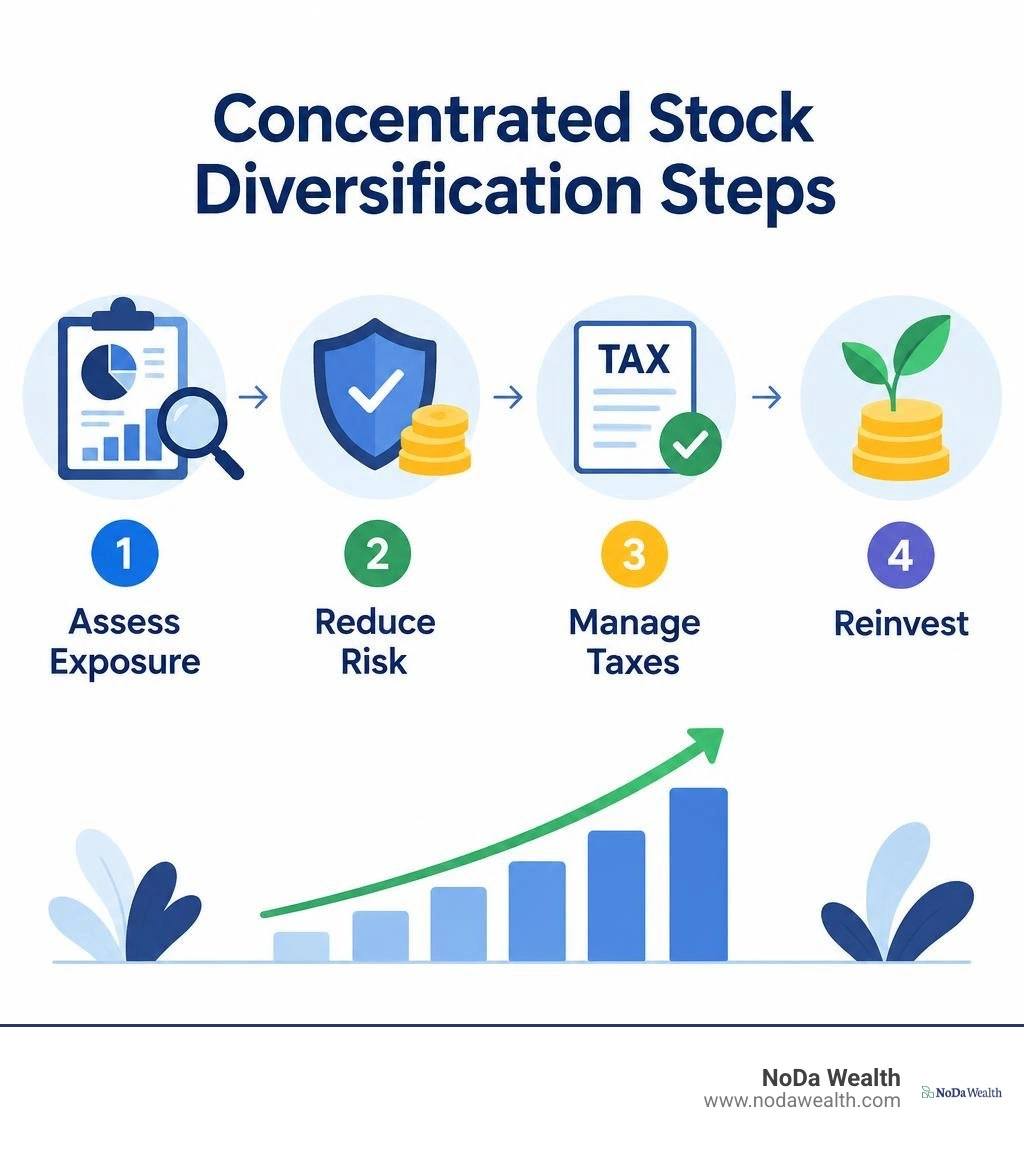
Concentrated stock position diversification means reducing your reliance on one company without letting taxes, timing, or emotion drive every decision. Start by measuring the stock as a share of your investable assets and total net worth, set a target allocation, then use a plan that may combine staged sales, tax-loss harvesting, charitable gifts, and short-term hedging.
A single stock deserves a close review around 10% of a portfolio and can pose serious planning risk at 20% or more. The risk is even greater with employer stock: a company setback can affect your investments, salary, bonus, and future equity awards at the same time.
This is not just theory. Research by Hendrik Bessembinder found that only 42.6% of individual stocks outperformed one-month Treasury bills over their full lifetimes from 1926 through 2016, while a small share of stocks created the market's net wealth. Paying capital-gains tax can hurt, but letting one holding put your family's financial plan at risk may cost far more.
I am Evan Luongo, and the next sections explain how to reduce a concentrated position with a clear plan built around your timeline, tax bracket, and goals.
Most wealth accumulation happens through concentration, building a successful business, rising through the corporate ranks, or holding an exceptional winner. Preserving that wealth, however, requires the exact opposite discipline.
When an individual holding exceeds 10% of your liquid portfolio, I flag it for structured monitoring. Once it crosses 20%, it ceases to be just an investment holding and becomes a structural vulnerability that can dictate your retirement timeline.
The underlying math of individual stocks is what makes concentration risk so uncomfortable:
Skewed Market Returns: In Hendrik Bessembinder’s study of U.S. equities from 1926 to 2016, the median stock produced a negative lifetime annualized return. A very small group of companies drove essentially all net wealth creation above Treasury bills.
Frequent Underperformance: That same research helps explain a painful reality: many individual stocks fail to keep up with broad market returns over long periods. Owning one “great company” is not the same as owning a durable, diversified portfolio.
Elevated Volatility: A single stock can swing much more than a broad index. For planning purposes, stress tests often assume individual-stock volatility is meaningfully higher than the volatility of a diversified U.S. equity index.
Catastrophic Tail Risk: Institutional research on concentrated stock positions highlights why downside modeling matters. Some public companies suffer large, lasting drawdowns, and sector-specific concentration can make that risk worse. The practical takeaway is simple: the danger is not just temporary volatility. It is the possibility that one stock falls hard and never fully recovers.

Many professionals hesitate to divest because they fall victim to survivorship bias, assuming their stock's historical run will persist indefinitely. When evaluating whether to trim exposure, I often run downside stress tests: if this position drops 50% over the next twelve months, does it change when you can retire or how you fund your living expenses? If the answer is yes, holding the stock is an uncompensated risk.
Understanding how to balance this volatility is critical when managing equity compensation and bonuses across your broader financial plan.
If your concentration is in your current employer's equity, your exposure is multiplied across several areas. Your salary, annual cash bonuses, health insurance, unvested restricted stock units (RSUs), and future vesting packages are all tied to the operating performance of a single balance sheet.
If the company encounters severe headwinds, your human capital (earning ability) and your financial capital are hit simultaneously. This makes keeping employer stock below 5% to 10% of your total net worth a prudent risk-management rule of thumb.
For executives and professionals navigating these packages, coordinating benefits like non-qualified stock options, RSUs, and retirement plans requires an integrated strategy. Learn more about maximizing stock options and 401(k) plans to optimize compensation without overconcentrating.
The primary barrier to diversification is rarely a lack of desire to reduce risk; it is the tax liability associated with realizing low-cost-basis shares.
When liquidating appreciated long-term positions, investors face several layers of taxation:
Investors must understand cost basis rules—especially when navigating RSUs, where compensation is already taxed at vesting. To avoid costly reporting errors on your tax return, review our guide on avoiding double taxation on vested RSUs.
Letting the "tax tail wag the investment dog" often leads investors to retain dangerous single-stock positions simply to avoid paying taxes. However, experiencing a 40% decline to avoid a 25% tax bill leaves you significantly worse off. The goal is to unwind the position systematically while minimizing the tax bite.
Rather than triggering an immediate, massive liquidity event in a single calendar year, you can implement a staged liquidation schedule over two to five years. By selecting specific, high-basis tax lots first, you can extract capital while controlling the realization of taxable gains.
To accelerate diversification without incurring excessive tax drag, you can pair staged sales with Direct Indexing in Separately Managed Accounts (SMAs). In direct indexing, you own the underlying individual stocks of an index (such as the S&P 500 or Russell 1000) directly, rather than through an ETF wrapper.
This structure allows the portfolio manager to sell individual underperforming components within the index to systematically harvest capital losses throughout the year. Those harvested losses are then used dollar-for-dollar to offset the capital gains generated by selling down your concentrated position, an approach institutional research on diversifying concentrated stock positions has long supported as an effective, systematic method for managing tax drag.
When an investor cannot immediately sell shares due to lockups, blackout periods, or an impending tax year change, derivative overlays can protect portfolio value:
While options collars provide downside security, they must be structured carefully to prevent an unintended tax event. Under Internal Revenue Code §1259, enacted to curb abusive hedging strategies, entering into transactions that eliminate virtually all risk of loss and opportunity for gain on an appreciated position is treated as a constructive sale.
If the IRS deems a transaction a constructive sale, you are treated as having sold the underlying position at its fair market value on the date the hedge was established, triggering immediate capital gains taxes without generating any cash proceeds to pay the bill.
To ensure compliance with IRC §1259:
High-net-worth investors holding extremely low-basis positions can explore structural vehicles that offer diversification alongside tax deferral or elimination:
| Diversification Vehicle | Target Investor | Primary Mechanism | Liquidity / Constraints | Tax Treatment |
|---|---|---|---|---|
| Direct Indexing (SMA) | Liquid taxable accounts ($250k+) | Security-level tax-loss harvesting offsets stock sales | High daily liquidity | Gains realized gradually, offset by harvested capital losses |
| Exchange Fund | Qualified Purchasers / Accredited Investors | Contribution of shares into a pooled private partnership | 7-year statutory lockup period | Complete tax deferral; original basis carries over to pool |
| Section 351 ETF Transfer | Ultra-HNW / Institutional ($1M+ lots) | Contribution of equity lots to an ETF in exchange for fund shares | Varies based on creation-unit parameters | Tax-deferred transfer of assets into diversified ETF wrapper |
| Charitable Remainder Trust (CRT) | Philanthropic investors seeking income | Transfer of shares to tax-exempt trust, which sells at 0% tax | Irrevocable; non-charitable income stream for life/term | Immediate partial tax deduction; eliminates immediate capital gains |
| Donor-Advised Fund (DAF) | Philanthropically minded individuals | Direct gifting of appreciated shares to a public charity | Irrevocable contribution; donor grants out over time | Full fair market value deduction; avoids capital gains entirely |
An Exchange Fund (or swap fund) is a private partnership that allows investors from different companies to pool their individual low-basis stocks into a single diversified portfolio.
Section 351 ETF Transfers operate on a similar principle, allowing investors to exchange large blocks of appreciated stock for shares of an actively managed or index ETF without immediate taxation under Section 351 of the Internal Revenue Code.
Philanthropic strategies provide an effective way to eliminate capital gains entirely while advancing personal giving goals:
Structuring these income streams works hand-in-hand with comprehensive retirement cash flow strategies.

To protect against allegations of insider trading, corporate insiders can establish Rule 10b5-1 Trading Plans. These are written, predetermined schedules that lay out specific dates, share counts, or limit prices for selling stock in the future.
If you hold highly appreciated company stock inside an employer-sponsored 401(k), rolling those shares directly into a Traditional IRA can be an expensive mistake. Doing so ensures that every dollar withdrawn in retirement will eventually be taxed at ordinary income rates (up to 37%+).
Using the Net Unrealized Appreciation (NUA) strategy offers an alternative:
Integrating NUA decisions early is a crucial element of comprehensive retirement estate planning.
To systematically de-risk your balance sheet without unnecessary friction, NoDa Wealth follows an established five-step protocol:
A single stock holding may warrant review when it exceeds 10% of your total investable portfolio. At 20% or higher, the position can create structural, uncompensated risk that may threaten long-term financial security. For employer equity, NoDa Wealth typically evaluates lower exposure ranges, often 5% to 10% of total net worth, because salary and future compensation may already depend on the same company.
Rarely. Holding a volatile single stock indefinitely to avoid capital gains taxes often leads to significant wealth destruction. Over 40% of all public companies historically suffer severe, permanent declines from their peak valuations. Experiencing a 50% drawdown to save 20% to 30% in taxes results in a substantial net loss. Risk management should take priority over tax minimization.
NUA allows employees holding company stock inside a 401(k) to distribute the shares in-kind to a taxable account during a qualifying lump-sum distribution. You pay ordinary income tax only on the stock's original purchase basis. The rest of the value—the unrealized appreciation—is taxed at lower long-term capital gains rates upon sale, avoiding ordinary income tax rates on that growth.

A concentrated stock position can be an effective way to build wealth, but it is rarely the best way to protect it. Relying too heavily on a single company exposes your family to unnecessary volatility, career correlation, and the historical reality of single-stock risk.
Navigating the exit requires a balanced approach that pairs tax efficiency with decisive risk management. At NoDa Wealth, we provide fee-only, fiduciary wealth management and financial planning for busy professionals and corporate leaders. We operate on transparent, data-driven advice with zero product sales or commissions, helping you design an actionable plan to unwind concentrated holdings systematically.
Do not let fear of a tax bill keep you from securing what you have built. Schedule a free assessment to map your diversification strategy, and I will help you build a durable, diversified portfolio aligned with your long-term goals.
Educational Purposes Only. Content on this blog is for general educational and informational purposes only. It is not investment, tax, accounting, or legal advice, and it is not a recommendation or solicitation to buy or sell any security or to adopt any investment strategy. Past performance does not guarantee future results. Investing involves risk, including the possible loss of principal.
NoDa Wealth Management, LLC ("NoDa Wealth") is an investment adviser registered with the State of North Carolina. Advisory services are offered only where NoDa Wealth and its representatives are properly registered or exempt from registration. Readers should consult their own financial, tax, and legal advisors regarding their specific situation before making any decisions. For important disclosures, see the site footer and Form ADV.
Feeling overwhelmed? Let’s simplify things! Schedule your Free Assessment for an easy, 30-minute chat to help you tackle life’s transitions.
Enjoy a hassle-free conversation that puts your needs front and center!
)%20(3).avif)
