Retirement Cash Flow Planning: The Practical Step-by-Step Blueprint
Learn to master retirement cash flow with a practical step-by-step blueprint for income, taxes, and spending.


Learn to master retirement cash flow with a practical step-by-step blueprint for income, taxes, and spending.
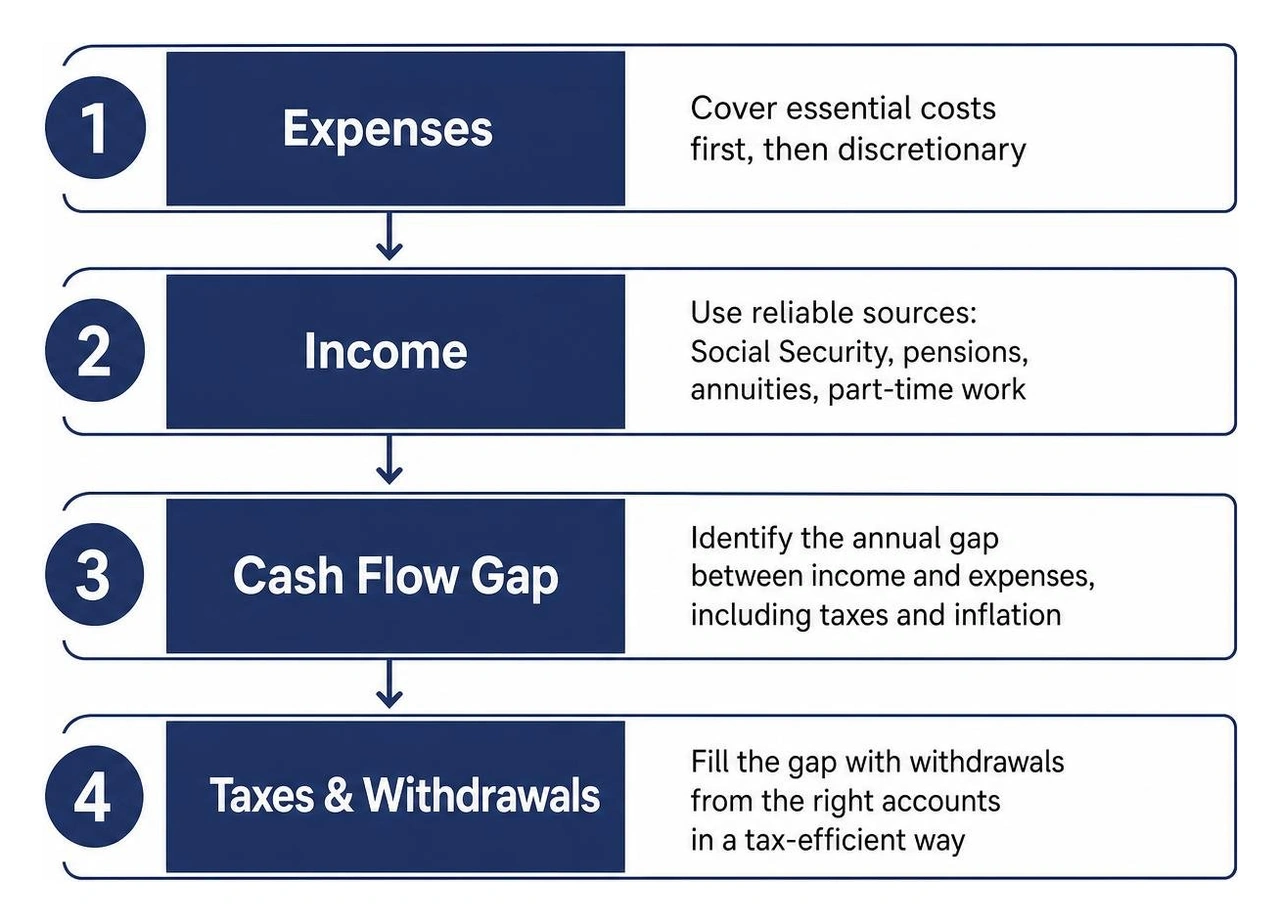
To manage retirement cash flow in September 2026, make a year-by-year plan that shows where money will come from, what it must cover, and when you may need portfolio withdrawals. For Charlotte, NC professionals and families, that plan should also account for local costs such as Mecklenburg County property taxes, homeowners insurance, healthcare access, and the lifestyle spending that comes with retiring in or near the Queen City.
Start with these four steps:
This is different from simply asking whether you have "enough" saved. A traditional retirement projection may give you one success score. A cash flow plan answers the practical questions: How will we pay the bills next year? What changes when Social Security begins? What happens if healthcare costs rise? How would a Charlotte financial advisor help us coordinate withdrawals with taxes and local living costs?
Retirement is the shift from building wealth to using it carefully. Your spending will not be flat, either. Many households spend more in active early retirement, less during the middle years, and more later as healthcare needs grow. With inflation at 3%, costs can roughly double over 24 years, so today's budget is only the starting point.
A clear visual timeline can turn a vague worry into a set of choices: spend less, work a little longer, delay benefits, change withdrawals, adjust investments, or revisit your Charlotte retirement planning strategy before a shortfall becomes urgent.
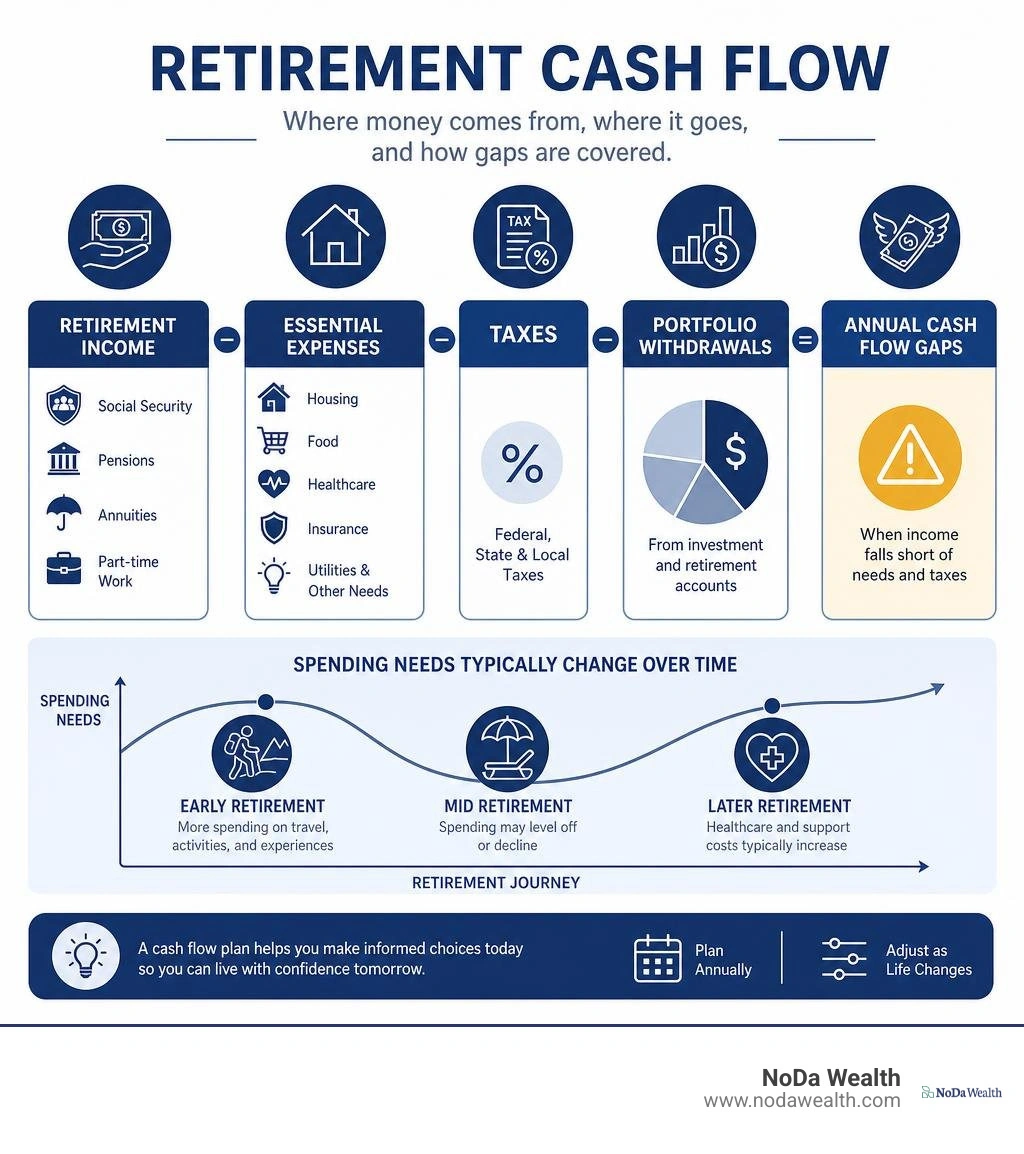
Transitioning into retirement means trading the steady cadence of a biweekly paycheck for a decumulation blueprint you build yourself. Instead of watching your investment balances grow month after month, you now have to solve for sustainable net cash flow.
This requires coordinating several moving parts at once: portfolio liquidations, guaranteed income sources, tax bracket sequencing, and lifetime longevity targets. Utilizing interactive retirement spending calculators can help you model your baseline needs, but true financial security comes from understanding how each operational layer works together over a multi-decade horizon.
For a household in Charlotte, retirement cash flow planning also means translating national assumptions into a local plan. A couple retiring in South End, NoDa, Dilworth, Myers Park, or the Lake Norman area may have very different housing, transportation, charitable giving, and family-support needs than a national calculator assumes.
For decades, traditional financial planning relied heavily on static Monte Carlo simulations. While seeing an "87% probability of success" on a static PDF can feel reassuring, it fails to answer the everyday questions that keep people up at night. A probability score does not tell you which account to sell down in March, how to cover property taxes in November, or how your tax bracket will shift when you turn 73.
As fee-only, fiduciary financial planners in Charlotte, NC, we find that static success rates conceal critical operational details. A dynamic cash flow map tracks real money:
Knowing if you can handle retiring early with adequate cash flow requires looking past a single total savings number and building an operational roadmap for every stage of retirement.
A dependable cash flow plan requires categorizing your outflows accurately. We separate spending into non-negotiable baseline expenses and flexible lifestyle goals:
According to the Bureau of Labor Statistics' Consumer Expenditure Survey, the average household aged 65 to 74 spends approximately $63,000 per year. However, high-income households often need closer to 60% to 80% of their pre-retirement earnings to maintain their standard of living.
By creating a flexible retirement budget, you create built-in spending guardrails. When equity markets experience an inevitable downturn, trimming discretionary line items by 10% to 15% preserves your principal balance without compromising your day-to-day comfort.
Retirement spending rarely moves in a straight line. Many traditional retirement calculators assume you will spend the exact same inflation-adjusted dollar amount at age 62, 75, and 90. In reality, actual spending patterns follow what researchers call the retirement spending smile.

This spending trajectory breaks down into three distinct phases:
Building dependable monthly cash flow involves layering your guaranteed income streams alongside your portfolio assets:
For Charlotte retirement planning, the order and timing of these income sources should be coordinated with your tax picture, charitable giving goals, and whether you plan to stay in North Carolina long term. To understand how these income streams change your required portfolio withdrawals year over year, you can explore comprehensive cash flow drawdown models as well as the detailed step-by-step methodologies used by financial planners.
To protect your long-term portfolio from sequence-of-returns risk—the danger of being forced to sell depressed assets during a market crash—you need a dedicated cash buffer.
We recommend maintaining a tiered liquidity strategy:
When evaluating where to hold your short-term cash buffer, parking cash in high-yield savings versus money market funds can optimize your yield while keeping your reserves completely liquid and protected from market drops.
Taxes do not vanish when you stop working; they simply become more complex. Without a deliberate distribution plan, a naive withdrawal order—such as draining taxable accounts first, then traditional IRAs, and leaving Roth accounts for last—can cost you significant unnecessary taxes over a 25- to 30-year retirement.

The "bridge years"—the window between your retirement date and the age when Social Security and Required Minimum Distributions (RMDs) kick in at age 73 under SECURE 2.0—present a valuable tax-planning opportunity.
During these lower-income years, your taxable income may fall into the 10% or 12% federal tax brackets. Rather than leaving these brackets empty, you can execute strategic Roth account conversions.
By systematically converting pre-tax IRA dollars to Roth accounts at lower rates, you:
For retirees in Charlotte, NC, these bridge-year decisions should be modeled alongside federal tax brackets, North Carolina income taxes, property-tax timing, charitable giving, and Medicare premium thresholds. The goal is not simply to reduce this year's tax bill; it is to create more predictable after-tax retirement cash flow over the rest of your life.
Healthcare is often one of the most underestimated expenses in retirement planning. A 65-year-old couple retiring in 2025–2026 can expect substantial lifetime healthcare costs, even before long-term care is considered.
Compounding this challenge, medical inflation has often outpaced general inflation. Furthermore, many retirees mistakenly assume Medicare pays for everything. In practice, Medicare does not cover dental, vision, hearing, copays, deductibles, and long-term care in full, so those expenses still need to be built into a Charlotte retirement income plan.
Longevity planning is especially critical for women. Because women live longer than men on average, they face a higher probability of living alone in later life, requiring extended healthcare funding and greater cash flow protection.
Balancing your annual withdrawal rate with smart debt management is essential to keep your plan sustainable.
The traditional "4% rule" suggests that withdrawing 4% of your starting portfolio balance in year one, adjusted annually for inflation, offers a high probability of your money lasting for 30 years. However, sticking to a rigid withdrawal schedule can create unnecessary risk during severe bear markets.
| Strategy Type | Initial Withdrawal Rate | Spending Adjustments | Downside Protection | Longevity Risk |
|---|---|---|---|---|
| Static 4% Rule | Fixed 4.0% | Annual inflation adjustment | Low (withdraws regardless of market) | Moderate |
| Dynamic Guardrails | Flexible 4.5%–5.5% | Adjusts up/down based on portfolio value | High (spending trims during dips) | Very Low |
| Fixed Percentage | Flat 5.0% | Adjusts directly with annual balance | High (can cause volatile income) | None (never hits zero) |
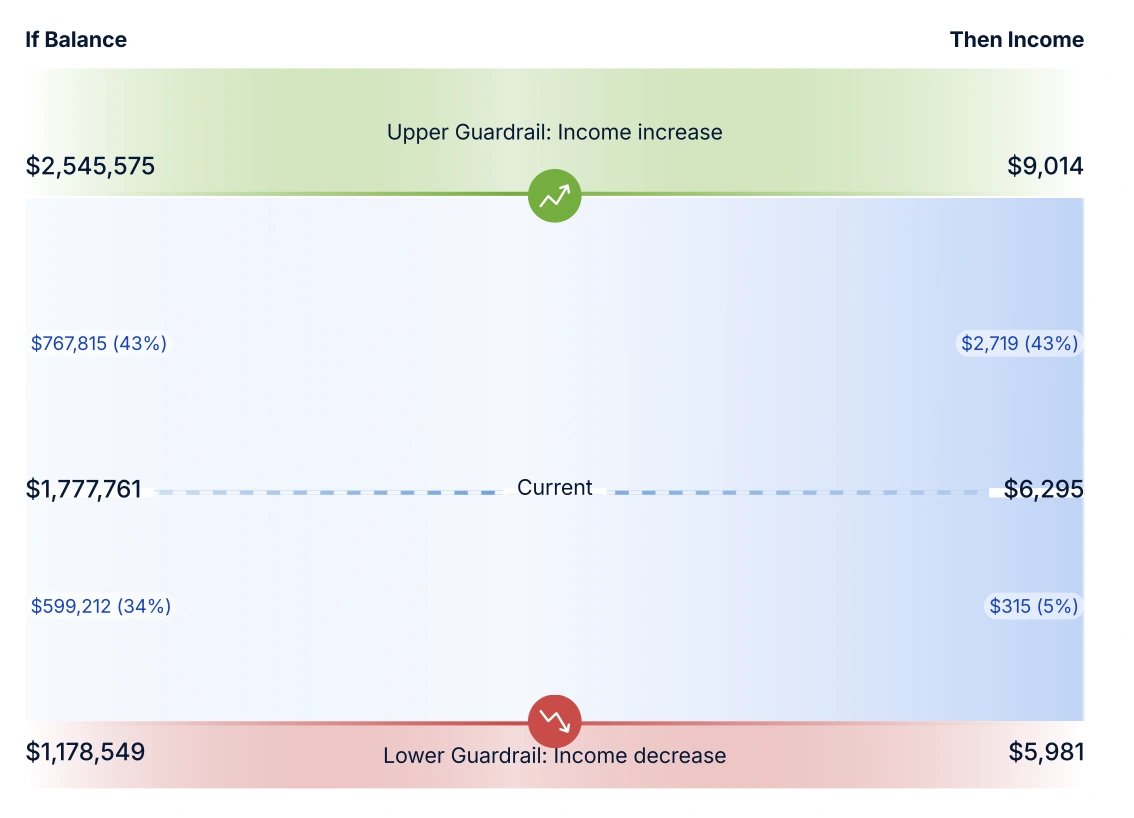
Dynamic guardrail strategies allow you to use a more flexible initial withdrawal rate while agreeing to modest spending adjustments if the portfolio drops below predefined thresholds. For mid-career professionals looking ahead, learning the best ways for allocating high-earner cash flow effectively helps build the asset base needed to leverage these dynamic withdrawal models later.
One of the most common pre-retirement questions is whether to pay off a mortgage early or keep the money invested.
In Charlotte, the answer also depends on whether you plan to age in place, downsize, move closer to family, or keep a second property. When weighing interest rates, liquidity needs, and peace of mind, deciding whether to pay off a mortgage or invest often comes down to personal comfort with debt alongside the raw mathematical spread.
Historically, a 4% initial withdrawal rate provides a dependable starting baseline for a balanced 30-year retirement. However, a safe withdrawal rate is dynamic. If your portfolio incorporates flexible spending guardrails, your safe initial rate may rise toward 4.5% to 5%. Conversely, if your retirement spans 35 to 40 years, targeting an initial rate between 3.25% and 3.75% provides extra safety against early-retirement market volatility.
Charlotte retirees should start with the same national retirement cash flow framework—income, expenses, taxes, healthcare, and withdrawals—but localize every assumption. Build in North Carolina income taxes, Mecklenburg County or surrounding-county property costs, healthcare access, transportation, charitable giving, and whether you expect to stay in Charlotte, downsize, or relocate later. A Charlotte financial planner can help coordinate those local assumptions with Social Security timing, Roth conversions, investment withdrawals, and estate planning.
Roth conversions improve long-term cash flow by generating tax-free income buckets that can be accessed at any time without triggering ordinary income taxes. By intentionally realizing taxable income during lower-earning bridge years, you permanently reduce future pre-tax account balances. This lowers your future RMD obligations at age 73, keeps you out of higher tax brackets, and helps protect against Medicare IRMAA surcharges.
Even modest inflation can significantly diminish your purchasing power over a 30-year retirement. At a historical long-term average inflation rate of 3%, the cost of living doubles in roughly 24 years. If your baseline retirement spending begins at $70,000 per year at age 65, you will need approximately $140,000 annually by age 89 just to maintain the exact same standard of living. This makes inflation-adjusted assets, equities, and Social Security COLA essential components of long-term planning.
Retirement cash flow planning turns abstract balances into an actionable, stress-reducing roadmap. By mapping out your essential and discretionary expenses, planning for the retirement spending smile, accounting for healthcare realities, and implementing tax-smart withdrawal sequencing, you can move into retirement with greater clarity.
Because life, markets, and tax laws constantly evolve, an effective cash flow plan is never static. As of September 2026, retirees and pre-retirees should revisit assumptions around taxes, healthcare costs, inflation, interest rates, Social Security timing, and local Charlotte living expenses at least annually.
If you are ready to build a customized, fee-only roadmap tailored to your personal goals, consider partnering with NoDa Wealth for comprehensive retirement planning. Based in Charlotte, NC, NoDa Wealth helps busy professionals and families turn hard-earned wealth into dependable, tax-efficient retirement cash flow for life.
Feeling overwhelmed? Let’s simplify things! Schedule your Free Assessment for an easy, 20-minute chat to help you tackle life’s transitions.
Enjoy a hassle-free conversation that puts your needs front and center!
)%20(3).avif)
