Everything You Need to Know About ESPP Planning Basics
Master ESPP planning with strategies for lookback provisions, tax rules, and portfolio allocation to maximize your equity compensation returns.



Master ESPP planning with strategies for lookback provisions, tax rules, and portfolio allocation to maximize your equity compensation returns.
An Employee Stock Purchase Plan (ESPP) is an employer-sponsored benefit that allows you to buy company stock at a discounted price using after-tax payroll deductions. Over an established window known as the offering period—which usually lasts anywhere from 6 to 24 months—your employer sets aside a percentage of your salary into an accumulated cash pool.
At the end of an interim period, called the purchase period (typically every 6 months), the company automatically purchases company stock on your behalf at a discount relative to fair market value (FMV).
Most broad-based employee stock plans are structured under Section 423 of the Internal Revenue Code. According to survey data from the National Association of Stock Plan Professionals (NASPP), approximately 79% of U.S. public company ESPP programs are qualified plans under Section 423. These plans provide specific tax advantages, require equal terms for all eligible employees, and allow companies to provide a statutory maximum discount of up to 15%.
Under IRS rules, qualified Section 423 plans restrict purchases to a statutory cap of $25,000 worth of stock per calendar year, based on the undiscounted fair market value of the shares at the start of the offering period. Non-qualified ESPPs, by contrast, lack these statutory tax protections but can provide more bespoke rules, customized contribution amounts, or selective eligibility.
| Plan Feature | Qualified Section 423 ESPP | Non-Qualified ESPP |
|---|---|---|
| Maximum Purchase Discount | Up to 15% statutory limit | Discretionary (no IRS statutory cap) |
| IRS Annual Limit | $25,000 FMV per calendar year | No statutory IRS annual cap |
| Employee Participation | Must include all eligible employees equally | Employer can select specific participants |
| Tax Advantages | Favorable long-term capital gains eligible | Spread taxed as ordinary income at purchase |
| Payroll Deductions | Accumulated post-tax contributions | Accumulated post-tax contributions |
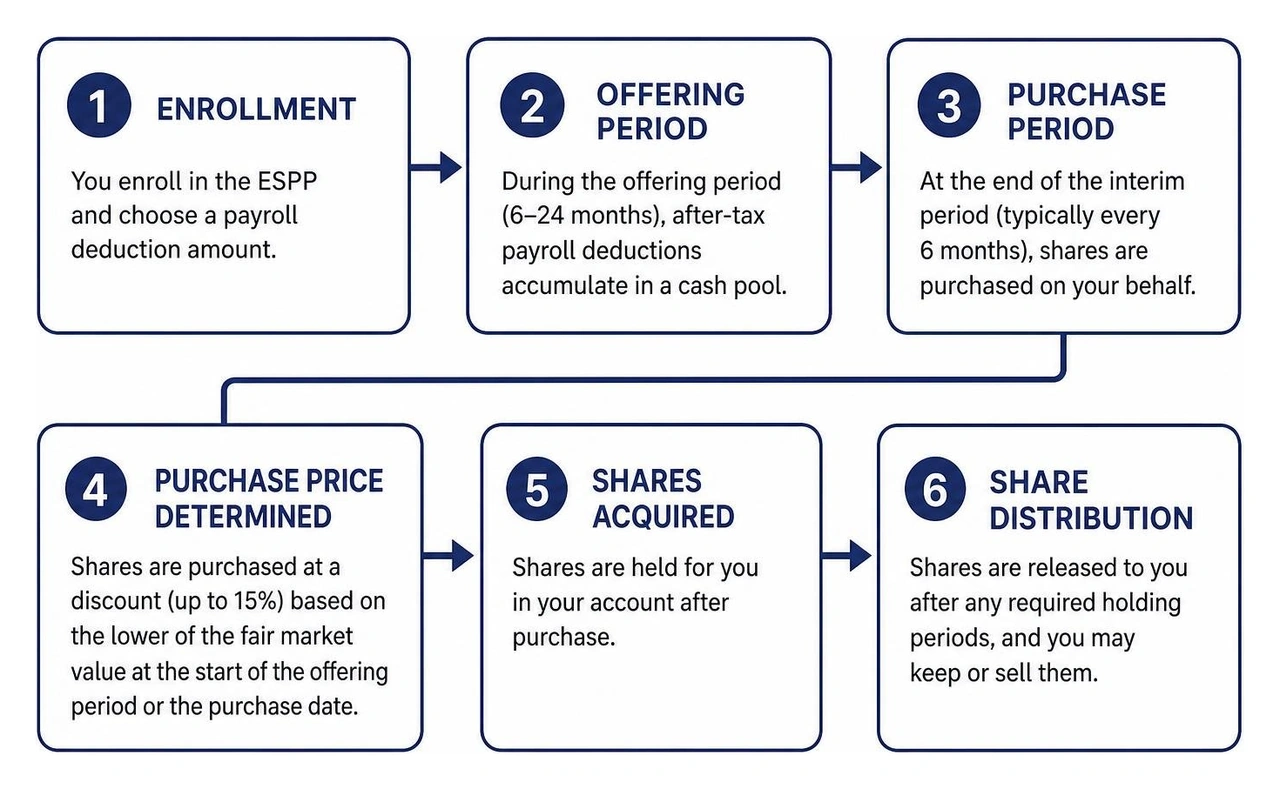
The lookback provision is one of the most profitable mechanics in an equity compensation package. When a plan includes a lookback feature, your employer calculates the purchase price discount based on either the fair market value at the beginning of the offering period (the offering date) or the price at the purchase date—whichever is lower.
This structure creates an asymmetric payoff. If the underlying company stock climbs during the offering period, your discount is applied to the lower starting price, locking in gains that exceed the stated discount percentage. If the stock falls over the period, the discount is calculated using the lower closing price, ensuring you still receive the full discount on market value at the purchase date.
With a standard 15% discount and an immediate sale upon purchase, the mathematical return is higher than 15%. Because you pay $85 for a share worth $100, your immediate gross return on investment equals:
If the stock is worth $100 and you buy it for $85, the $15 difference equals about a 17.65% gain on your $85 purchase price.
Even in a flat or declining market, a qualified plan featuring a lookback provision guarantees an effective return of roughly 17.65% before transaction fees and income taxes. You can test various scenarios and estimate your potential net proceeds using this ESPP profit estimation tool.
To build a coordinated wealth strategy, you must evaluate where your ESPP fits relative to other forms of equity compensation like Restricted Stock Units (RSUs) and Incentive Stock Options (ISOs).
For executives and professionals balancing multiple equity awards, maximizing equity compensation and retirement accounts ensures each award type serves a distinct role in your broader portfolio.
The tax consequences of an ESPP depend entirely on how long you hold the shares after purchasing them. The IRS divides all sales of Section 423 stock into two categories: qualifying dispositions and disqualifying dispositions.
When your company purchases shares on your behalf, you do not owe any income taxes on the purchase date for a qualified plan. Taxes are deferred until the tax year in which you sell or transfer those shares. When you sell, your brokerage issues Form 1099-B, while your employer supplies IRS Form 3922, which documents the original grant price, purchase price, and fair market values.
One common pitfall is double taxation. The brokerage's Form 1099-B often lists your cost basis as the discounted price you paid, rather than the fair market value at purchase. If your employer already reported the bargain element on your Form W-2 as ordinary income, failing to manually adjust your cost basis on IRS Form 8949 means you will pay taxes on that discount twice. Learning how to properly report transactions can help with preventing double taxation on equity compensation.
To achieve qualifying disposition status under Section 423 rules, you must hold your purchased shares until both of the following statutory thresholds are satisfied:
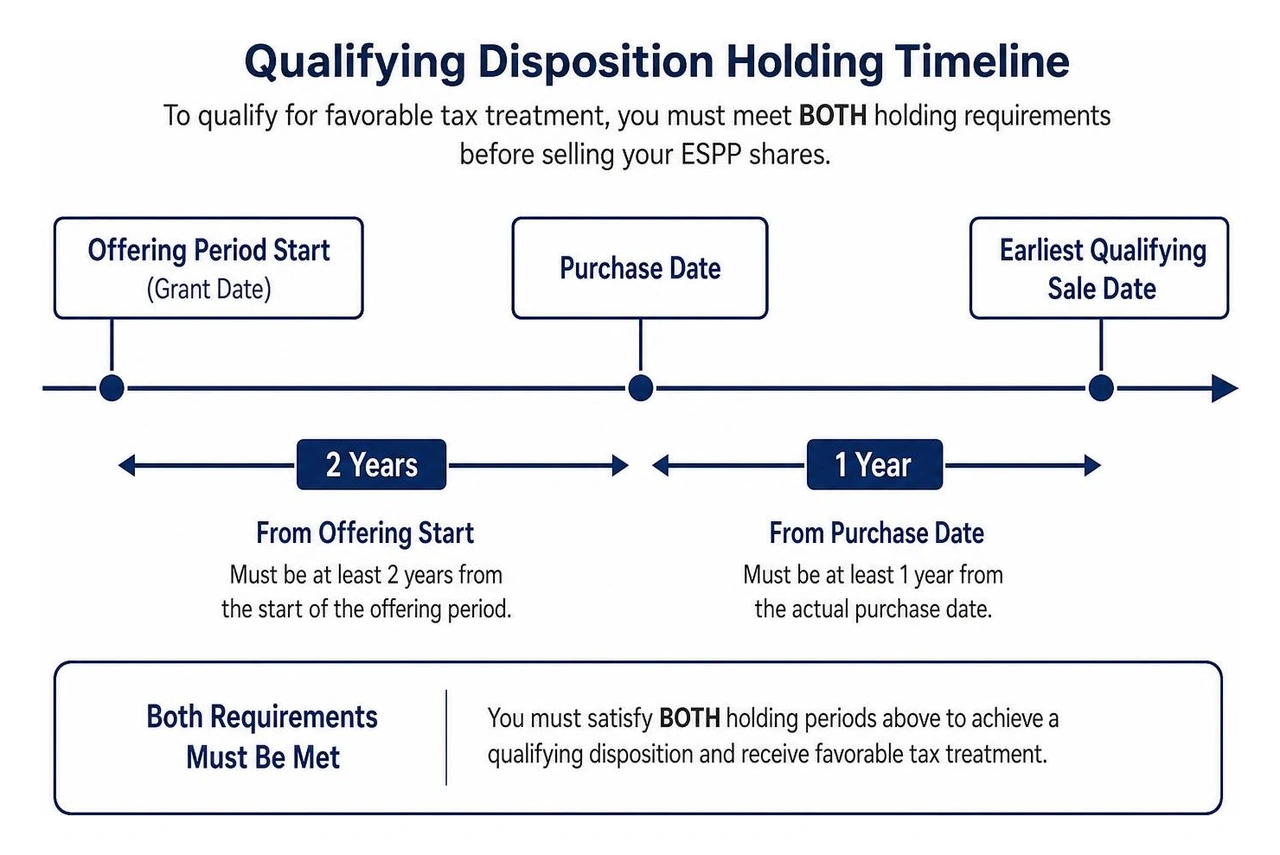
If you meet both holding requirements, the IRS splits your profit between ordinary income and long-term capital gains:
For high-income earners in top federal tax brackets, using advanced stock purchase tax strategies to secure capital gains rates on large stock gains can create substantial tax savings. For example, a taxpayer in the 37% federal tax bracket realizing a $50,000 equity gain can save roughly $11,000 in federal taxes by qualifying for a 15% long-term capital gains rate instead of paying ordinary income rates across the entire gain.
A disqualifying disposition occurs whenever you sell shares before satisfying both statutory holding periods—including an immediate sale on the purchase date.
In a disqualifying disposition:
While holding shares for qualifying tax status reduces your tax rate, it exposes your capital to single-stock volatility. A stock decline of 30% to 35% will completely erase the entire gain from a 15% discount. Selling immediately secures the guaranteed ~17.65% gross spread upfront, removing downside market risk.
A successful equity strategy balances participation discounts against portfolio risk. When your salary, health insurance, and investment holdings all depend on a single employer, a business downturn puts both your income and your investment portfolio at risk.

Financial planning best practices advise that single-stock holdings should not exceed 10% to 15% of your total investable net worth. When accumulated ESPP shares begin exceeding this threshold, systematic quarterly rebalancing protects your financial foundation. Proactively managing single-stock concentration risk allows you to lock in gains and redeploy capital into diversified index funds, real estate, or retirement assets.
Because ESPP contributions are deducted directly from your net take-home pay, funding your plan requires a clear cash-flow hierarchy:
Understanding how to balance these competing priorities starts with coordinating paycheck budgeting with equity benefits and setting up effective ESPP cash flow management throughout the calendar year.
Diverting 10% to 15% of your gross pay into payroll deductions can cause short-term cash flow pinches. Since accumulated contributions remain illiquid until the purchase date, you must manage your household budget around this cycle.
Many professionals implement an ESPP Cash Flow Loop:
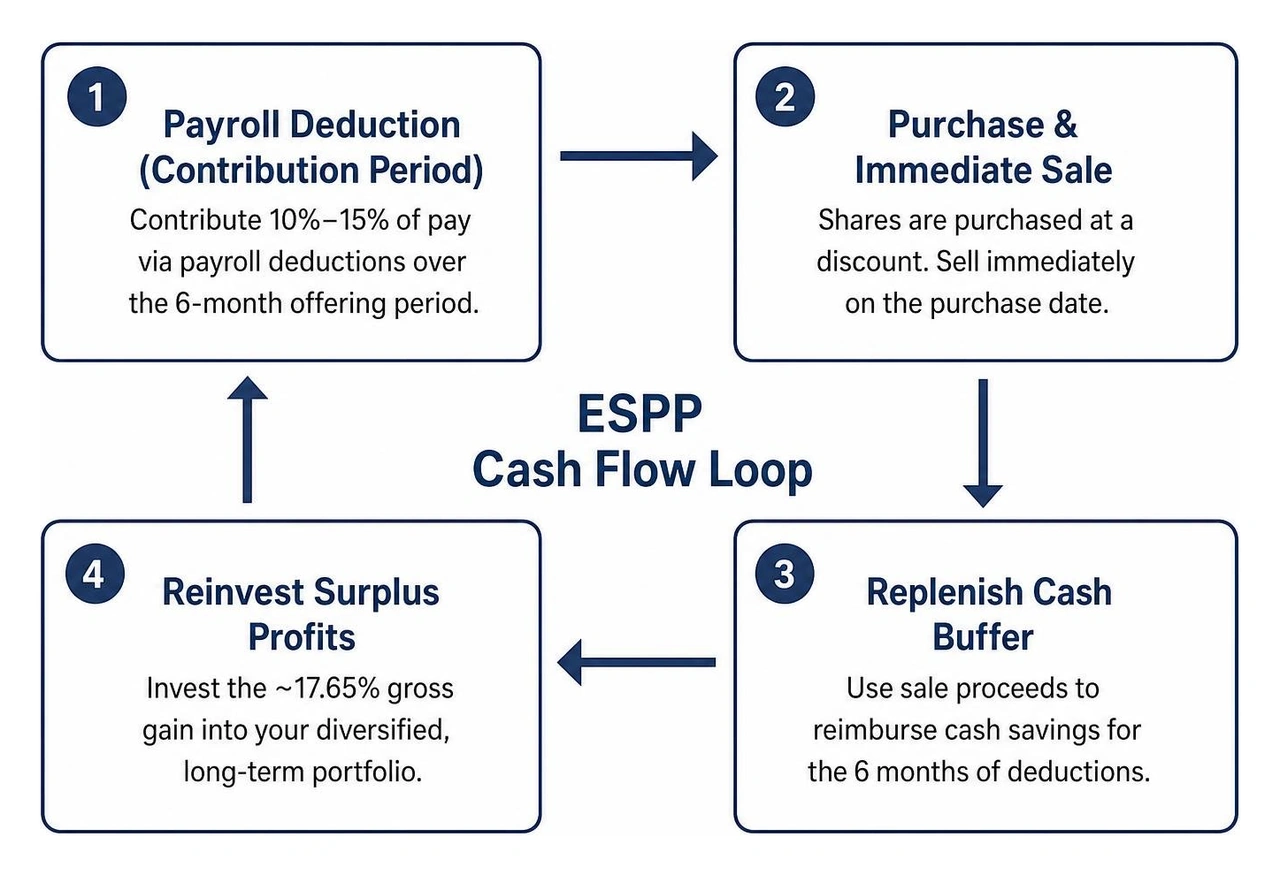
Adopting this self-funding cycle makes living off equity compensation and bonuses sustainable without causing monthly cash flow shortfalls.
When changing jobs, retiring, or navigating corporate layoffs, you must know what happens to your pending payroll deductions and existing shares.

If your cash flow supports it and you have established an emergency fund alongside your 401(k) match, consider contributing enough to maximize the $25,000 annual IRS statutory limit (or your plan's specific cap, usually between 10% and 15% of gross pay). If cash flow is tight, contribute only what you can afford without running credit card balances or compromising daily needs.
If you depart before the designated purchase date, your accumulated payroll contributions are returned to you as cash on your final paycheck. These funds will not be used to buy stock, and you will not receive a purchase discount for that incomplete cycle.
For most employees, selling shares immediately upon purchase is the most reliable strategy. While holding shares for two years from grant and one year from purchase offers qualifying disposition tax rates, holding company stock introduces market risk. An immediate sale locks in a minimum pre-tax gain of roughly 17.65% while keeping single-stock exposure in check.
A well-structured ESPP is one of the most effective tools for building wealth, offering access to company shares at a discount. However, turning these benefits into lasting progress requires a structured approach to cash flow, a clear plan for managing taxes, and guardrails against concentrated company stock risk.
At NoDa Wealth, a fee-only, fiduciary financial planner provides transparent, data-driven advice to help professionals make the most of their equity compensation packages. If you are ready to coordinate corporate benefits with a broader financial plan, schedule your free financial assessment to get started.
Educational Purposes Only. Content on this blog is for general educational and informational purposes only. It is not investment, tax, accounting, or legal advice, and it is not a recommendation or solicitation to buy or sell any security or to adopt any investment strategy. Past performance does not guarantee future results. Investing involves risk, including the possible loss of principal.
NoDa Wealth Management, LLC ("NoDa Wealth") is an investment adviser registered with the State of North Carolina. Advisory services are offered only where NoDa Wealth and its representatives are properly registered or exempt from registration. Readers should consult their own financial, tax, and legal advisors regarding their specific situation before making any decisions. For important disclosures, see the site footer and Form ADV.
Feeling overwhelmed? Let’s simplify things! Schedule your Free Assessment for an easy, 30-minute chat to help you tackle life’s transitions.
Enjoy a hassle-free conversation that puts your needs front and center!
)%20(3).avif)
