Make Your $200k Work Harder with These Wealth-Building Fundamentals
Master the 200k wealth building steps to automate savings, optimize taxes, and grow your net worth faster.


Master the 200k wealth building steps to automate savings, optimize taxes, and grow your net worth faster.
To build lasting wealth on a $200,000 income, the most effective 200k wealth building steps are: reverse budgeting 15% to 20% of gross pay ($30,000 to $40,000 annually), automating transfers into tax-advantaged retirement accounts, eliminating high-interest consumer debt, maintaining a dedicated 3-to-6-month liquid cash reserve, and channeling residual cash flow into low-cost index funds within a taxable brokerage account.
Earning $200,000 puts your household well above the national median, but high income does not instantly translate into a stress-free balance sheet. Many professionals find themselves trapped in the HENRY cycle—High Earner, Not Rich Yet. When you reach a six-figure salary, financial pressure doesn’t vanish; it simply changes shape.
The primary reason six-figure earners feel financially constrained comes down to lifestyle inflation combined with heavy fixed costs. When household income climbs, baseline spending tends to rise quietly alongside it. A slightly nicer home leads to higher property taxes, private school tuition or full-time child care enters the equation, and insurance premiums climb. Before long, structural commitments consume 70% to 80% of take-home pay, leaving surprisingly little room for discretionary savings.
Another common pitfall is falling victim to the "best case" mentality. It is tempting to plan annual spending around anticipated bonuses, commissions, or equity vestings. When you treat variable compensation as guaranteed cash flow, a softer bonus pool or a dip in share prices can leave your budget upside down. Learning how to live off equity compensation or bonuses without losing your sanity requires decoupling everyday living expenses from incentive pay. Base your mortgage, utilities, car payments, and daily lifestyle entirely on your base salary, treating any bonuses or equity grants as pure fuel for long-term investing and debt reduction.
Achieving long-term financial independence on a $200k income requires shifting from reactive spending to proactive wealth accumulation. The most reliable way to bridge the gap between high earnings and genuine wealth is to implement structured systems that remove daily willpower from the equation.
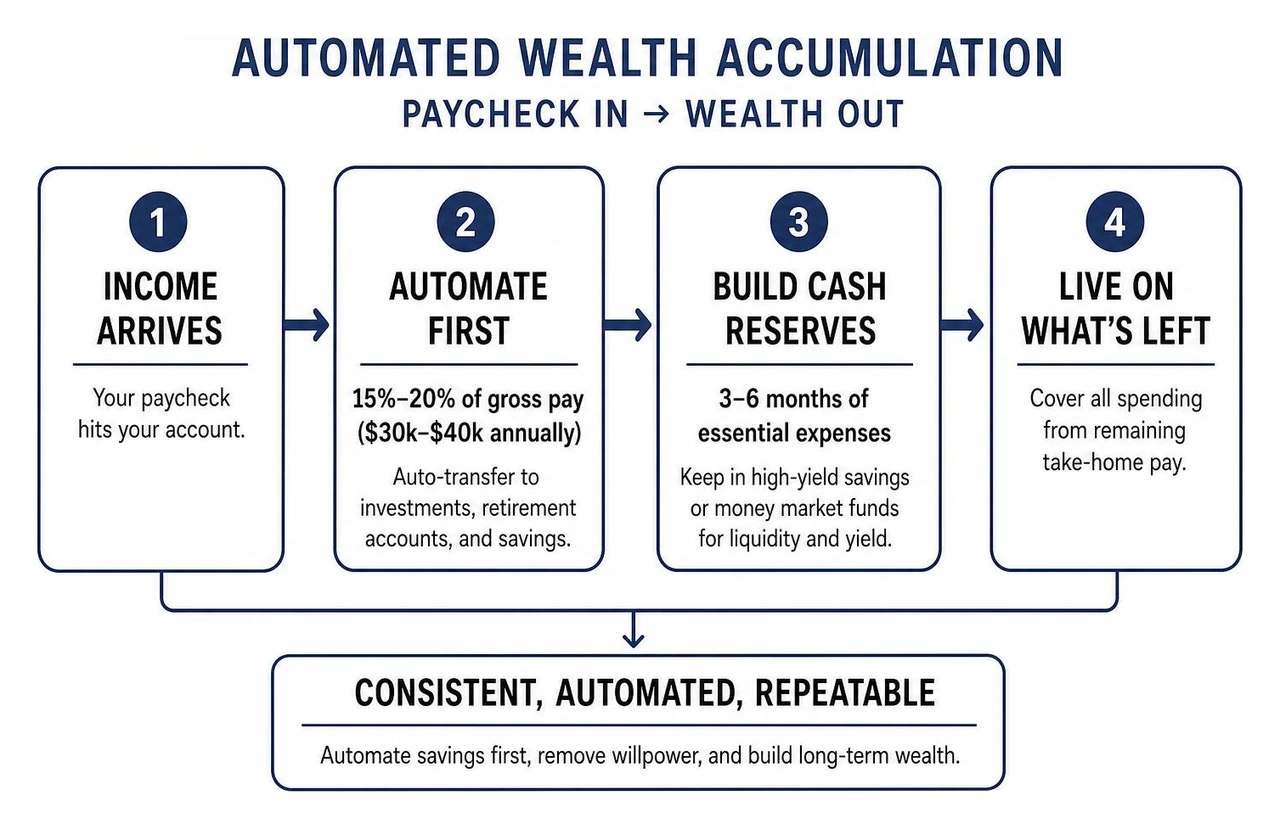
According to data from the National Study of Millionaires, 93% of millionaires stick to the budgets they create. Wealthy individuals do not bypass budgeting because they earn more; they accumulate wealth precisely because they maintain intentional guardrails. For high earners, the most effective framework is reverse budgeting: automating your investments and savings first as soon as your paycheck hits, and living freely on whatever remains.
While general financial advice often recommends saving 10% to 15% of gross income, high earners need a higher threshold. Setting aside 15% to 20% of your gross pay—equivalent to $30,000 to $40,000 annually on a $200k income—accounts for higher progressive taxation and ensures your retirement savings scale adequately to support your lifestyle. Consistently hitting these targets allows compound interest to accelerate your timeline to financial independence.
Part of this foundation involves right-sizing your liquid reserves. A high earner with higher monthly overhead needs a dedicated cash buffer of three to six months' worth of essential living expenses to guard against unexpected career transitions or sudden market downturns. Rather than letting those reserves languish in a traditional account, look into high yield savings vs money market funds to ensure your emergency cash earns a competitive yield while remaining fully liquid.
Building sustainable wealth demands clear cash-flow architecture. Start with zero-based budgeting, where every single dollar coming into your household is assigned a specific job—whether that is covering baseline mortgage costs, funding a taxable brokerage account, or fueling family travel.
As your cash-flow engine stabilizes, tax optimization becomes your greatest wealth multiplier. At a $200,000 income level, federal and state taxes take a substantial bite out of marginal earnings, making tax diversification essential across taxable, tax-deferred, and tax-free accounts.
Maximize employer-sponsored plans up to the annual limits set by the Internal Revenue Service (IRS), including your 401(k) or 403(b), and evaluate whether traditional pre-tax contributions or Roth contributions make the most sense for your tax bracket. Exploring the Roth 401(k) vs traditional 401(k) debate helps clarify how current tax deductions compare against tax-free growth in retirement.
If you receive corporate equity as part of your compensation package, handle vesting dates strategically. Knowing how to manage vesting periods and how to avoid being double taxed on RSUs ensures you do not overpay on your tax return when reporting capital gains and ordinary income. Direct surplus cash into low-cost, broadly diversified index funds (such as total stock market or S&P 500 ETFs) within a taxable brokerage account to establish liquidity for mid-term financial goals and create a bridge to early retirement.
Balancing debt reduction with long-term investing is a foundational dilemma for high earners. The key lies in comparing the guaranteed after-tax return of eliminating debt against the historical expected returns of diversified market investing.
| Financial Priority | Average Interest Rate / Expected Return | Strategic Action |
|---|---|---|
| High-Interest Consumer Debt | 15% – 25%+ (Credit Cards) | Eliminate immediately using debt snowball or avalanche |
| Moderate Debt | 6% – 9% (Personal / Student Loans) | Accelerate payoff alongside baseline retirement matches |
| Broad-Market Equities | 7% – 10% (Long-Term Historical Nominal) | Invest consistently across tax-advantaged and taxable accounts |
| Fixed Income / Cash Equivalents | 3.5% – 5% (Treasuries / High-Yield) | Maintain strictly for emergency funds and short-term goals |
High-interest consumer debt acts as a direct anchor on your balance sheet, and eliminating it delivers an immediate, risk-free return matching the card's interest rate. Once high-interest liabilities are clear, evaluate moderate-interest debts like mortgages. If you are weighing whether to direct extra monthly cash flow toward a home loan or equities, exploring the math behind paying down a 6% mortgage versus investing can help determine the right split between debt elimination and wealth building.
Consistent long-term investing across index funds and tax-efficient vehicles sets the stage for genuine financial freedom. When determining whether early retirement is achievable, having enough money is only half the answer; establishing lifestyle clarity, healthcare coverage, and withdrawal sustainability are equally vital.
A $200k household income often comes with elevated fixed expenses, including higher housing costs in competitive metro areas, child care, and progressive income taxes. When paired with unmonitored lifestyle creep and relying on variable bonuses to pay regular bills, monthly cash flow can feel uncomfortably tight despite strong earnings.
High earners should aim to save 15% to 20% of gross income annually ($30,000 to $40,000). This target can be reached by maxing out an employer 401(k), utilizing Backdoor Roth IRAs or Health Savings Accounts (HSAs) where eligible, and channeling remaining savings into a diversified taxable brokerage account.
Yes. Achieving financial independence depends primarily on your savings rate rather than top-line income alone. By maintaining modest fixed overhead and saving 30% to 50% of your earnings into low-cost index investments, a $200k earner can build a portfolio capable of supporting early retirement through sustainable safe withdrawal strategies.
A $200,000 income gives you a tremendous foundation to build lasting financial independence, but earnings alone will not carry you across the finish line. Transforming high cash flow into sustainable wealth requires disciplined cash-flow architecture, intentional lifestyle boundaries, strategic tax planning, and consistent market participation.
The goal is not to restrict every enjoyable purchase. It is to make sure your highest-priority dollars are assigned first, your fixed costs remain flexible, and your investment plan keeps working even when career demands, markets, or family needs change. With a repeatable system, high income can become durable net worth rather than simply supporting a more expensive lifestyle.
At NoDa Wealth, based in Charlotte, NC, we provide fee-only, fiduciary financial planning and wealth management for busy professionals. Our transparent, data-driven, no-commission process removes the guesswork from your investments, taxes, and retirement roadmap.
If you are ready to put a systematic wealth-building plan in place, discover how to invest your $200k paycheck like a pro and schedule a free financial assessment with our team today.
Feeling overwhelmed? Let’s simplify things! Schedule your Free Assessment for an easy, 20-minute chat to help you tackle life’s transitions.
Enjoy a hassle-free conversation that puts your needs front and center!
)%20(3).avif)
