Making Sense of ESPP Payroll Deductions and Purchase Dates
Learn how do ESPP plans work with payroll deductions, lookback provisions, and tax rules to maximize your equity compensation.


Learn how do ESPP plans work with payroll deductions, lookback provisions, and tax rules to maximize your equity compensation.
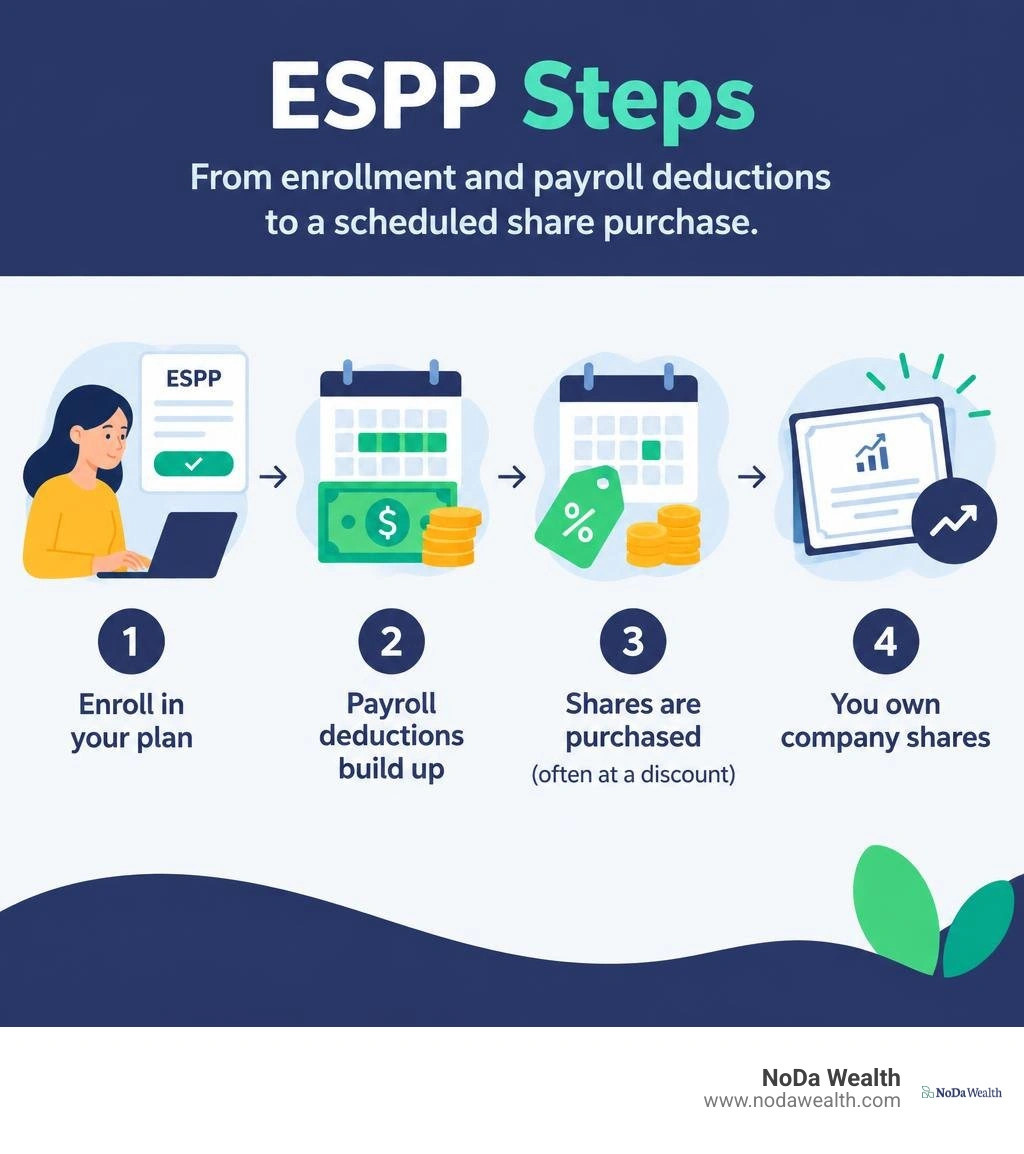
To use an employee stock purchase plan (ESPP), enroll during your plan's sign-up window and choose a payroll deduction you can afford. Those after-tax deductions build up until a set purchase date, when they buy company shares, often at a discount. Before enrolling, check the purchase date, how the share price is set, and when you can change or stop your deductions.
I'm Evan Luongo, and I'll help you make sense of those dates and deductions without adding another complicated task to your week.
ESPP planning usually comes down to two practical questions: managing payroll deductions without straining your budget and avoiding too much exposure to one employer’s stock. These guides on ESPP cash flow management and single stock risk management can help.
An Employee Stock Purchase Plan (ESPP) is a company-run benefit program that allows eligible employees to purchase shares of company stock using accumulated payroll deductions, typically at a discounted price. To make the most of this benefit, it helps to understand the core terms and operational schedule governing the plan.
Every plan operates on a recurring cycle with specific milestone dates:

During the offering period, your employer deducts a predetermined percentage or flat dollar amount from each paycheck after taxes. These contributions sit in an escrow-style, non-interest-bearing payroll reserve. On the scheduled purchase date, the total accumulated capital automatically purchases full (and sometimes fractional) shares based on the plan’s pricing formula.
While offering structures vary by employer, the standard framework consists of a six-month accumulation cycle. For example, a company might establish two distinct cycles each year:
Some organizations design 24-month offering periods divided into four separate six-month purchase periods. In this multi-period setup, your initial offering date price locks in for up to two full years, providing long-term pricing advantages.
The most lucrative feature in modern ESPPs is the lookback provision. A lookback allows the plan administrator to calculate the purchase discount using the stock's Fair Market Value on either the offering date or the purchase date—whichever is lower.
ESPP discounts typically range from 5% to 15%, with 15% being the most common discount rate. When paired with a lookback provision, your effective return on investment on purchase day can easily surpass the nominal 15% discount.

Consider how a 15% discount with a lookback functions across different market environments:
Plans with a 15% discount and a lookback feature generally see stronger employee interest because the pricing benefit is easier to understand and potentially more valuable.
ESPPs fall into two primary regulatory categories under US federal tax law: Qualified (Section 423) plans and Non-Qualified plans.
| Plan Feature | Qualified Section 423 ESPP | Non-Qualified ESPP |
|---|---|---|
| IRS Regulatory Code | Internal Revenue Code Section 423 | Non-statutory equity rules |
| Maximum Discount | Capped at 15% | No statutory cap (can exceed 15%) |
| Annual Purchase Limit | $25,000 worth of FMV per calendar year | Set at company discretion |
| Taxation at Purchase | No tax owed on purchase date | Discount taxed immediately as ordinary income |
| Holding Period Benefits | Favorable long-term capital gains available | Standard capital gains from purchase date |
| Employee Inclusion | Broad-based; must include most employees | Flexible; can target specific executive tiers |
The vast majority of corporate plans are qualified under IRC Section 423. To maintain tax-advantaged status, the IRS imposes specific operational boundaries:
Equity compensation takes several forms across corporate America. Understanding where your ESPP fits alongside other incentives helps ensure cohesive financial decision-making:
Understanding the structural differences between ESPPs and ESOP structures ensures that you treat your ESPP as an active cash-flow investment vehicle rather than a passive retirement account.
ESPP contributions are deducted strictly from after-tax pay. This means your gross earnings are fully assessed for federal income tax, state income tax, Social Security, and Medicare before ESPP funds are directed to the accumulation account.
Because most companies permit contribution rates between 1% and 15% of your base salary, maxing out an ESPP creates a noticeable drop in take-home pay. For high-earning households, structuring sustainable ESPP cash flow management strategies is essential to avoid tapping emergency savings or carrying high-interest debt between purchase cycles.

Many professionals master living off equity compensation and bonuses by adopting a cash-flow buffer strategy:
Life happens, and unexpected liquidity needs can emerge midway through a six-month purchase window. Most Section 423 plans offer built-in flexibility:
If you separate from your employer—whether through voluntary resignation, layoff, or retirement—prior to the scheduled purchase date:
The taxation of Section 423 ESPP shares is unique: no taxable event occurs when the shares are purchased. You owe taxes only when you sell (dispose of) the shares.
When you sell, the IRS classifies the transaction into one of two buckets based on your holding period:
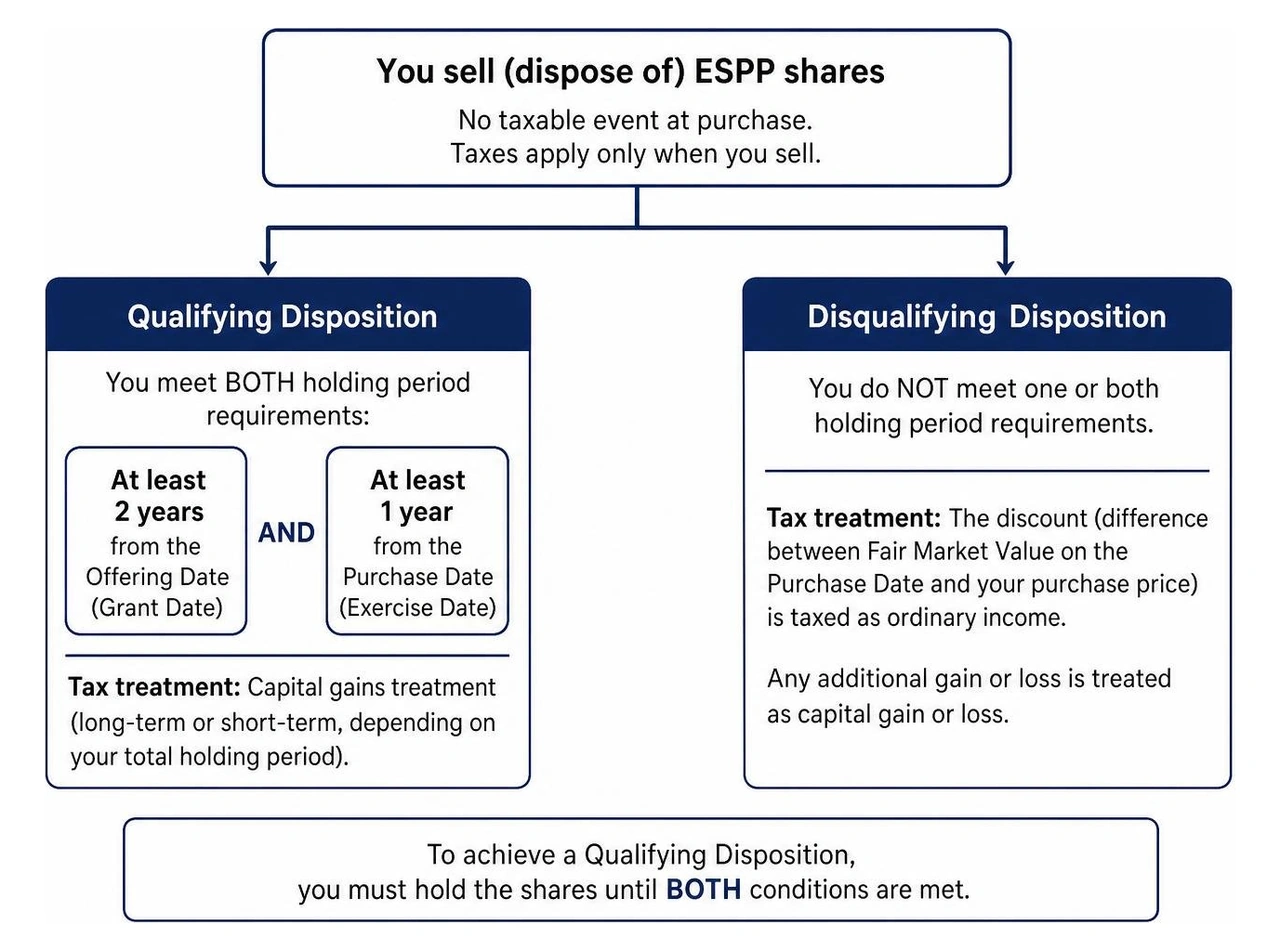
To achieve a Qualifying Disposition, you must hold the shares until:
If you sell the stock before meeting both conditions, the sale is classified as a Disqualifying Disposition.
Reviewing IRS Form 3922 (Transfer of Stock Acquired Through an Employee Stock Purchase Plan) is critical for tracking your offering dates, purchase dates, and cost basis numbers. Proper tracking helps prevent avoiding double taxation on equity sales, a common trap that occurs when brokerages report an unadjusted cost basis to the IRS on Form 1099-B.
For multinational employees moving across jurisdictions, reviewing cross-border and international share scheme rules ensures compliance with foreign revenue agencies alongside IRS guidelines.
A disqualifying disposition occurs whenever shares are sold immediately or before satisfying both statutory holding timelines.
In a disqualifying disposition:
Tax Breakdown:
Qualifying dispositions offer preferential tax treatment by capping the portion of your gain that is taxed at higher ordinary income rates.
In a qualifying disposition:
Tax Breakdown:
If you sell the shares at a loss in a qualifying disposition, you recognize zero ordinary income and report the entire loss as a long-term capital loss.
Deciding whether to hold ESPP shares for qualifying tax treatment or sell them immediately upon purchase requires balancing tax efficiency against concentration risk.
Many professionals hold excessive equity in their employer's stock in pursuit of lower capital gains taxes. However, relying on one company for both your primary paycheck and a major portion of your liquid portfolio exposes you to severe downside volatility.
Implementing deliberate single stock risk management protects your balance sheet. As a general rule of thumb, holding more than 5% to 10% of your total net worth in company stock introduces unnecessary concentration risk.
Selling your shares on the purchase date (or as soon as the trading window opens) locks in the 15% discount as an immediate cash return. While the entire discount is taxed as ordinary income on your W-2, you eliminate market risk entirely. The net proceeds can then be redirected into diversified index funds, real estate, or high-priority financial goals.
Holding shares for the full qualifying disposition window (at least two years from grant and one year from purchase) makes sense when:
Advantages:
Disadvantages:
ESPPs are common among large U.S. public companies. NASPP research on ESPP prevalence in the S&P 500 reports that roughly half of S&P 500 companies offer an ESPP, with information technology showing the highest adoption rate. Rutgers-affiliated research in Shared Capitalism at Work also connects broad-based equity and profit-sharing programs with stronger workplace and company outcomes.
Companies provide these programs because:
Most employer plan documents set payroll deduction caps between 10% and 15% of your base compensation. Regardless of company policy, total purchases in a Section 423 qualified plan cannot exceed the IRS statutory maximum of $25,000 worth of Fair Market Value per calendar year.
If your plan features a lookback provision and you sell immediately on the purchase date, you cannot lose money under normal market conditions. The lookback ensures your purchase price is calculated at a discount below the lower of the start or end price, creating an instant profit margin. You take on downside risk only if you choose to hold the shares after the purchase date.
ESPP contributions are always made on an after-tax basis. Your standard federal, state, and FICA payroll taxes are calculated on your full gross earnings before ESPP deductions are transferred into the plan reserve account.
An Employee Stock Purchase Plan is one of the most effective tools available for building wealth. When structured with a 15% discount and a lookback feature, an ESPP offers a virtually unmatched risk-adjusted return on short-term savings.
Maximizing your plan requires integrating payroll deductions into your broader cash-flow framework, managing single-stock exposure, and accurately tracking tax dispositions to avoid unnecessary tax liabilities.
NoDa Wealth's fee-only, fiduciary wealth management and financial planning helps busy professionals make smarter decisions. Based in Charlotte, NC, NoDa Wealth provides transparent, data-driven advice to coordinate equity compensation, investments, and proactive tax strategies.
Ready to take control of your company equity? Schedule a free assessment to optimize your equity compensation and build a personalized strategy for your financial future.
Educational Purposes Only. Content on this blog is for general educational and informational purposes only. It is not investment, tax, accounting, or legal advice, and it is not a recommendation or solicitation to buy or sell any security or to adopt any investment strategy. Past performance does not guarantee future results. Investing involves risk, including the possible loss of principal.
NoDa Wealth Management, LLC ("NoDa Wealth") is an investment adviser registered with the State of North Carolina. Advisory services are offered only where NoDa Wealth and its representatives are properly registered or exempt from registration. Readers should consult their own financial, tax, and legal advisors regarding their specific situation before making any decisions. For important disclosures, see the site footer and Form ADV.
Feeling overwhelmed? Let’s simplify things! Schedule your Free Assessment for an easy, 30-minute chat to help you tackle life’s transitions.
Enjoy a hassle-free conversation that puts your needs front and center!
)%20(3).avif)
