How to Choose a Physician Financial Advisor in Charlotte, NC
If you're looking for a physician financial advisor in Charlotte, NC, start with a fee-only fiduciary. Ask how they would help you manage student loans, plan for taxes, save for retirement, and prepare for a job change or practice sale. Get a clear explanation of their fees before you hire them.
Those decisions can overlap, especially when you have little time outside work and family. I'm Evan Luongo, and this guide will help you ask the right questions at each stage of your medical career.
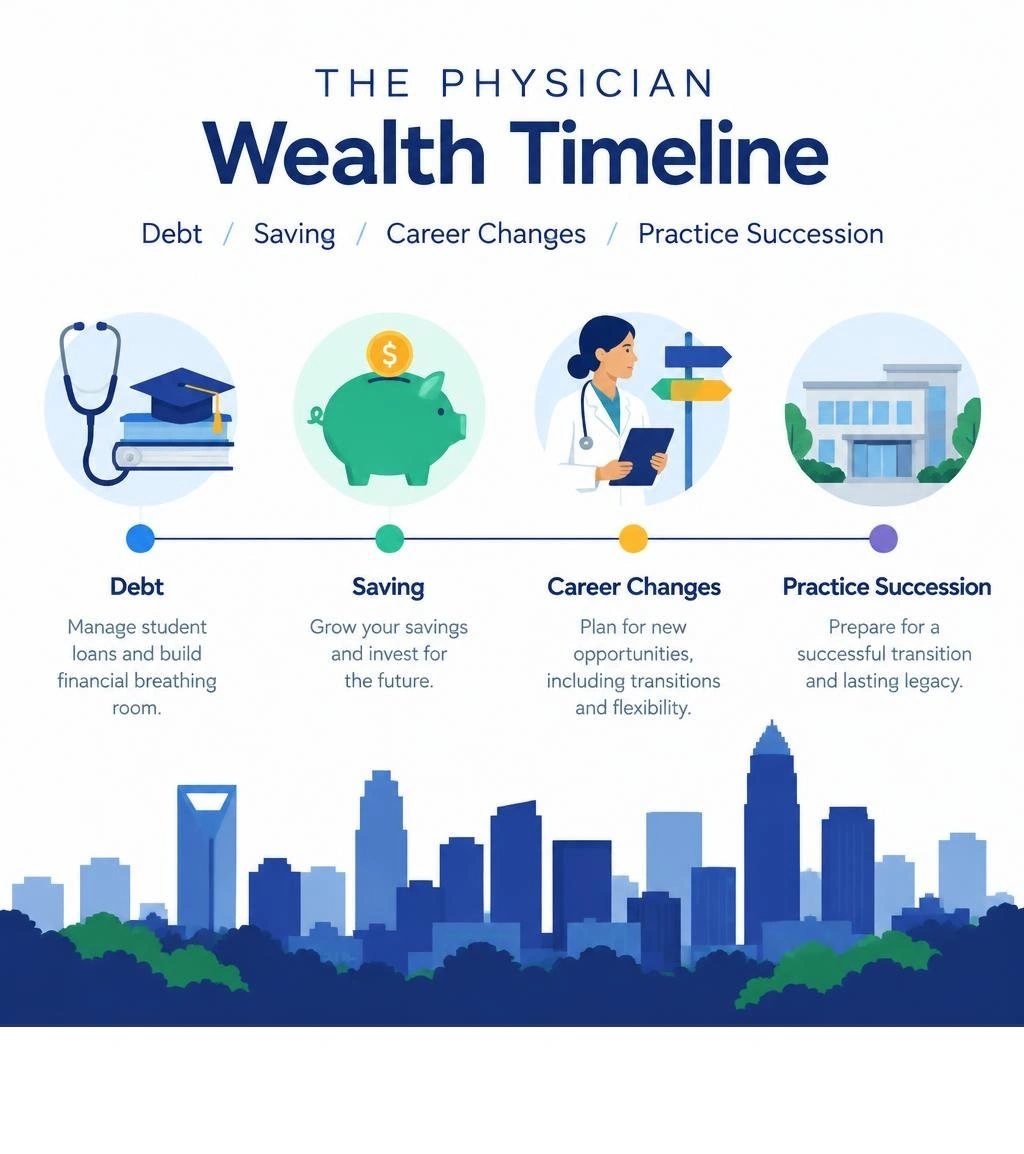
Basic physician financial advisor charlotte nc vocab:
Why You Need a Physician Financial Advisor in Charlotte, NC
Charlotte stands as one of the premier healthcare hubs in the Southeast. Anchored by major health networks like Atrium Health and Novant Health alongside a thriving community of independent specialty clinics, Charlotte is home to over 5,000 practicing physicians.

Practicing medicine in the Queen City offers strong earning potential. Physicians in Charlotte earn an average annual salary ranging from $250,000 to $350,000, with surgical and sub-specialists frequently exceeding $400,000. However, high clinical income does not automatically translate into simple wealth accumulation.
Medical professionals face a distinct financial lifecycle:
- Delayed Earning Curve: While peers enter the workforce in their early twenties, physicians spend nearly a decade in medical school, residency, and fellowships earning modest stipends.
- Compressed Accumulation Window: Doctors often begin aggressive saving and investing in their early-to-mid thirties, leaving fewer years for compound growth before retirement.
- Severe Time Scarcity: Demanding call schedules, administrative burdens, and patient care leave minimal time to analyze market volatility, tax law adjustments, or practice balance sheets.
- The Financial Literacy Gap: Many physicians report having received little formal financial education during their undergraduate or graduate medical training.
Many physicians feel pressure around both personal finances and practice decisions. That pressure helps explain why local doctors often seek more specialized guidance. Working with a financial advisor in Charlotte, NC who understands the medical career path can help turn strong clinical earnings into durable, multi-generational wealth.
Navigating Medical Student Debt and Cash Flow Optimization
Medical school debt presents a major early-career obstacle. According to the Association of American Medical Colleges, the median medical school debt for graduating students nationally exceeds $200,000, with many doctors practicing in Charlotte managing balances of $250,000 to over $400,000.
Navigating this debt requires an analytical approach tailored to your employer type and long-term career track:
- Public Service Loan Forgiveness (PSLF): For doctors employed by qualifying non-profit healthcare systems, PSLF can be a major wealth-building tool. The key is making 120 qualifying monthly payments while working full-time for an eligible employer and using a qualifying repayment plan. Federal IDR rules have changed: SAVE has ended, PAYE is being phased out, and RAP and IBR are now the main repayment options physicians typically evaluate for PSLF. Review current rules before enrolling or switching plans. The U.S. Department of Education's Federal Student Aid office provides detailed eligibility requirements.
- Private Refinancing Strategies: For physicians transitioning into private group practices or non-qualifying for-profit clinical environments, refinancing high-interest federal and private loans with private lenders can lower interest rates significantly. This path requires caution because refinancing federal loans with a private lender typically means giving up federal protections, including PSLF eligibility.
- Cash Flow Hierarchy: High earners often struggle with cash flow drag. A dedicated financial advisor for professionals helps construct an automated savings waterfall: funding emergency cash reserves, capturing full employer retirement plan matches, funding health savings accounts, maxing out tax-advantaged accounts, and directing surplus cash toward high-interest debt or taxable brokerage accounts.
Advanced Tax Planning and Retirement Strategies for High Earners
High-earning clinical professionals face some of the highest combined marginal tax rates in the country. Effective wealth building requires moving beyond basic tax filing into year-round, proactive tax location and deferral strategies.
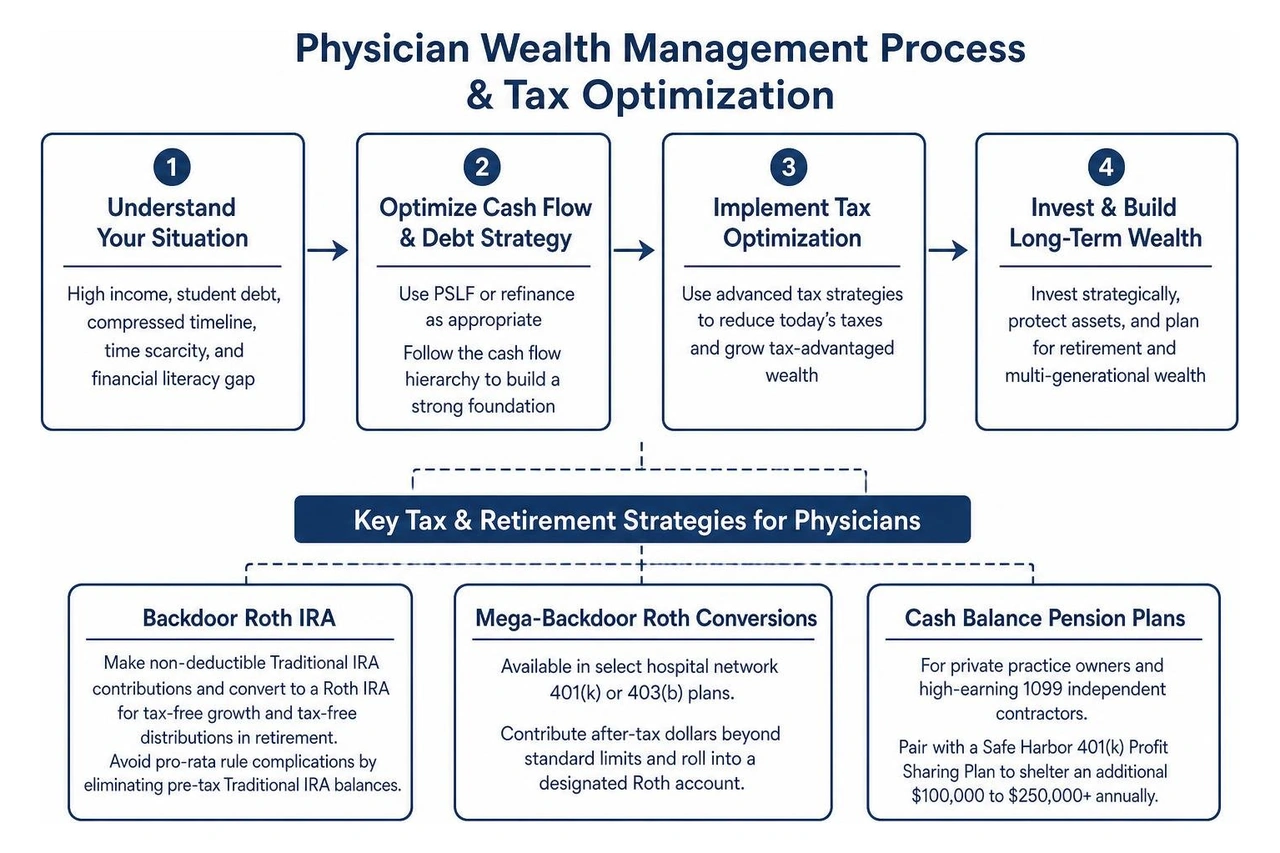
Key tax and retirement vehicles utilized for Charlotte medical professionals include:
- Backdoor Roth IRAs: Because high-earning physicians exceed the direct contribution income limits for Roth IRAs, the Backdoor Roth IRA strategy allows doctors to make non-deductible traditional IRA contributions and promptly convert them to a Roth IRA, generating tax-free growth and tax-free distributions in retirement (avoiding pro-rata rule complications by eliminating pre-tax traditional IRA balances).
- Mega-Backdoor Roth Conversions: Available in select hospital network 401(k) or 403(b) plans, this strategy allows after-tax contributions beyond standard annual limits, which are subsequently rolled into a designated Roth account.
- Cash Balance Pension Plans: For private practice owners and high-earning 1099 independent contractors, Cash Balance Plans serve as an exceptional tax-deferral vehicle. When paired with a standard Safe Harbor 401(k) Profit Sharing Plan, private practice owners can shelter an additional $100,000 to $250,000+ annually in pre-tax income, depending on age and partner census.
- Coordinating a retirement planner in Charlotte, NC: Integrating 401(k), 403(b), and governmental 457(b) plans alongside taxable investment portfolios ensures asset location efficiency—placing income-generating assets in tax-deferred vehicles while housing tax-efficient index funds in taxable accounts.
Practice Succession and Career Transitions for Medical Professionals
Whether you are stepping into a partnership track, launching an independent specialty group, or preparing to exit your practice after decades of clinical service, career transitions carry massive financial implications.

Planning an exit strategy requires early coordination across practice valuation, tax structuring, and continuity planning. The American Medical Association emphasizes the importance of structured transition models in their guide on what to consider when planning a practice exit strategy.
| Decision Metric | Independent Private Practice / Equity Track | Hospital System Employment |
|---|
| Compensation Upside | High; tied to practice profitability, ancillary services, and real estate equity | Predictable; fixed base salary plus wRVU productivity incentives |
| Autonomy & Governance | Complete operational, clinical, and scheduling control | Standardized clinical protocols, institutional overhead, and administrative oversight |
| Retirement Plan Design | Customized 401(k) Profit Sharing + defined benefit/Cash Balance Plans | Standard 403(b)/401(k) matches, optional non-qualified 457(b) plans |
| Exit / Equity Monetization | Substantial enterprise value realized via internal partner buyout or private equity | No equity value; transition involves contractual severance or retirement notice |
| Administrative Burden | High; billing, regulatory compliance, HR, and overhead management | Low; administrative functions handled by institutional departments |
How a Physician Financial Advisor in Charlotte, NC Evaluates Practice Buy-Ins and Sales
Entering or exiting a medical practice requires rigorous due diligence:
- EBITDA & Practice Valuation: Assessing whether a buy-in valuation is calculated fairly using historical cash flows, EBITDA multiples, or adjusted book value.
- Financing Buy-Ins: Structuring partner buy-ins using internal sweat equity, pre-tax compensation reductions, or specialized commercial healthcare lender financing.
- Practice Real Estate Opportunities: Evaluating investments in medical office building (MOB) real estate partnerships alongside the clinical practice to create passive rental cash flows.
- Exit Structuring: When selling to an internal successor or private equity group, properly structuring asset sales versus stock purchases drastically alters the capital gains and ordinary income tax liability of the selling physician.
Managing Contract Negotiations and Institutional Transitions
For hospital-employed physicians, reviewing compensation packages with an experienced wealth manager in Charlotte, NC ensures alignment with broader financial goals:
- wRVU Tier Optimization: Structuring productivity thresholds and bonus payment schedules.
- Restrictive Covenants: Reviewing non-compete clauses under North Carolina employment law to ensure geographic radius limits do not restrict future local career flexibility.
- Signing Bonuses and Retention Clawbacks: Managing the tax withholding and repayment liabilities associated with upfront recruitment incentives.
- Deferred Compensation (457(b)) Risk Analysis: Assessing the solvency risks associated with non-governmental hospital 457(b) plans, which remain subject to creditor claims against the healthcare system.
Asset Protection, Risk Management, and Estate Planning for Doctors
Physicians operate in a high-liability environment. Comprehensive wealth management requires safeguarding accumulated assets against litigation, personal disability, and unexpected life events.
Essential Risk Management Strategies for Physicians:
- True Own-Occupation Disability Insurance: A physician's most valuable asset is their future earning capacity. Standard group disability plans provided by hospitals often cap benefits and use restrictive definitions of disability. True own-occupation, specialty-specific coverage pays full benefits if an injury or illness prevents you from practicing in your specific medical sub-specialty, even if you work in another clinical, academic, or administrative role.
- Medical Malpractice Policy Audit: Understanding whether your clinical coverage includes "claims-made" or "occurrence" policies, and confirming that adequate "tail coverage" is funded during career transitions.
- Personal Umbrella Liability: Maintaining adequate personal excess liability coverage, often $3 million to $10 million, above underlying auto and homeowner policies to help protect against non-clinical personal liability risks.
- North Carolina Tenancy by the Entirety: Under North Carolina law, real property owned jointly by married couples as tenants by the entirety provides strong statutory protection against individual creditor claims directed at only one spouse.
- Trusts & Estate Structures: Structuring revocable living trusts, irrevocable life insurance trusts, and beneficiary designations to transfer wealth efficiently, reduce probate delays, and provide asset protection for heirs.
Selecting the Right Financial Partner for Your Medical Career
Choosing a wealth advisor is a long-term partnership that directly influences your financial freedom. The number of advisory firms marketing to medical professionals in Charlotte has grown steadily in recent years, making careful evaluation essential.
Advisory Fee Models in Charlotte, NC
Fee structures vary across the Charlotte financial landscape:
- Assets Under Management (AUM): Advisory fees typically range from 0.50% to 1.50% annually. Look for tiered schedules that reduce the percentage fee as your portfolio grows.
- Flat-Fee Retainers: Fixed annual or quarterly fees that decouple advisory costs from portfolio size, offering transparency for high-income physicians with complex planning needs.
- Fiduciary vs. Commission Standard: Always partner with a 100% fee-only fiduciary advisor who never accepts commissions, kickbacks, or product sales incentives. Review NoDa Wealth's fiduciary advisor Charlotte guide and examine transparent services and fees before signing any engagement agreement.
Credentials to Look for in a Physician Financial Advisor in Charlotte, NC
When interviewing advisory firms, prioritize:
- Certified Financial Planner (CFP®) designation, demonstrating rigorous education in investments, taxation, estate planning, and ethics.
- Direct Experience with Healthcare Professionals: Advisors who understand physician compensation arrangements, PSLF mechanics, and practice financials.
- Clean Regulatory Background: Transparent compliance records verifiable on the SEC Investment Adviser Public Disclosure database. Reviewing published client case studies can also clarify how an advisor addresses complex medical career scenarios.
Avoiding Common Financial Mistakes Made by High-Earning Physicians
Working with a local advisor helps physicians avoid predictable financial missteps:
- Lifestyle Inflation (The "Doctor Spender" Syndrome): Rapidly escalating living expenses upon finishing residency, delaying the start of structured investing.
- Underinsuring Human Capital: Relying solely on group disability policies that leave significant income gaps during prolonged illnesses.
- Speculative Investments: Committing capital to illiquid private placements, volatile crypto ventures, or friend-sponsored startups before establishing a solid, diversified liquid foundation.
- Delayed Practice Succession Planning: Postponing equity transfer and retirement planning until months before a desired exit, leading to discounted practice valuations and avoidable capital gains taxes.
Frequently Asked Questions about Physician Wealth Management in Charlotte
What fee structure should doctors expect from wealth advisors in Charlotte?
Doctors should expect clear, upfront pricing. Common structures include asset-based fees, flat annual retainers, or planning fees tied to the scope of advice. A fee-only fiduciary model helps reduce conflicts because the advisor is paid by the client, not through commissions for selling financial products. For more on NoDa Wealth’s approach, review NoDa Wealth's answers to frequently asked questions.
When should a physician begin planning practice succession or retirement?
Physicians should begin active practice succession and exit planning five to ten years prior to their target departure date. A multi-year runway allows private practice owners to optimize operational profitability, build transferable goodwill, recruit and mentor internal successor partners, and structure equity transfers tax-efficiently.
How does North Carolina law protect physician assets from liability?
North Carolina provides statutory creditor protections including tenancy by the entirety for primary residences and real estate owned jointly by married couples, statutory exemptions for ERISA-qualified retirement plans (401(k)s, defined benefit plans), and cash value protections for select life insurance policies. Working alongside a qualified estate planning attorney ensures these protections are integrated into a comprehensive asset protection framework.
Conclusion
A successful medical career in Charlotte demands years of rigorous clinical dedication. Preserving and growing the wealth generated by that dedication requires equal precision. By addressing student loans, tax optimization, practice buy-ins, risk management, and long-term retirement goals early, physicians can establish enduring financial security for themselves and their families.
Partnering with an experienced, fee-only fiduciary advisor gives doctors the clarity to focus on exceptional patient care while their financial foundation operates smoothly in the background. If you are ready to organize your medical career finances and develop a clear long-term strategy, schedule a free assessment today.
Educational Purposes Only. Content on this blog is for general educational and informational purposes only. It is not investment, tax, accounting, or legal advice, and it is not a recommendation or solicitation to buy or sell any security or to adopt any investment strategy. Past performance does not guarantee future results. Investing involves risk, including the possible loss of principal.
NoDa Wealth Management, LLC ("NoDa Wealth") is an investment adviser registered with the State of North Carolina. Advisory services are offered only where NoDa Wealth and its representatives are properly registered or exempt from registration. Readers should consult their own financial, tax, and legal advisors regarding their specific situation before making any decisions. For important disclosures, see the site footer and Form ADV.



)%20(3).avif)
