Employee Stock Purchase vs. Open Market: Is the Discount Worth It?
Compare employee stock purchase plan discounts vs. open market investing to see if the 15% savings and lookback provision are worth the risk.



Compare employee stock purchase plan discounts vs. open market investing to see if the 15% savings and lookback provision are worth the risk.
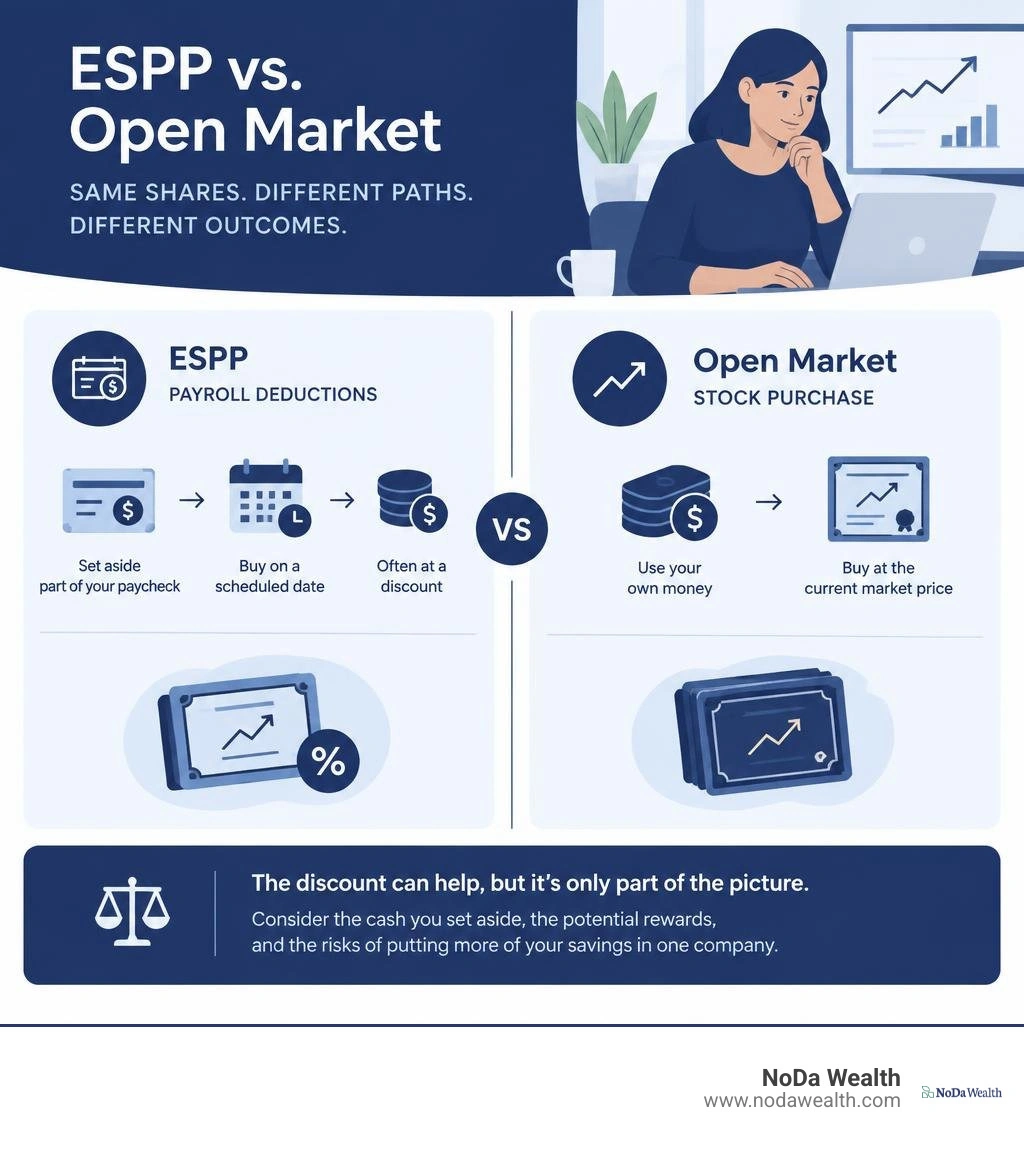
An employee stock purchase plan (ESPP) lets you set aside part of your paycheck to buy company shares on a scheduled date, often at a discount. In most cases, the discount is worth using if you can sell the shares immediately and manage the temporary cash-flow reduction: a 15% discount can produce an immediate return of roughly 17.65% before taxes. The trade-off is that holding the shares adds concentration risk, because your salary and your savings both depend on one company.
Unlike buying shares on the open market, you may pay less than the market price. But the discount is only part of the decision: your employer's stock can fall, and tying more of your savings to one company adds risk. I'm Evan Luongo, and I'll help you weigh that choice against your other financial goals.
Discover more about employee stock purchase:
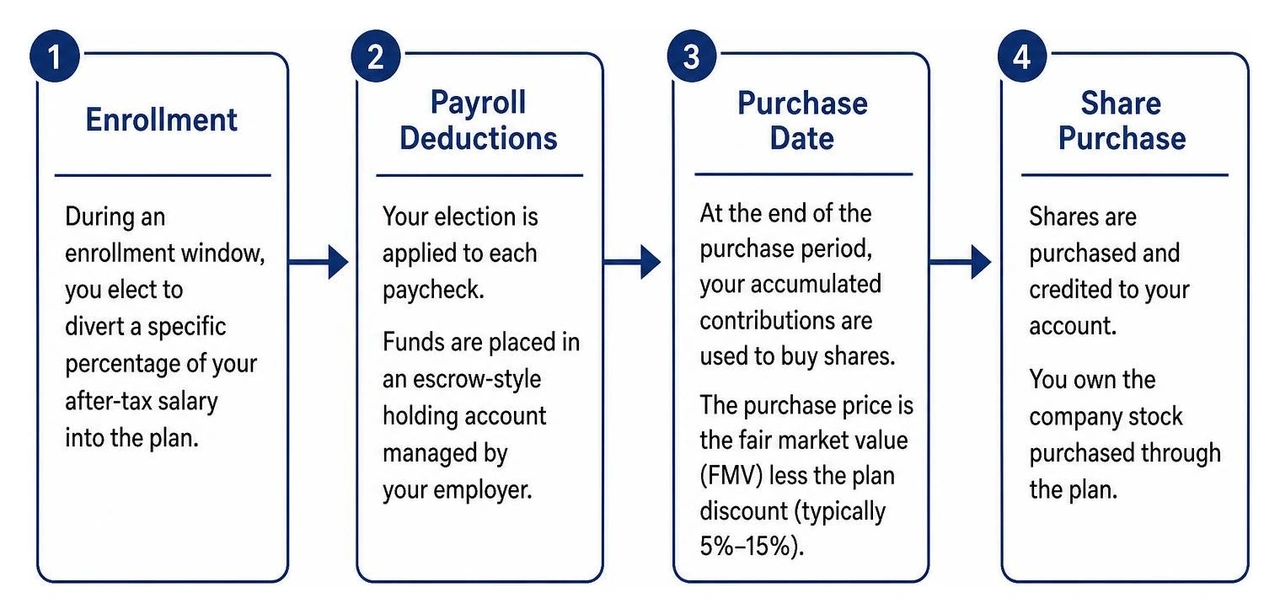
At its core, an employee stock purchase program functions as an automated accumulation vehicle. During a designated enrollment window, you elect to divert a specific percentage of your after-tax salary into an escrow-style holding account managed by your employer.
These plans operate across two distinct timeframes:
When the purchase date arrives, the plan calculates your purchase price based on the fair market value, or FMV, of the company stock, minus the discount your employer offers. ESPP discounts commonly range from 5% to 15%. In many qualified plans, 15% is the largest discount employees can receive.
Proper ESPP planning requires reviewing the specific provisions filed by corporate administrators, such as those registered via an SEC regulatory filing on employee equity plans, to understand how your company schedules offering periods, applies discounts, and processes share execution.
Under Internal Revenue Code Section 423, qualified plans must adhere to strict non-discrimination and participation rules. Generally, all full-time employees must be eligible to participate on an equal basis. Employers can exclude certain segments, including:
Federal statutory rules restrict qualified purchases to a maximum of $25,000 worth of company stock per calendar year. This cap is evaluated using the fair market value of the stock on the first day of the offering period (the offering date), rather than the discounted purchase price. If your plan establishes lower internal caps—such as limiting contributions to 10% or 15% of your base salary, or capping share totals per interval—those organizational parameters take precedence over the statutory maximum.
Most plans also offer flexibility during the cycle. If personal cash-flow demands change unexpectedly, participants can often decrease their contribution rate or process mid-cycle withdrawals, which halts ongoing payroll deductions and returns accumulated cash before the purchase date arrives.
One of the most potent mechanisms within qualified plans is the lookback provision. Rather than calculating your discount solely off the fair market value on the purchase date, a lookback provision directs the plan administrator to assess the stock price on both the offering date (the start of the period) and the purchase date (the end of the period). The plan then applies your discount to whichever price is lower.
Consider this mathematical reality:
With a standard lookback, your 15% discount applies to the lower price ($100), setting your effective purchase price at $85 per share. Because the equity is trading at $150 on the open market at the moment of execution, you immediately secure an asset worth $150 for just $85. That turns a nominal 15% discount into an effective instant gain of over 76%.
Even if the stock price drops during the period—falling from $100 to $70—the lookback bases your 15% discount on the lower $70 price. You buy at $59.50, securing your full 15% discount below current market value regardless of downward movement. Because of this dynamic, plans offering a 15% discount with a lookback tend to achieve substantially higher participation rates across corporate workforces.
Understanding how Uncle Sam treats your discounted shares is essential before deciding whether to sell immediately or hold for the long haul. How your gains are taxed depends directly on whether your company's plan is classified as a Section 423 qualified plan or a non-qualified plan.
In a non-qualified ESPP, the discount received is treated as compensation income immediately upon purchase. If you buy shares worth $100 for $85, the $15 spread is reported on your Form W-2 and subject to federal, state, and payroll taxes (FICA) right away, establishing your adjusted cost basis at $100. Any subsequent gain or loss when you sell those shares follows standard capital gains rules based on that $100 baseline.
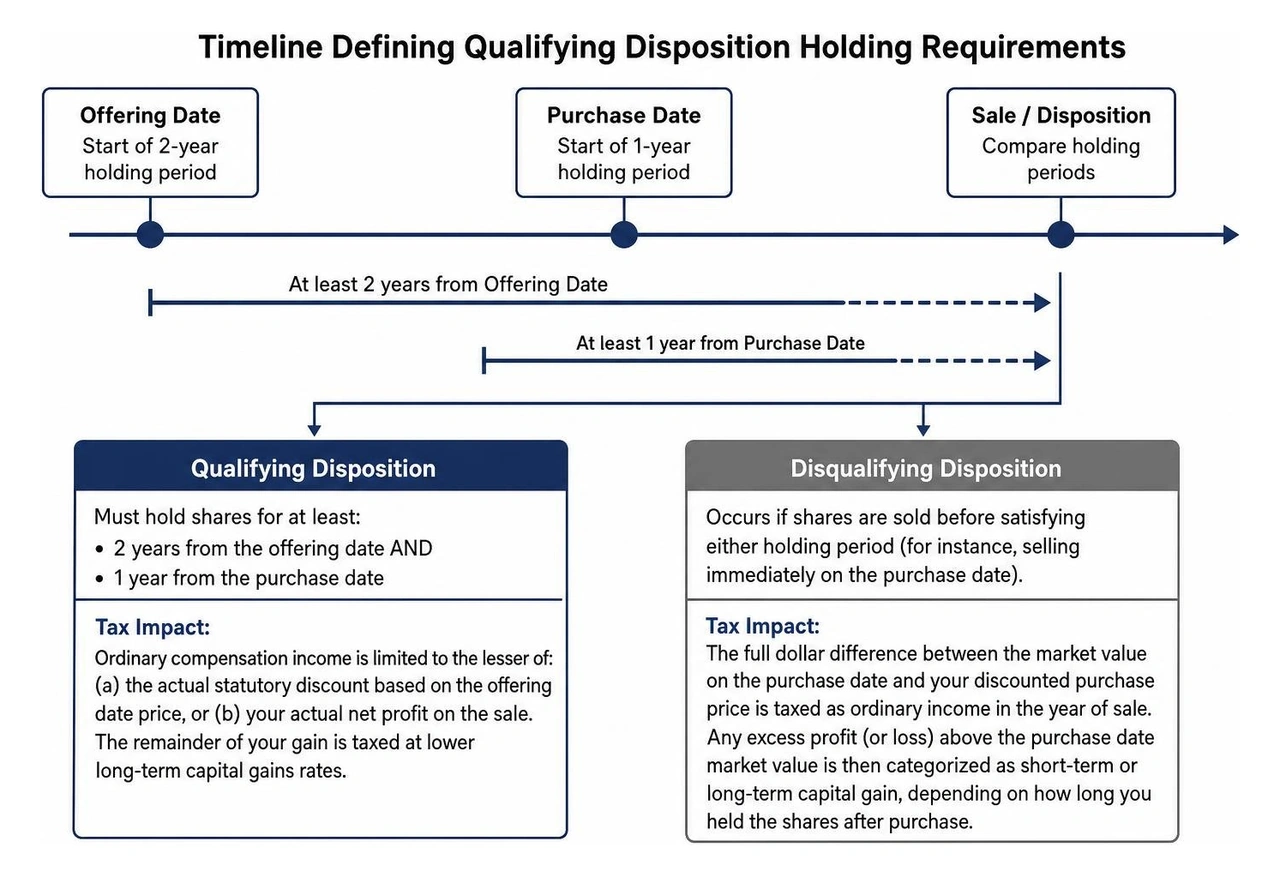
In a Section 423 qualified ESPP, no taxable event occurs on the purchase date. Tax liability is completely deferred until you sell or dispose of the stock. When you eventually sell, your total gain is split between ordinary income (reflecting the compensatory discount element) and capital gains (reflecting market appreciation). Your employer generates IRS Form 3922 following each purchase date, detailing the offering date value, purchase date fair market value, and actual price paid per share so you can establish your tax records accurately.
For qualified ESPPs, the classification of your eventual sale determines whether you receive favorable long-term tax rates:

When deciding whether to allocate capital toward an ESPP or direct those funds into open market index funds through a brokerage account, the trade-off centers on balancing immediate, guaranteed returns against concentration risk and liquidity limitations.
An ESPP with a 15% discount gives you an immediate, built-in return on capital that open-market investing cannot guarantee. Buying an asset trading at $100 for $85 provides an instant paper gain of roughly 17.65% ($15 gain / $85 cost basis). If you execute a quick-flip strategy—selling your shares immediately on the purchase date—you lock in that arbitrage spread with minimal exposure to long-term market volatility.
However, open market investing provides total freedom from company blackout periods, insider trading policies, and asset concentration. When buying broadly diversified ETFs on the open market, you eliminate the risk of having both your primary employment income and a significant portion of your investment portfolio tied to the fortunes of a single corporate balance sheet.

Diverting up to 15% of your gross compensation into an ESPP creates a noticeable drop in your regular take-home pay. Successfully capturing the plan's benefits requires proactive ESPP cash flow management so you do not end up running credit card balances or draining emergency savings while waiting for the purchase cycle to close.
For professionals navigating multiple equity vehicles alongside an ESPP, learning how to live off equity compensation or bonuses without losing your sanity is vital for balancing daily household expenses with long-term wealth building. We often help clients establish an automated "revolving cash-flow buffer" in high-yield savings to smooth out monthly living expenses during active accumulation windows.
From a broader investment perspective, accumulating company shares without a disciplined exit strategy can quickly create dangerous portfolio concentration. As a general rule of thumb, holding more than 10% to 15% of your total liquid net worth in your employer's stock exposes you to excessive uncompensated volatility.
Implementing a systematic framework for concentrated stock position diversification and applying strict rules for single stock risk management lets you capture the discount upside while systematically redirecting gains into a resilient, globally diversified investment portfolio.
If you separate from your company (whether through voluntary resignation, retirement, or termination) before an active purchase date occurs, your participation terminates immediately. Any payroll deductions accumulated in your holding account during that open cycle will be refunded to you in full as cash through normal payroll channels, without interest.
Any company shares you previously purchased during earlier completed cycles belong entirely to you. Those shares will remain in your designated custodial brokerage account, or you can transfer them to an external personal brokerage account without affecting your ownership rights.
Yes. Virtually all qualified Section 423 plans allow participants to cancel or pause their contributions mid-cycle prior to the designated purchase cutoff date (typically between 15 to 30 days before the purchase window closes).
When you formally request a withdrawal through your plan administrator's portal, the company stops future payroll deductions for that cycle and returns all contributions accumulated up to that point directly into your next paycheck. This gives you valuable liquidity protection if unexpected life events strain your household budget.
Companies design and sponsor ESPPs primarily as a strategic human capital and retention tool. Offering discounted equity fosters a culture of ownership across the workforce, directly aligning employee incentives with shareholder value creation.
Furthermore, broad-based equity programs have been shown to improve employee retention rates, boost engagement, and provide companies with an auxiliary source of internal capital funding as accumulated payroll deductions are converted into treasury shares.
An employee stock purchase plan remains one of the most powerful wealth-building tools available in modern corporate compensation packages. When backed by a 15% statutory discount and an offering-date lookback provision, an ESPP offers a built-in pricing advantage that open market investing simply cannot match on day one.
However, maximizing that advantage requires balancing immediate arbitrage gains against long-term tax drag, household cash-flow realities, and concentrated equity risk.
NoDa Wealth's fee-only, fiduciary process in Charlotte, NC help busy professionals integrate their corporate equity plans into an organized, data-driven financial plan. Through NoDa Wealth's transparent, no-commission 3-step process, NoDa Wealth helps you optimize payroll elections, minimize ordinary income taxes, and systematically diversify company stock into long-term wealth.
Ready to see how your employee stock purchase plan fits into your bigger financial picture? Book a free assessment today to build an intentional, tax-smart roadmap for your corporate benefits.
Educational Purposes Only. Content on this blog is for general educational and informational purposes only. It is not investment, tax, accounting, or legal advice, and it is not a recommendation or solicitation to buy or sell any security or to adopt any investment strategy. Past performance does not guarantee future results. Investing involves risk, including the possible loss of principal.
NoDa Wealth Management, LLC ("NoDa Wealth") is an investment adviser registered with the State of North Carolina. Advisory services are offered only where NoDa Wealth and its representatives are properly registered or exempt from registration. Readers should consult their own financial, tax, and legal advisors regarding their specific situation before making any decisions. For important disclosures, see the site footer and Form ADV.
Feeling overwhelmed? Let’s simplify things! Schedule your Free Assessment for an easy, 30-minute chat to help you tackle life’s transitions.
Enjoy a hassle-free conversation that puts your needs front and center!
)%20(3).avif)
