RSUs vs RSAs: Understanding the IRS Section 83(b) Difference
Can you file an 83(b) election for RSUs? No. Learn why RSUs don't qualify, how they're taxed, and alternative strategies for your equity.



Can you file an 83(b) election for RSUs? No. Learn why RSUs don't qualify, how they're taxed, and alternative strategies for your equity.
An 83b election for RSUs isn't available. An RSU is a promise to deliver shares later, not stock you own at grant. Check your award agreement: if it says restricted stock units, plan for income tax when the shares are delivered, usually at vesting. If it says restricted stock, ask a tax advisor whether an 83(b) election makes sense before the 30-day filing window closes.
The names sound alike, but the tax choices are different. I'm Evan Luongo, and I'll walk you through how to tell the awards apart and plan for the taxes each one can bring.
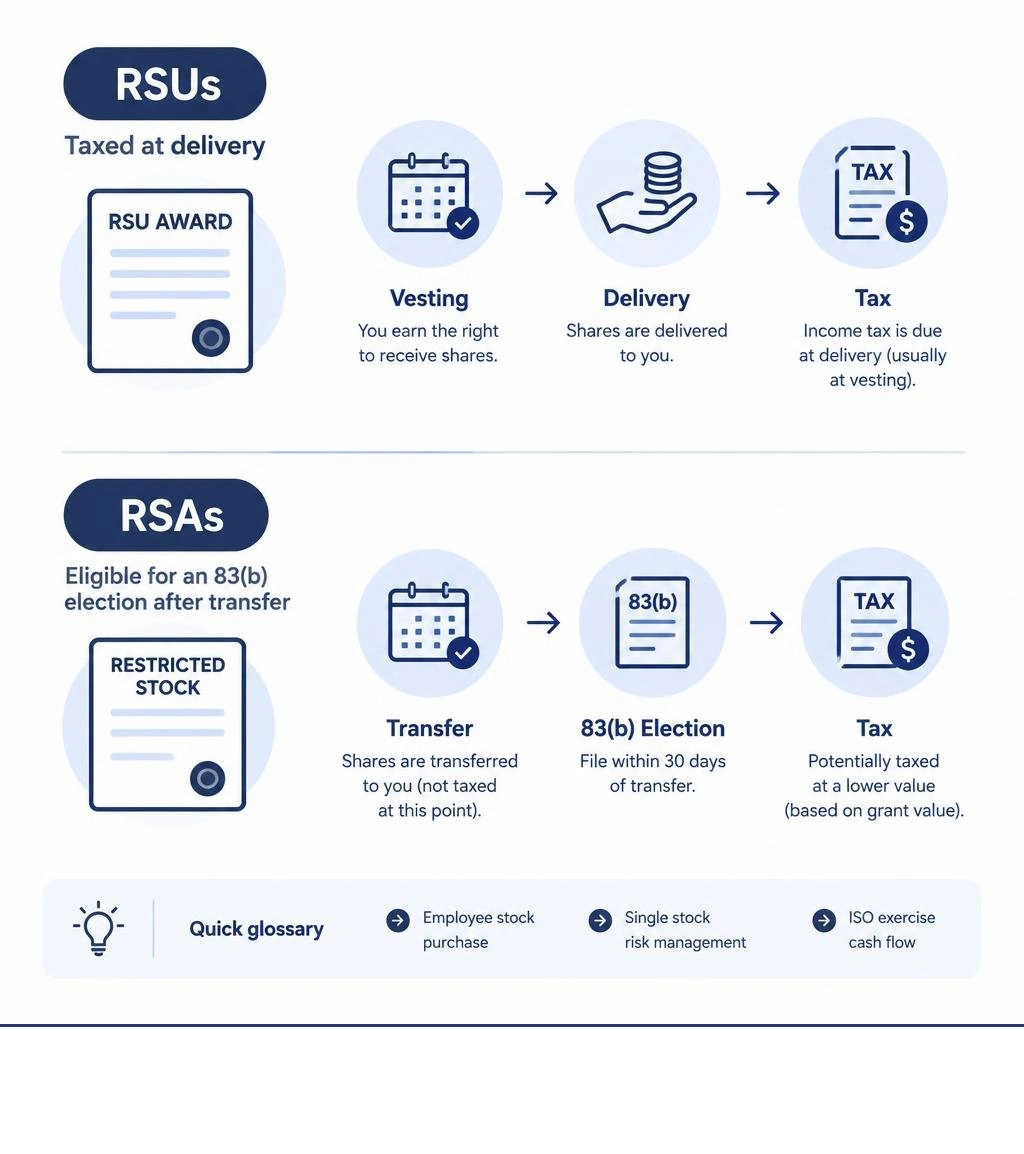
Simple 83b election for RSUs glossary:
Under standard Internal Revenue Code rules, when an employee receives equity compensation subject to a vesting schedule, the IRS considers each vesting date a taxable event. The fair market value of the shares vesting on that date gets treated as ordinary income and is reported directly on Form W-2.
A Section 83(b) election changes this standard timeline. It is an explicit tax election filed with the IRS that allows the recipient to include the fair market value of unvested property in their gross income for the tax year in which the property is granted, rather than waiting for it to vest.
By paying ordinary income tax on the grant date value, the taxpayer establishes their initial tax basis immediately. Any subsequent increase in value from the grant date onward gets taxed as capital gains when the shares are eventually sold, rather than as ordinary income at vesting. If the shares are held for more than one year following the transfer date, that appreciation qualifies for long-term capital gains rates (which top out at 20% federally, plus the 3.8% Net Investment Income Tax for high earners), compared to the top ordinary income tax rate of 37% in 2026. For a complete look at equity mechanics, reviewing the tax treatment of stock options provides helpful context on how tax basis operates across different vehicles.
Section 83(b) applies exclusively when there has been an actual transfer of property in connection with the performance of services, and that property remains subject to a substantial risk of forfeiture.
A substantial risk of forfeiture exists when the rights to full enjoyment of the property are conditioned upon the future performance of substantial services (such as remaining at the company for four years) or the achievement of specific performance milestones. When property is transferred subject to these conditions, Section 83(a) dictates taxation at the time the risk lapses (vesting). Section 83(b) allows the taxpayer to override Section 83(a) and accelerate that tax calculation to the initial transfer date.
Not all equity structures qualify for an 83(b) election. The three primary eligible categories include:
The inability to file a Section 83(b) election on Restricted Stock Units often creates confusion among corporate professionals. The limitation comes down to how the Internal Revenue Code classifies the underlying instrument.
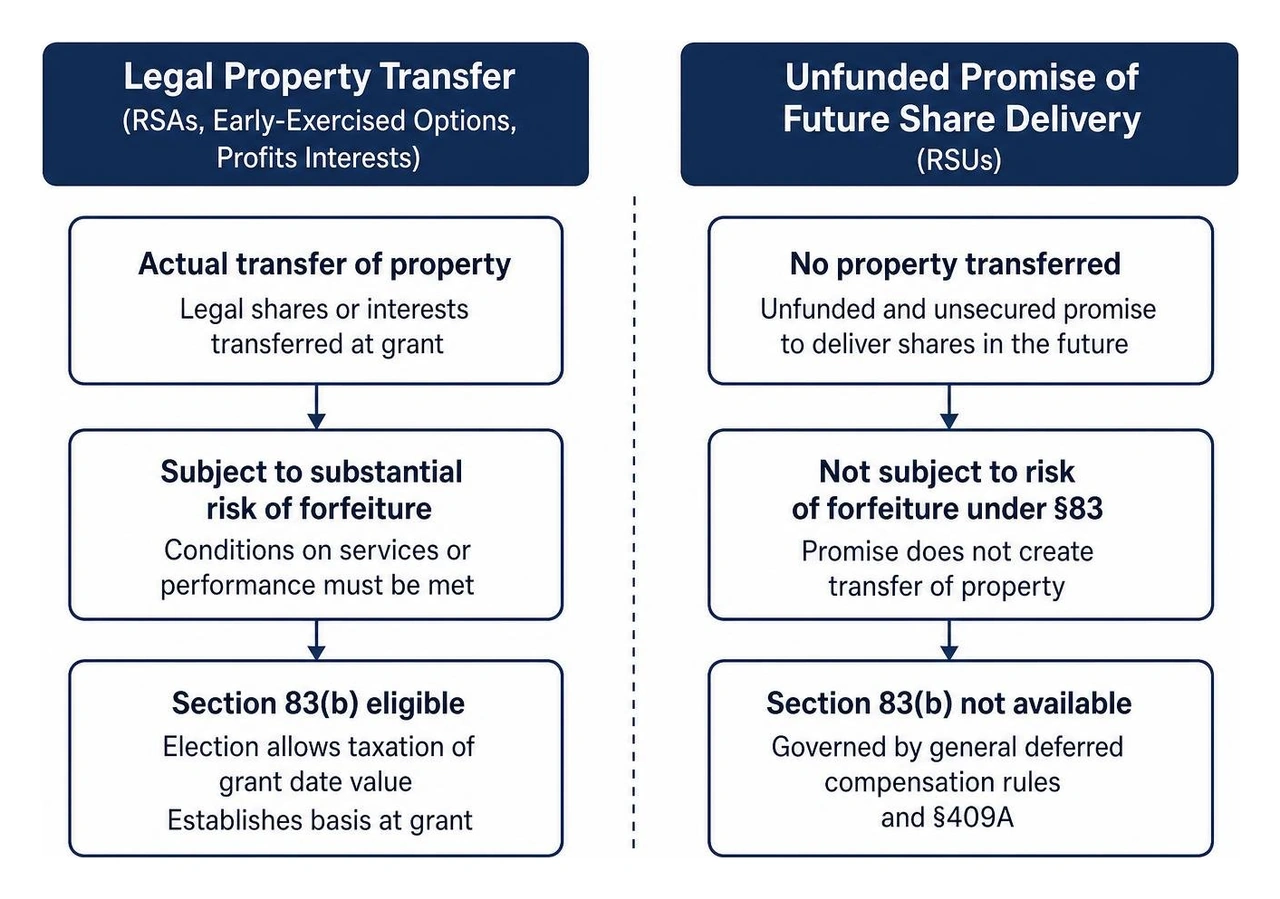
Section 83 applies strictly to the transfer of property. Under Treasury Regulation Section 1.83-3(e), an unfunded and unsecured promise to pay money or property in the future is explicitly excluded from the definition of property.
An RSU is not stock. It is a contractual commitment by an employer to deliver shares of stock (or cash equivalent) at a designated settlement date in the future, provided vesting conditions are met. Because no property transfers to the employee at the grant date, Section 83 does not govern the grant. Instead, RSUs fall under general deferred compensation principles and IRC Section 409A.
Because there is no property transfer at the grant of an RSU, there is no Section 83 transaction occurring, making an 83(b) election legally impossible.
| Feature | Restricted Stock Award (RSA) | Restricted Stock Unit (RSU) |
|---|---|---|
| Legal Status at Grant | Actual shares transferred immediately | Unfunded promise to deliver shares later |
| Governing Tax Code | IRC Section 83 | IRC Section 409A / Constructive Receipt |
| Shareholder Rights (Voting/Dividends) | Yes (immediate voting rights upon grant) | No (accrues only after settlement) |
| Section 83(b) Eligibility | Yes (within 30 days of transfer) | No (ineligible by statute) |
| Tax Event Timing | Grant date (if 83(b) elected) or Vesting date | Settlement/Vesting date |
| Income Classification at Vesting | None (if 83(b) filed) or Ordinary Income | Ordinary Income on total fair market value |
A widespread equity myth suggests that employees can simply complete IRS Form 15620 and mail it in for their RSUs to lock in low grant-date valuations. Filing an 83(b) for an RSU is legally invalid. The IRS will reject the election upon review or audit, leaving the taxpayer fully exposed to ordinary income taxes upon settlement.
Some corporate plans attempt alternative structures, such as exchanging RSUs for restricted shares to enable an upfront tax election, but standard RSU plans offered at public and late-stage private companies do not permit upfront taxation.
Because an 83(b) election cannot be used for RSUs, receiving RSUs results in ordinary income taxation on the exact date the units vest and settle.
The taxable income equals the total number of vested shares multiplied by the fair market value of the stock on the settlement date. This amount gets categorized as supplemental wages and is included in gross income on Form W-2, subject to federal income tax, state income tax, Social Security (up to the annual wage cap), and Medicare taxes.
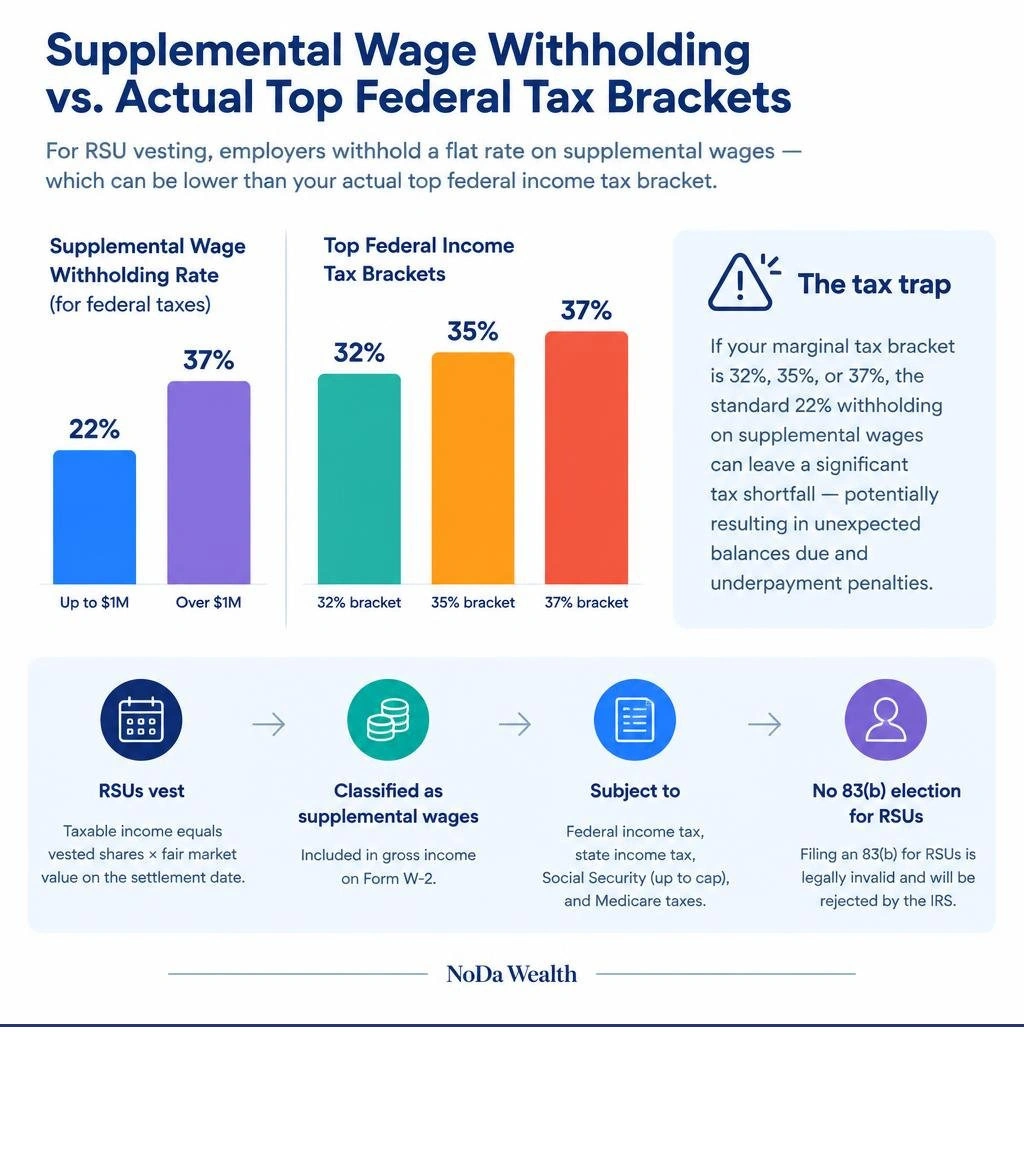
The standard administrative mechanism for handling taxes at RSU vesting is supplemental wage withholding. For federal tax purposes, most employers withhold a flat 22% on supplemental wages up to $1 million, and they must withhold 37% on amounts over $1 million.
This 22% rate creates a common tax trap for high-earning professionals whose marginal federal tax bracket is 32%, 35%, or 37%. When the company withholds only 22%, a significant tax shortfall accrues throughout the year, potentially resulting in large unexpected balances due and underpayment penalties when filing returns.
To manage this shortfall:
When RSUs settle, the resulting shares represent an immediate long position in a single company. Holding accumulated company stock can quickly expose a household portfolio to outsized volatility.
For individuals receiving equity eligible for Section 83(b)—such as RSAs or early-exercised options—the filing process requires strict adherence to administrative deadlines.

The statutory deadline for filing an 83(b) election is exactly 30 days from the date the property was transferred.
There are no extensions, exceptions, or reasonable-cause relief provisions under IRS regulations. Missing the 30-day window by even a single day permanently invalidates the election, reverting the grant to standard Section 83(a) taxation at vesting.
To complete the filing:
Filing an 83(b) election is an irrevocable decision that carries real economic downside risks:
When an employee departs before satisfying the vesting schedule, any unvested restricted stock is forfeited according to the terms of the equity incentive agreement.
From a tax perspective, the ordinary income tax previously paid on those forfeited shares is completely lost. Under IRC Section 83(b)(1), no tax deduction or capital loss is permitted for the amount previously included in gross income as compensation. The employee can only recognize a capital loss to the extent of any actual cash out-of-pocket purchase price paid for the shares that was not recovered upon forfeiture.
Yes. The IRS supports electronic submission of Form 15620 through its dedicated online forms portal for taxpayers with an authenticated IRS online account. When using digital submission, taxpayers receive immediate digital confirmation of receipt, eliminating the transit delays associated with physical mail.
If filing by mail, sending the document via USPS Certified Mail with Return Receipt Requested remains essential to establish legal proof of timely postmarking within the strict 30-day window.
When RSUs vest, the employer's stock plan administrator typically executes one of three withholding methods:
Restricted stock units and restricted stock awards serve distinct compensation purposes with completely different tax trajectories. While RSAs allow early-stage employees and founders to optimize future tax liability through a timely Section 83(b) election, RSUs are deferred compensation instruments that cannot be accelerated upfront.
Managing RSU vesting schedules requires ongoing attention to tax bracket management, quarterly estimated payments, and systematic concentration de-risking. Aligning equity vests with your broader household balance sheet ensures that stock compensation builds lasting, diversified wealth without unexpected tax surprises.
For corporate executives and professionals looking to optimize their equity grants, tax withholdings, and broader financial plans, NoDa Wealth provides transparent, fee-only, fiduciary wealth management. To review your equity compensation structure, consider scheduling a free financial assessment.
Educational Purposes Only. Content on this blog is for general educational and informational purposes only. It is not investment, tax, accounting, or legal advice, and it is not a recommendation or solicitation to buy or sell any security or to adopt any investment strategy. Past performance does not guarantee future results. Investing involves risk, including the possible loss of principal.
NoDa Wealth Management, LLC ("NoDa Wealth") is an investment adviser registered with the State of North Carolina. Advisory services are offered only where NoDa Wealth and its representatives are properly registered or exempt from registration. Readers should consult their own financial, tax, and legal advisors regarding their specific situation before making any decisions. For important disclosures, see the site footer and Form ADV.
Feeling overwhelmed? Let’s simplify things! Schedule your Free Assessment for an easy, 30-minute chat to help you tackle life’s transitions.
Enjoy a hassle-free conversation that puts your needs front and center!
)%20(3).avif)
