Employee Stock Purchase Plan Taxes: Qualifying for Long-Term Capital Gains
Learn how to achieve employee stock purchase plan long term capital gains tax treatment by meeting Section 423 holding period requirements.


Learn how to achieve employee stock purchase plan long term capital gains tax treatment by meeting Section 423 holding period requirements.
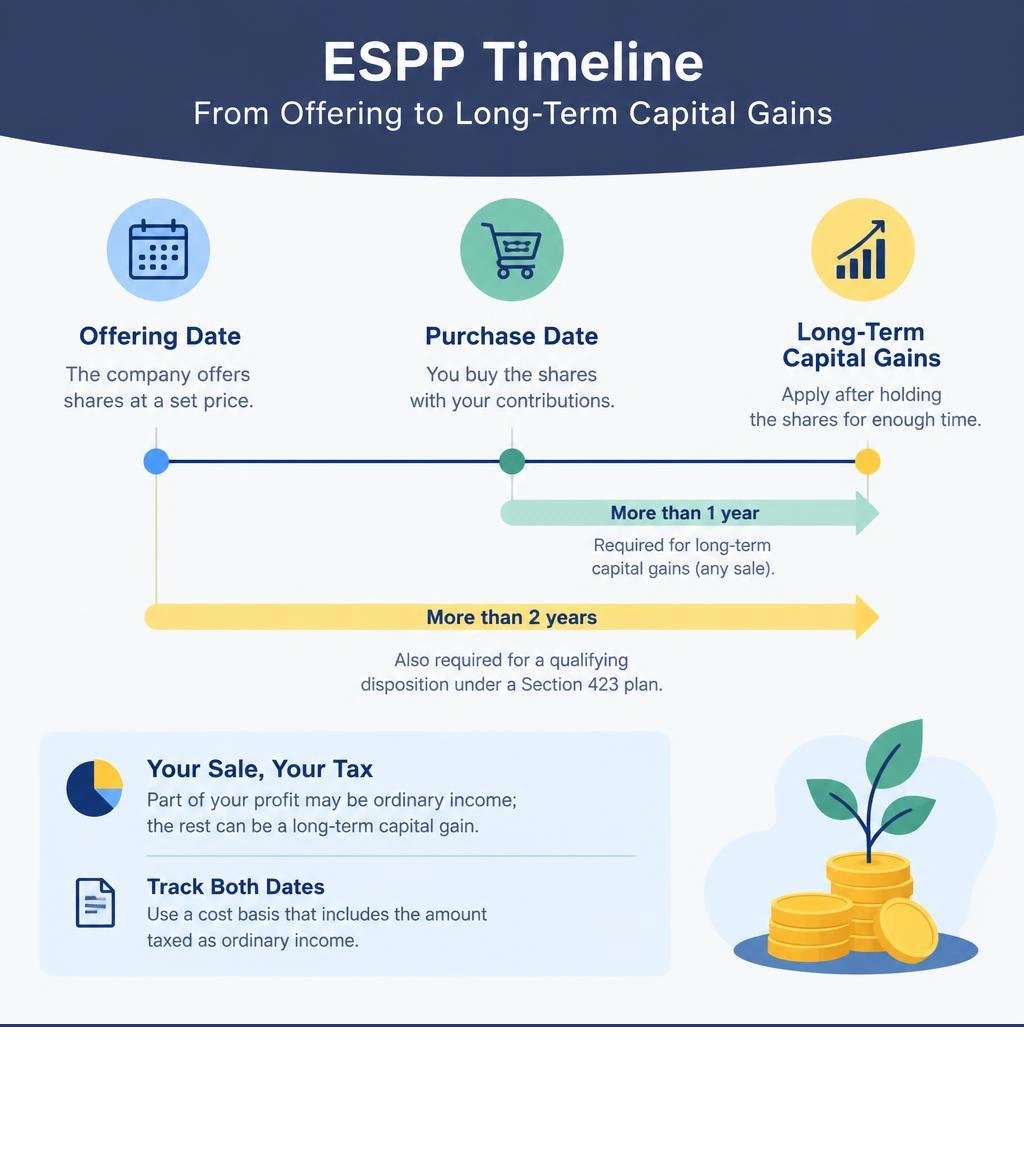
You can have long-term capital gains from an employee stock purchase plan once you hold the shares for more than one year after purchase. For a qualifying disposition under a Section 423 plan, you must also sell more than two years after the offering date. Part of your profit may still count as ordinary income; the rest is a long-term capital gain. Even if you miss the two-year rule, a sale after more than one year can still produce a long-term capital gain.
The key is to track both dates and use a cost basis that includes the amount taxed as ordinary income. I'm Evan Luongo, and I'll show you how those rules affect your sale and tax return.
Discover more about employee stock purchase plan long term capital gains:
An Employee Stock Purchase Plan (ESPP) lets corporate employees buy company stock at a discount, often up to 15% below fair market value, using accumulated payroll deductions. The tax treatment depends on when you sell, how the plan is structured, and whether the sale qualifies for favorable long-term capital gains treatment. Understanding how ESPP plans work is the first step toward turning this workplace benefit into tax-efficient wealth.
Section 423 of the Internal Revenue Code sets the ground rules for tax-qualified plans. Under Section 423, no tax is owed when the shares are purchased. Instead, taxation occurs only when the shares are sold, transferred, or gifted. To achieve the most favorable tax treatment, the sale must be classified as a qualifying disposition.
| Feature | Qualifying Disposition | Disqualifying Disposition (Long-Term) | Disqualifying Disposition (Short-Term) |
|---|---|---|---|
| Holding Period from Offering Date | Greater than 2 years | 2 years or less | 2 years or less |
| Holding Period from Purchase Date | Greater than 1 year | Greater than 1 year | 1 year or less |
| Ordinary Income Calculation | Lesser of statutory discount at grant OR actual total gain | Full discount spread at purchase date (FMV at purchase minus purchase price) | Full discount spread at purchase date (FMV at purchase minus purchase price) |
| Capital Gain / Loss Classification | Always long-term capital gain or loss | Long-term capital gain or loss | Short-term capital gain or loss |
| FICA / Medicare Tax on Discount | Exempt | Exempt | Exempt |
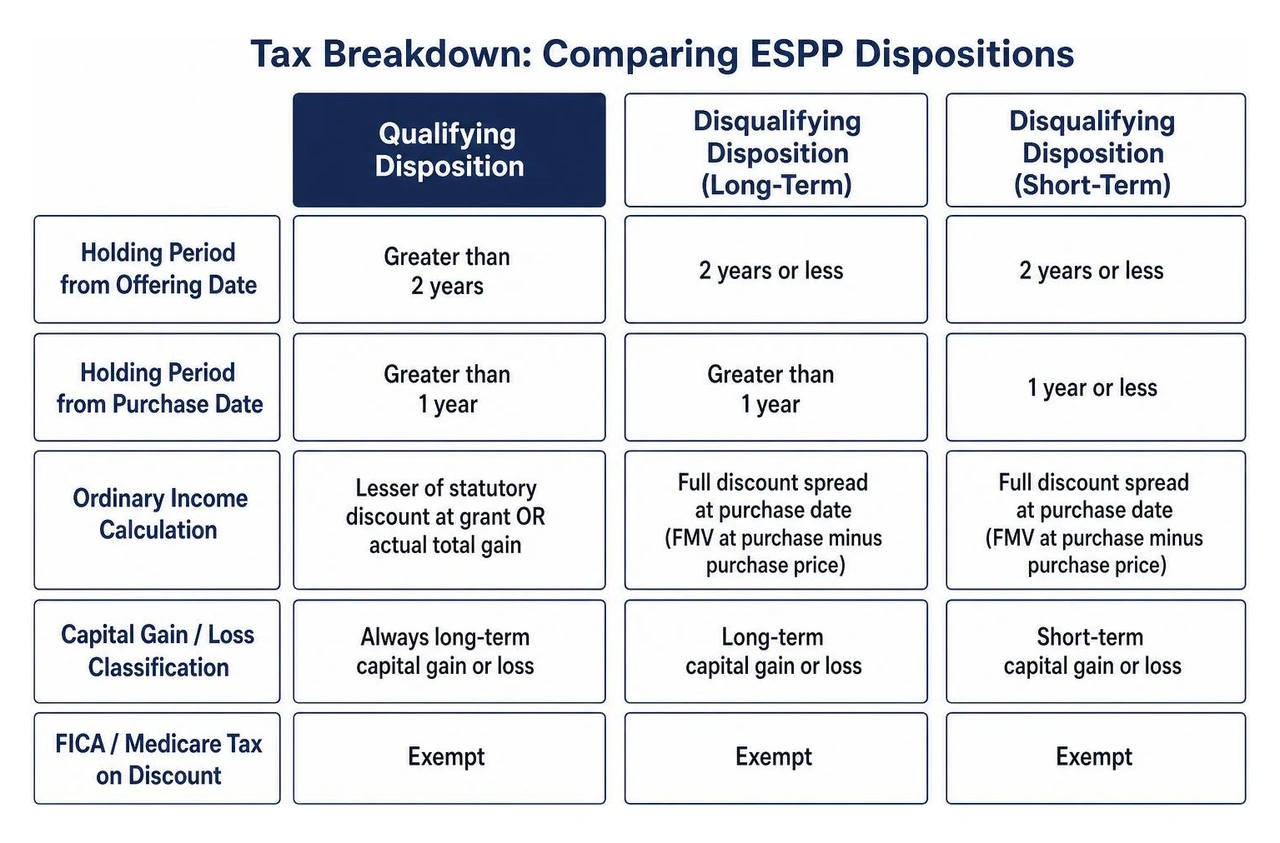
To secure a qualifying disposition, you must satisfy two distinct statutory timelines simultaneously:
Meeting both criteria ensures that the discount element is taxed under the favorable Section 423 statutory calculation, while the remaining share appreciation qualifies for lower federal long-term capital gains tax rates.
A common point of confusion occurs when an employee holds shares for more than one year after purchase, but sells before the two-year mark from the offering date. This scenario represents a disqualifying disposition with long-term capital gains.
In this situation:
Comprehensive ESPP planning helps weigh the risks of holding company stock across volatile markets against the tax advantages of qualifying treatment.
When selling shares in a qualifying disposition, the IRS splits the total financial gain into two buckets: ordinary compensation income and long-term capital gain.
Under Section 423, the ordinary income portion is defined as the lesser of:
Any remaining profit above the recognized ordinary income is taxed as a long-term capital gain according to standard IRS guidance on stock sales.

A lookback provision allows the plan to determine the purchase price by applying the discount to the lower of two prices: the stock price on the offering date or the stock price on the purchase date.
Consider an example:
If you hold the shares for three years and sell them for $180 per share (a qualifying disposition):
The lookback provision protected $40 of in-period growth ($140 − $100) from ever being taxed as ordinary income, shifting all post-offering appreciation into long-term capital gains.
If you sell your ESPP shares in a qualifying disposition for less than the purchase price paid:
Capital losses are reported on IRS Schedule D and can offset other realized capital gains dollar-for-dollar, with up to $3,000 in excess losses deductible against ordinary income each tax year.
One of the most frequent and costly tax errors made by equity compensation recipients is paying tax twice on the same ESPP discount.
When you sell ESPP shares, your brokerage firm issues IRS Form 1099-B reporting the gross proceeds and cost basis. Under federal reporting regulations, brokers report the unadjusted cost basis (the actual cash paid per share) in Box 1e of Form 1099-B. Meanwhile, the discount amount is separately reported as taxable wages on your Form W-2.
If you transfer the cost basis directly from Form 1099-B to your tax return without an adjustment, you will pay ordinary income tax on the discount through your W-2 and then pay capital gains tax on that same discount amount.
To correctly file long-term capital gains from an employee stock purchase plan:
The statutory formula for your true adjusted basis is:
Adjusted Cost Basis = Actual Purchase Price Paid + Ordinary Income Recognized on Form W-2
Applying this basis on Form 8949 reconciles the IRS records and ensures that every dollar of discount is taxed exactly once.
Maximizing equity compensation requires looking beyond standard federal income brackets. High earners must account for surtaxes and local tax conformity when timing stock sales.
For high-income professionals in 2026, federal long-term capital gains tax rates range from 0% to 15% or 20%, depending on taxable income thresholds. In addition, the Net Investment Income Tax (NIIT) levies an extra 3.8% surtax on net investment income for single filers with modified adjusted gross income (MAGI) exceeding $200,000 (or $250,000 for married couples filing jointly). This pushes the top effective federal capital gains rate to 23.8%.
State tax laws also affect net returns. For professionals in North Carolina, long-term capital gains are taxed as ordinary income at the state flat individual income tax rate. Balancing equity sales alongside single stock risk management and concentrated stock position diversification strategies ensures that company stock does not dominate your broader investment portfolio.
Transferring ESPP shares can create tax consequences whether the shares are transferred before or after qualifying status:
Gifting to Individuals: A gift before the ESPP holding periods are met is a disqualifying disposition, which usually triggers ordinary compensation income for the employee based on the purchase discount or bargain element. A gift after both holding periods are met is still a disposition under Section 423, so the employee may still owe ordinary income under the qualifying disposition “lesser of” rule. The recipient generally receives the shares under gift-basis rules.
Charitable Donations: Donating ESPP shares to a qualified 501(c)(3) charity may help avoid capital gains tax on appreciation, but the ESPP compensation-income result is not automatic. A charitable transfer needs separate tax analysis based on the plan, holding period, stock value, and applicable IRS deduction limits.
You need four primary tax documents:
Under Section 423(b)(8), an employee cannot purchase more than $25,000 worth of stock (valued at the fair market value on the offering date) during any single calendar year. If your plan offers a 15% discount on a $100 stock at the offering date, your maximum annual payroll contribution toward that offering is capped at $21,250 ($25,000 worth of stock at the $85 purchase price).
If you leave your employer prior to the plan purchase date, your accumulated payroll deductions are refunded back to you in full without stock purchases. Because these funds were withheld from your post-tax compensation, the cash refund is non-taxable.
Managing an employee stock purchase plan requires a disciplined approach to holding periods, statutory discount rules, and tax reporting. Holding shares for more than two years from the offering date and one year from purchase unlocks preferential long-term capital gains treatment, reducing the ordinary income drag on your investment returns.
Tracking Form 3922 data and making accurate cost basis adjustments on Form 8949 safeguards your gains against accidental double taxation. Integrating your equity compensation into a broader wealth strategy allows you to build long-term financial independence while mitigating concentrated employer risk. For a detailed review of your company stock options and equity plan, schedule a free assessment to evaluate your holding periods and tax strategies.
Educational Purposes Only. Content on this blog is for general educational and informational purposes only. It is not investment, tax, accounting, or legal advice, and it is not a recommendation or solicitation to buy or sell any security or to adopt any investment strategy. Past performance does not guarantee future results. Investing involves risk, including the possible loss of principal.
NoDa Wealth Management, LLC ("NoDa Wealth") is an investment adviser registered with the State of North Carolina. Advisory services are offered only where NoDa Wealth and its representatives are properly registered or exempt from registration. Readers should consult their own financial, tax, and legal advisors regarding their specific situation before making any decisions. For important disclosures, see the site footer and Form ADV.
Feeling overwhelmed? Let’s simplify things! Schedule your Free Assessment for an easy, 30-minute chat to help you tackle life’s transitions.
Enjoy a hassle-free conversation that puts your needs front and center!
)%20(3).avif)

