Exercise Options for Long-Term Capital Gains: Key Holding Periods and Pitfalls
Learn how to exercise options for long-term capital gains treatment, including key holding periods, ISO vs NSO rules, and AMT pitfalls.



Learn how to exercise options for long-term capital gains treatment, including key holding periods, ISO vs NSO rules, and AMT pitfalls.
To exercise options for long-term capital gains, start by checking whether you have incentive stock options (ISOs) or nonqualified stock options (NSOs). For ISOs, sell the shares more than two years after the grant date and more than one year after exercise to seek favorable treatment. For NSOs, the gain after exercise can qualify as long-term if you hold the shares for more than one year. Exercising alone does not create a capital gain, but it can create an income-tax bill: NSOs generally produce taxable wages at exercise, while ISOs may trigger the alternative minimum tax even if you have not sold a share. The IRS stock option guide explains these different tax events.
Those dates matter, but so do the cash needed to exercise and the risk of holding your employer’s stock. I’m Evan Luongo, and I’ll walk through the tax rules and trade-offs that can help you plan the next step.
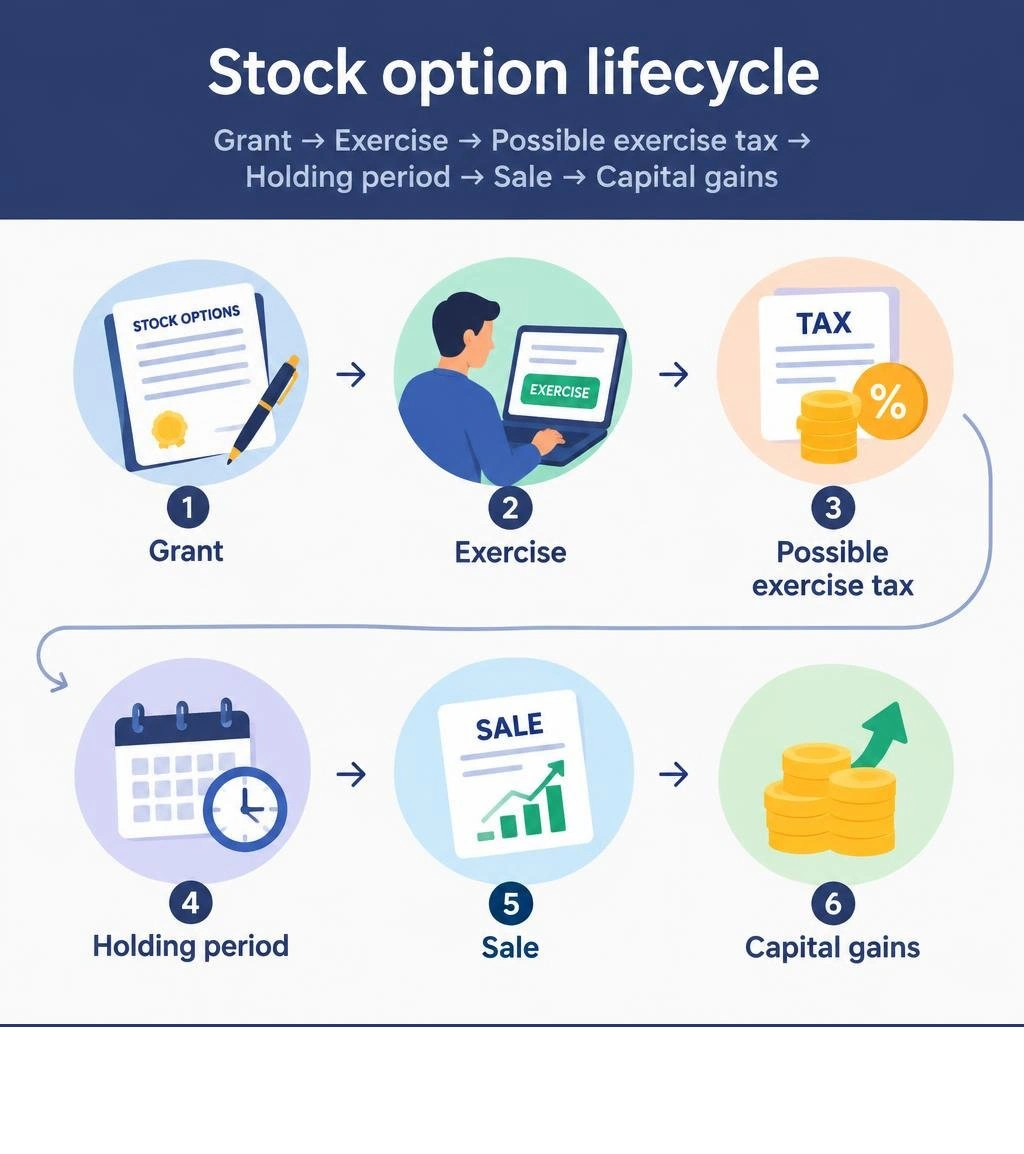
Exercise options long term capital gains terminology:
Equity compensation is a significant part of total pay at many large technology companies, yet it remains one of the most misunderstood pieces of a compensation package. The challenge is that stock options can create taxes at several points: when you exercise, when you sell, and, in some ISO cases, when the Alternative Minimum Tax applies. Employees often focus on the potential upside and miss the cash needed for taxes, withholding gaps, holding-period rules, and concentration risk. That is why a clear exercise plan matters. Before exercising options, you need to understand the tax trigger, the holding period, and the downside if the stock price falls.

Understanding the basic anatomy of an option exercise is the first step toward avoiding unnecessary costs. When an employee is granted stock options, they receive the contractual right to purchase company shares at a fixed strike price (also known as the exercise price). Over time, if the company grows, the fair market value (FMV) of the underlying stock often exceeds this strike price. The difference between the FMV on the date of exercise and the strike price is called the spread or the bargain element.
A widespread point of confusion is assuming that exercising stock options immediately triggers a capital gains tax. Under IRS Topic no. 427 on stock options, the exercise event itself does not generate capital gains. Instead, the exercise event falls under compensation rules, generating either ordinary income or an alternative tax adjustment depending on whether the options are statutory (ISOs) or non-statutory (NSOs). Navigating the complexities of stock options tax requires distinguishing between this initial exercise tax and the capital gains taxes assessed on subsequent sales.
The simple answer is no. Exercising an option converts a derivative contract into actual corporate shares. At the moment of exercise, no capital asset has been sold, disposed of, or exchanged for cash.
The IRS guidance on stocks and options transactions confirms that capital gains or losses occur only upon the final disposition (sale) of the acquired stock. What the exercise does trigger is a potential tax liability based on the spread:
To benefit from preferential long-term capital gains tax rates, the underlying shares must be held for a specific period before selling. For regular equity investments, holding an asset for more than one year qualifies any appreciation for long-term rates (0%, 15%, or 20% at the federal level for the 2026 tax year, plus the 3.8% Net Investment Income Tax where applicable), compared to ordinary income brackets that reach up to 37%.
When evaluating how to exercise options long term capital gains strategies effectively, the type of grant dictates how those rates apply. Understanding the core structural differences between ISO vs. NSO options is crucial. For NSOs, holding the shares for more than one year post-exercise guarantees long-term capital gains treatment on any growth occurring after the exercise date. For ISOs, meeting strict statutory holding periods allows the entire appreciation from the original strike price to qualify for long-term capital gains.
The tax code establishes two distinct frameworks for option equity: statutory options (governed by Internal Revenue Code Section 422 for ISOs and Section 423 for Employee Stock Purchase Plans) and non-statutory options.
| Feature | Incentive Stock Options (ISOs) | Non-Qualified Stock Options (NSOs) |
|---|---|---|
| Tax at Exercise | No ordinary income tax; spread is subject to AMT calculation | Ordinary income tax + payroll taxes (FICA) on spread |
| Holding Period for Long-Term Treatment | > 2 years from grant date AND > 1 year from exercise date | > 1 year from exercise date |
| Tax on Eventual Sale (Holding Period Met) | Entire gain (Sale Price minus Strike Price) taxed at Long-Term Capital Gains rates | Additional gain (Sale Price minus FMV at exercise) taxed at Long-Term Capital Gains rates |
| Tax on Eventual Sale (Holding Period NOT Met) | Disqualifying disposition: Spread at exercise taxed as ordinary income; remaining gain taxed as capital gain | Short-term capital gain on appreciation above FMV at exercise |
| Cost Basis for Regular Tax | Strike price paid | FMV on the date of exercise (Strike Price + Taxed Spread) |
To achieve a "qualifying disposition" for ISOs—unlocking long-term capital gains rates on the entire growth from strike price to ultimate sale price—two strict statutory clocks must be satisfied simultaneously:
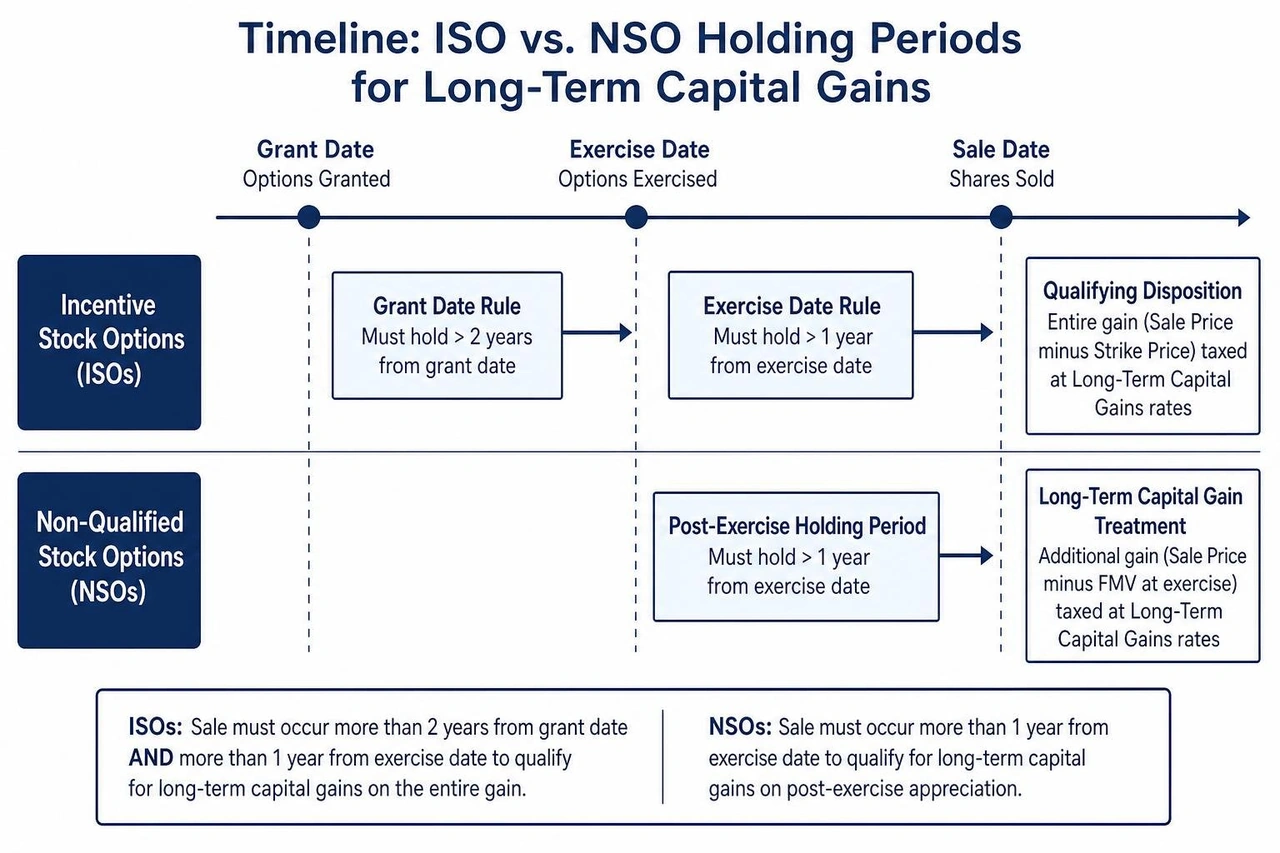
Failing either of these criteria turns the sale into a "disqualifying disposition." For employees tracking their overall employee share options tax obligations, missing the required holding period by even a single day can convert hundreds of thousands of dollars of capital gains into high-bracket ordinary income.
Under IRC Section 422(d), there is an annual statutory ceiling on how many shares can qualify as ISOs. Specifically, an individual may not have more than $100,000 worth of ISOs first become exercisable in any single calendar year.
As outlined in Grant Thornton's equity-based compensation tax analysis, this limit is evaluated based on the aggregate fair market value of the stock determined at the time of the grant, not at vesting or exercise. If an employee receives a grant where $160,000 worth of shares (calculated using grant-date FMV) vests and becomes exercisable in year one, the first $100,000 qualifies as ISOs, while the remaining $60,000 is automatically reclassified by the IRS as NSOs. The reclassified portion loses ISO tax deferral privileges and is taxed as ordinary income upon exercise.
While ISOs are free from regular federal income tax at exercise, the spread between the strike price and the current FMV is considered an alternative minimum taxable income preference item under IRC Section 56(b)(3). When large spreads exist on paper, this creates "phantom income"—paper wealth on which real taxes are owed to the IRS, even if the shares cannot yet be sold on a public exchange.
The AMT calculation runs parallel to regular federal income tax. Filers complete IRS Form 6251 to determine their AMT liability. If the tentative minimum tax exceeds regular tax liability, the taxpayer pays the regular tax plus the difference as AMT.
For the 2026 tax year, do not rely on last year’s AMT exemption and phaseout thresholds without checking the current IRS figures. Even when thresholds rise with inflation, an employee exercising ISOs at a rapidly appreciating private company can still trigger an unexpected five- or six-figure tax bill by the filing deadline without having sold shares. Managing cash flow during an ISO exercise is vital so you have enough liquid reserves to cover potential AMT obligations without being forced into a distressed share sale.
When AMT is paid on an ISO exercise, the taxpayer generates an AMT Credit (tracked via Form 8801). This credit can be carried forward indefinitely to offset regular tax liability in future tax years when regular tax exceeds the tentative minimum tax.
If the shares acquired through an ISO exercise are sold before meeting both the 2-year from grant and 1-year from exercise rules, a disqualifying disposition occurs.
In a disqualifying disposition:
While a disqualifying disposition forfeits the preferential long-term capital gains rate on the exercise spread, it can serve as a vital defensive mechanism. If an employee exercises ISOs and the company’s valuation drops dramatically within the same calendar year, selling the shares before December 31 can eliminate phantom AMT liability based on the earlier peak valuation. In that case, ordinary income is generally capped at the actual gain: the sale price minus the strike price.
Non-Qualified Stock Options follow a completely different tax track. When an employee exercises NSOs, the transaction triggers an immediate, mandatory taxable compensation event. The amount of ordinary income recognized is calculated by subtracting the strike price from the fair market value at exercise, then multiplying that difference by the number of shares exercised.
Employers are required by law to withhold federal income taxes, state taxes, Social Security (up to the annual wage cap), and Medicare taxes (including the 0.9% Additional Medicare Tax where applicable) on this bargain element. Because the spread is already taxed at ordinary rates at the time of exercise, anyone looking to exercise NSO stock options must decide whether holding the remaining shares for more than 12 months to earn long-term capital gains rates on future growth justifies the risk of tying up capital.
One of the most expensive and frequent errors reported on equity compensation tax returns is basis miscalculation. When an employee exercises NSOs, the employer includes the spread in Box 1 of Form W-2 as taxable wages. Therefore, the adjusted tax cost basis for those shares equals the fair market value at exercise, which is the strike price paid plus the ordinary income reported on the W-2.
However, brokerage firms typically report the unadjusted cost basis (the strike price paid) in Box 1e of Form 1099-B when the shares are eventually sold. If a taxpayer blindly copies the 1099-B figures into their tax software, they will pay tax on the spread twice: once as ordinary income on their W-2, and a second time as a capital gain on Form 1040 Schedule D.
To correct this discrepancy, filers must report an adjustment code (Code B) on Form 8949 using the broker's supplemental equity statement, ensuring they are avoiding double taxation on equity compensation.
When exercising NSOs, option holders must choose how to satisfy the strike price and tax withholding obligations:
While a cash-funded exercise maximizes the number of shares eligible for future long-term capital gains, it exposes the employee to substantial downside risk. If the stock drops, the employee has lost cash and paid taxes on wealth that no longer exists. Implementing prudent single stock risk management helps strike the right balance between upside tax optimization and capital preservation.
Navigating equity compensation requires proactive scheduling of grants, vestings, and exercises:
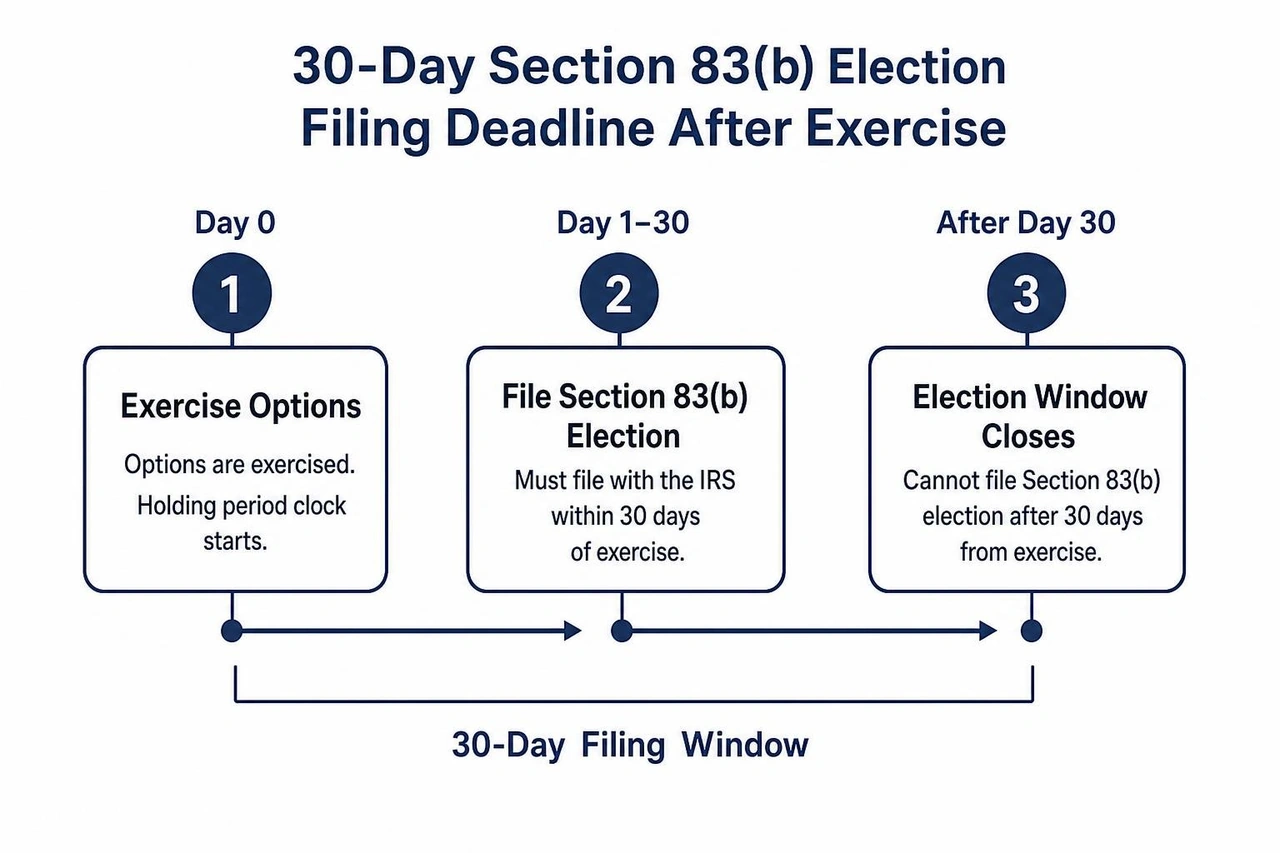
Yes. The holding period for capital gains begins on the day after the option is exercised (the settlement/acquisition date) and ends on the date the shares are sold. For non-qualified stock options, holding the stock for more than 365 days after exercise qualifies any appreciation above the exercise-date fair market value for long-term capital gains rates. For incentive stock options, the holder must satisfy both the 1-year post-exercise rule and the 2-year post-grant rule to achieve a qualifying disposition.
If the stock price declines after an ISO exercise, the employee may still owe Alternative Minimum Tax based on the fair market value on the exercise date if the shares are held past December 31 of that tax year. If the decline occurs in the same calendar year as the exercise, selling the shares before December 31 creates a disqualifying disposition, which generally caps ordinary income at the actual gain, meaning the sale price minus the strike price, and can eliminate the phantom AMT adjustment.
When exercising and selling stock options, several IRS forms are involved:
Maximizing equity compensation requires careful coordination between grant milestones, cash flow availability, and federal tax brackets. Exercising options to achieve long-term capital gains can produce substantial tax savings, but moving without a plan risks triggering sudden alternative minimum taxes, basis errors, or dangerous single-stock concentration.
Working with a fee-only fiduciary advisor ensures your equity transactions are timed effectively to protect net returns and support long-term goals. To model your specific grants and build a customized exercise plan, request a free financial assessment with NoDa Wealth.
Educational Purposes Only. Content on this blog is for general educational and informational purposes only. It is not investment, tax, accounting, or legal advice, and it is not a recommendation or solicitation to buy or sell any security or to adopt any investment strategy. Past performance does not guarantee future results. Investing involves risk, including the possible loss of principal.
NoDa Wealth Management, LLC ("NoDa Wealth") is an investment adviser registered with the State of North Carolina. Advisory services are offered only where NoDa Wealth and its representatives are properly registered or exempt from registration. Readers should consult their own financial, tax, and legal advisors regarding their specific situation before making any decisions. For important disclosures, see the site footer and Form ADV.
Feeling overwhelmed? Let’s simplify things! Schedule your Free Assessment for an easy, 30-minute chat to help you tackle life’s transitions.
Enjoy a hassle-free conversation that puts your needs front and center!
)%20(3).avif)
