Why Buying Discounted Company Stock Through an ESPP Makes Financial Sense
Learn if ESPP plans are worth it by exploring discounts, lookback provisions, and tax strategies to maximize your company stock purchase plan.



Learn if ESPP plans are worth it by exploring discounts, lookback provisions, and tax strategies to maximize your company stock purchase plan.
Are ESPP plans worth it? Often, yes. A discount can make buying company stock attractive, especially if you can sell the shares soon after purchase. But the benefit is less clear if payroll deductions strain your budget or you must hold the shares while their price can fall.
Start by checking your plan's discount, lookback feature, and sale rules. Then decide whether the purchase fits your cash flow and how much company stock you already own. I'm Evan Luongo, and this guide will help you make that choice without losing sight of your broader financial plan.
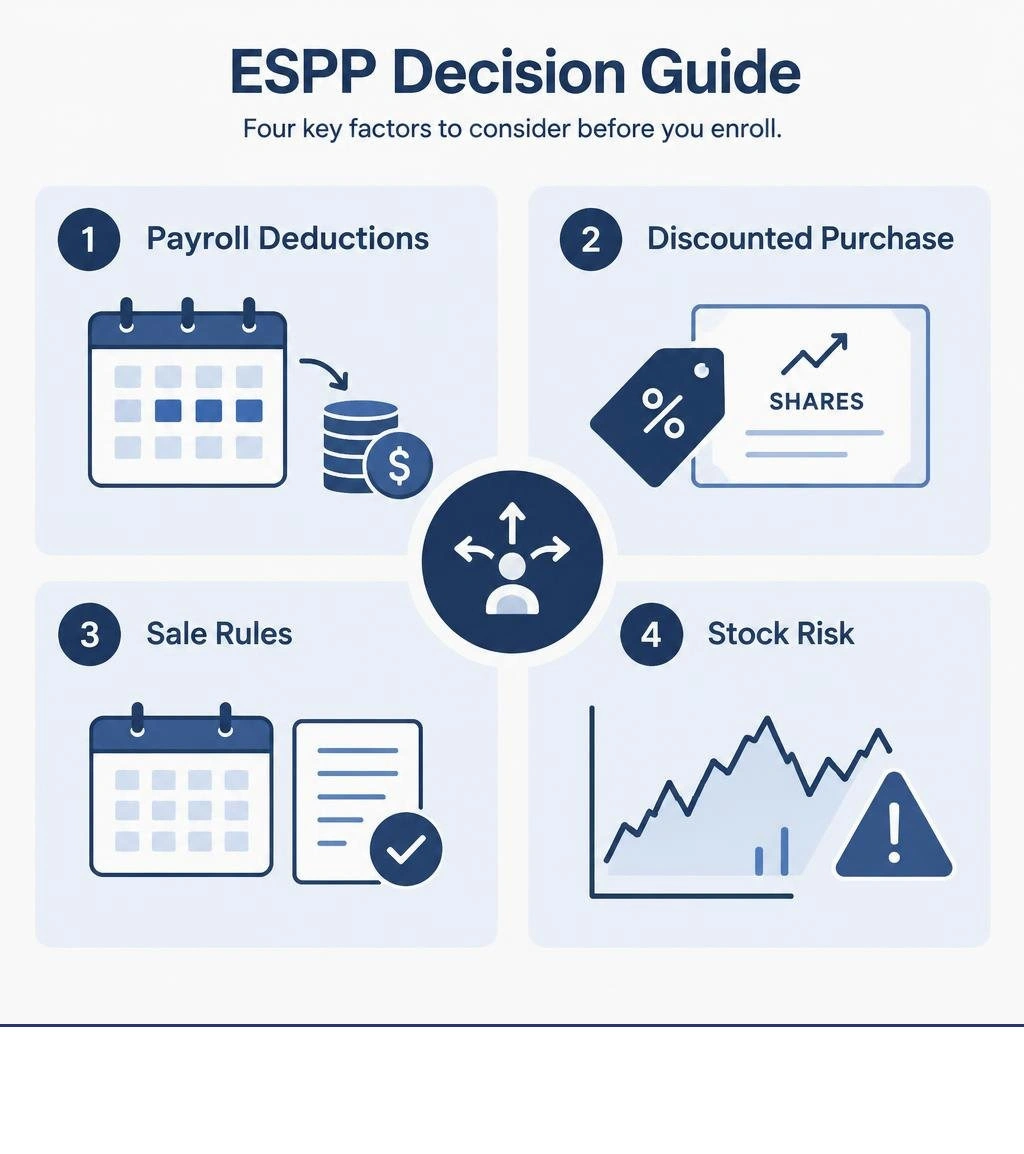
Key are espp plans worth it vocabulary:
An Employee Stock Purchase Plan (ESPP) is an employer-sponsored program that allows eligible employees to buy company stock at a discounted price using accumulated payroll deductions. Instead of purchasing shares on an open exchange at full market price, contributions accumulate over a defined timeframe, and the company executes a batch purchase on your behalf.
Understanding how do ESPP plans work requires tracking two core timeframes:
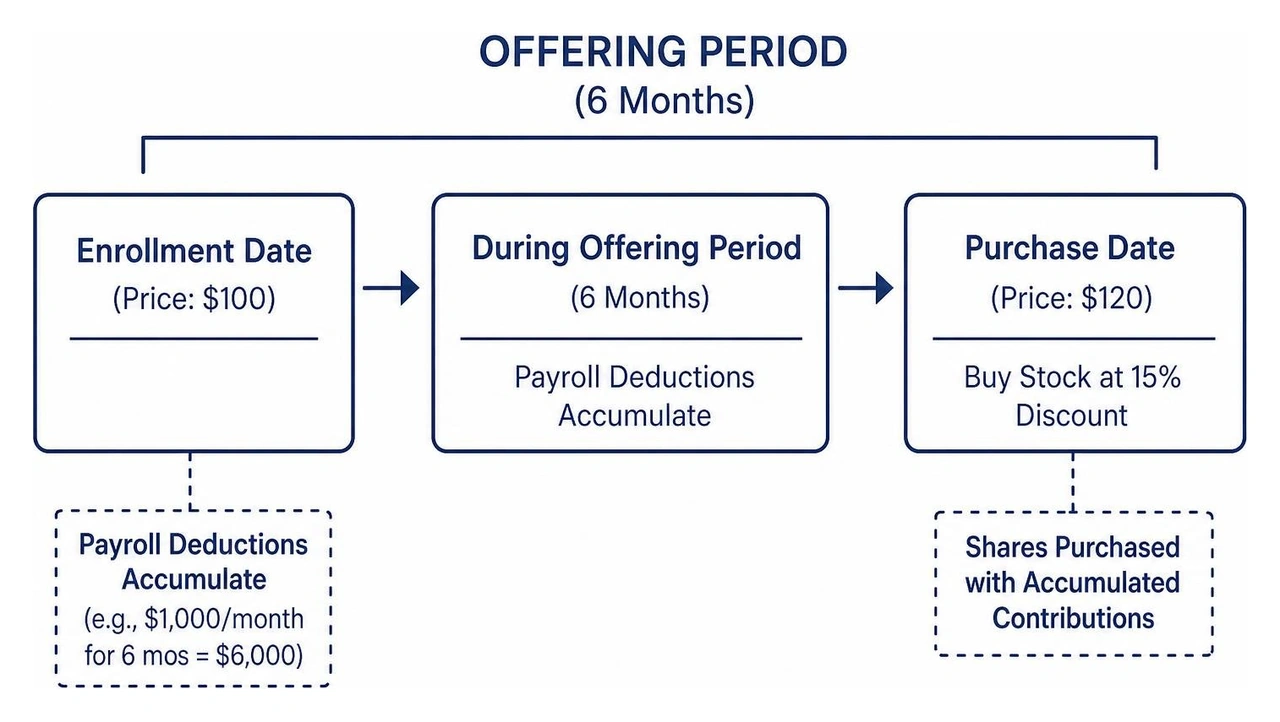
Most corporate ESPPs are structured as "tax-qualified" plans under Section 423 of the Internal Revenue Code. According to financial industry research, approximately 83% of public companies that provide an ESPP choose a qualified structure.
To maintain Section 423 status, plans must meet strict IRS standards:
Non-qualified plans, by contrast, do not have to meet these rigid non-discrimination rules. However, they lack the tax-deferral feature: the discount received on the purchase date is immediately taxed as ordinary income in that pay period. For a deeper breakdown of workplace equity structures, see this analysis on employee stock purchase benefits.
Three fundamental mechanics dictate the profitability of an ESPP:
Navigating these thresholds effectively requires proactive ESPP planning to align payroll elections with broader annual tax brackets and savings targets.
Evaluating whether an ESPP makes sense comes down to math, liquidity, and risk tolerance. When structured with a 15% discount and an immediate sale strategy, the return profile of an ESPP is one of the most advantageous benefits available to corporate workers.
Data shows that companies offering broad equity participation tend to be robust businesses. A comprehensive Deloitte study on ESPP corporate outperformance examined S&P 500 companies over a 10-year period and revealed that organizations with ESPPs significantly outperformed non-ESPP peers:
Prevalence is particularly high in technology and healthcare, where 82% of IT companies and 66% of healthcare companies in the S&P 500 offer an ESPP.
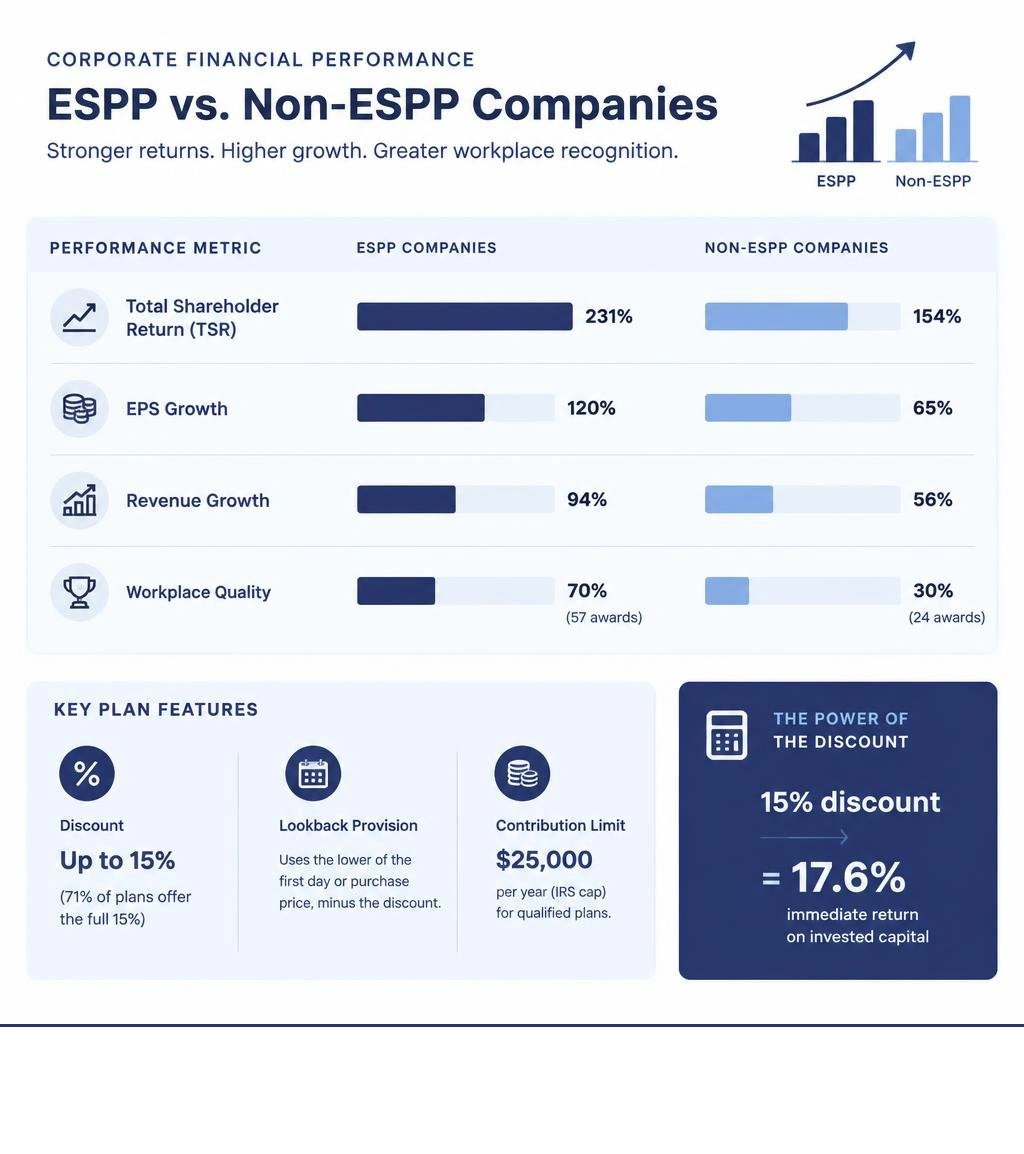
A 15% discount does not simply yield a 15% return; it delivers an immediate 17.6% return on invested capital.
To see why:
When combined with a lookback provision during a rising market, this return increases significantly:
Because your payroll dollars were withheld gradually across the 6-month cycle rather than deposited in one lump sum on day one, the annualized internal rate of return (IRR) on your cash is well over 50%.
A common concern is whether an ESPP remains useful during a down market. The answer is yes, provided your plan includes a lookback feature and permits immediate sales.
Consider a scenario where the stock price falls 20% over the offering period:
The lookback provision protects your discount regardless of whether the stock moves up or down. As long as you can sell immediately upon purchase, market declines during the accumulation period do not eliminate your profit margin.
How you handle ESPP shares after purchase determines whether your profits are taxed at ordinary income rates or preferential capital gains rates.
Every ESPP transaction generates two potential layers of gain:
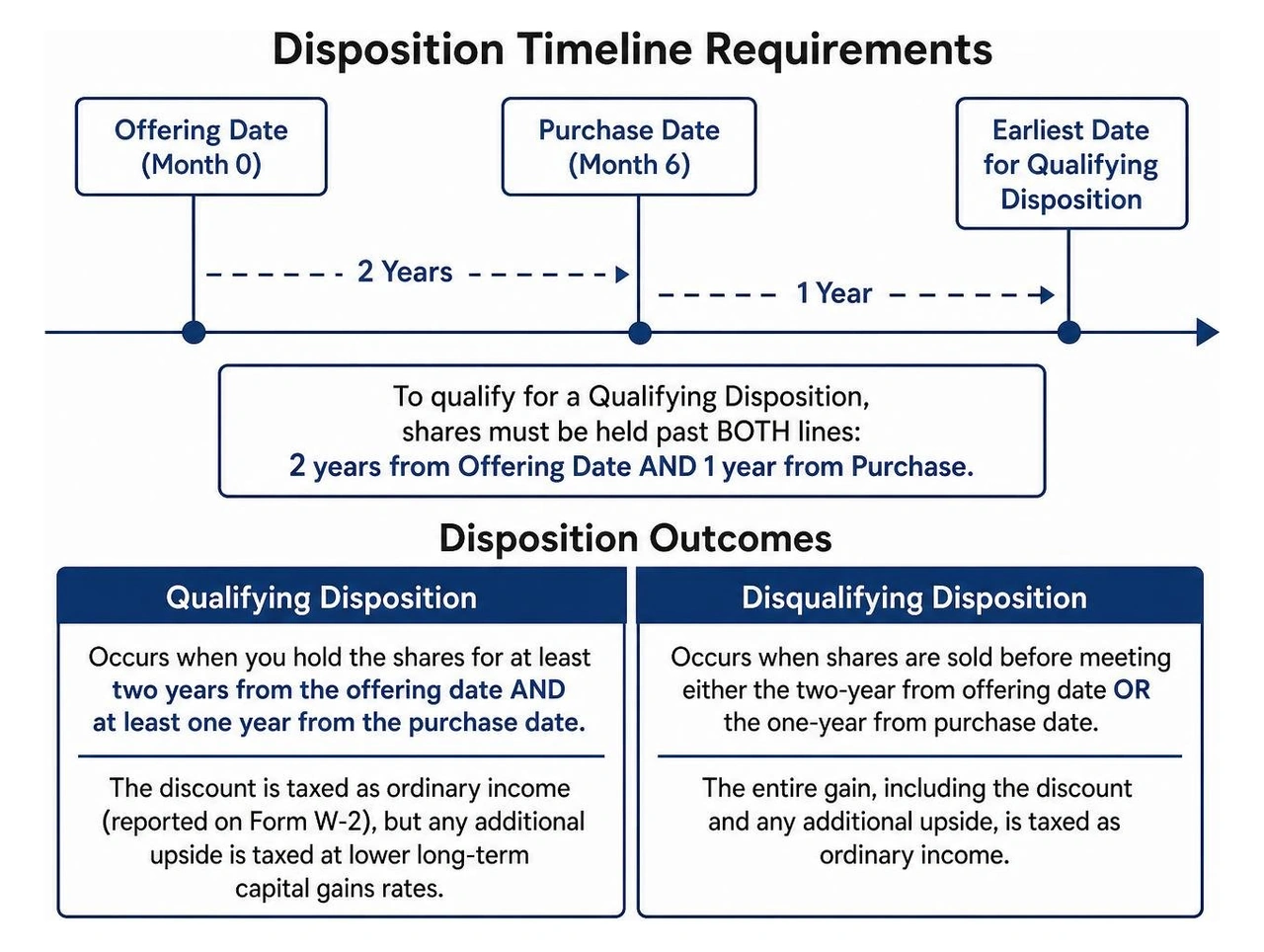
A sale of Section 423 shares falls into one of two categories:
Understanding how to optimize your employee stock purchase plan long term capital gains involves balancing tax rates against individual stock volatility.
| Feature | Qualifying Disposition | Disqualifying Disposition (e.g., Immediate Sale) |
|---|---|---|
| Holding Requirement | >2 years from offer date AND >1 year from purchase date | Sold before satisfying both holding periods |
| Ordinary Income Tax | Lesser of actual gain OR the statutory discount at offering | Full spread between purchase price and purchase-date FMV |
| Capital Gains Tax | Long-term capital gains on all remaining upside | Capital gains/losses on price changes after purchase date |
| Market Risk Exposure | High (must hold single stock for 12–24 months) | None to minimal (shares liquidated on purchase date) |
| Cash Flow Velocity | Locked up in employer stock | Immediate liquidity returned to participant |
While holding shares for a qualifying disposition offers potential tax savings, it introduces significant single-stock concentration risk.
Employees already rely on their employer for their primary salary, bonuses, healthcare, and unvested RSUs. Holding large volumes of company stock concentrates your human capital and financial capital in the same basket. If the company hits unexpected headwinds, your share value could drop at the same time your job security is threatened.
Financial planning best practices generally suggest capping exposure to employer stock at no more than 10% to 15% of your total investable assets. Practicing disciplined single stock risk management often means executing an immediate sale upon purchase and rotating those proceeds into broad index funds through concentrated stock position diversification.
An ESPP should not operate in isolation. It works best when integrated into your complete financial hierarchy alongside your emergency reserve, retirement accounts, and debt-management plan.

Before committing 10% to 15% of your take-home pay to an ESPP, ensure the following milestones are in place:
The main obstacle employees face when joining an ESPP is the temporary reduction in take-home pay during the initial 6-month accumulation window.
This challenge can be solved using cash flow recycling:
Once the initial purchase cycle completes, the ESPP becomes fully self-funding. For a comprehensive walkthrough on managing your cash flow through this process, review our guide on ESPP cash flow management. If you are balancing multiple equity streams and high compensation, our blueprint on how to invest your 200k paycheck like a pro provides an end-to-end framework.
| Advantages (Pros) | Disadvantages & Risks (Cons) |
|---|---|
| Instant Built-in Return: 15% discounts deliver an immediate 17.6% return on purchase. | Paycheck Reduction: Requires sufficient liquidity to handle 6 months of reduced take-home pay. |
| Asymmetric Upside: Lookback provisions let you capture market rallies during the cycle. | Concentration Risk: Holding shares long-term ties your investments to your employer. |
| Downside Buffer: Lookbacks ensure you buy below market value even if share prices fall. | Trading Restrictions: Company blackout windows and insider rules can limit sale timing. |
| Disciplined Savings: Automated payroll deductions build wealth systematically. | Tax Reporting Nuance: Brokerage tax forms require adjustments to prevent double taxation. |
If you leave your employer (voluntarily or involuntarily) before the scheduled purchase date, your participation terminates immediately. Any payroll deductions accumulated during the active cycle will be returned to you in cash via payroll or direct deposit without interest.
Any shares you bought in prior cycles belong entirely to you. They remain held in your designated brokerage account, and you can hold, transfer, or sell them according to your own timeline (subject to standard trading rules).
A widespread tax-filing mistake occurs when reporting ESPP sales on IRS Form 8949 and Schedule D.
When you sell ESPP shares in a disqualifying disposition, the discount is reported on your Form W-2 as ordinary compensation income. However, financial brokerages often issue Form 1099-B showing your unadjusted purchase price as the cost basis, rather than the fair market value on the purchase date.
If you do not adjust your cost basis correctly, you could pay tax twice on the ESPP discount: once as W-2 ordinary income and again as a capital gain. Box 1e on Form 1099-B shows the reported basis; on Form 8949, keep that amount in column (e), enter code B in column (f), and put the adjustment in column (g). Use IRS Form 3922 to confirm the correct adjusted basis.
Most Section 423 plans allow participants to decrease their contribution percentage or withdraw from the offering period entirely before the purchase date. If you withdraw mid-cycle, the company stops future deductions and refunds your accumulated cash balance on an upcoming paycheck.
However, some plans do not allow you to re-enroll or increase contributions until the next open enrollment window. Review your company's specific plan document for exact mid-cycle modification rules.
Participating in an ESPP is one of the most reliable ways to capture immediate investment returns, build savings discipline, and benefit from company growth. For plans offering a 15% discount and a lookback provision, executing an immediate-sale strategy provides a virtually unmatched low-risk return on your cash flow.
However, extracting the maximum value from your equity benefits requires careful execution:
NoDa Wealth provides fee-only, fiduciary financial planning and wealth management for busy professionals. Operating from Charlotte, NC, the firm delivers transparent, data-driven, no-commission advice covering investments, equity compensation, cash-flow structuring, and tax planning through a simple three-step process.
To align your ESPP elections, stock options, and retirement portfolio into a unified wealth strategy, visit NoDa Wealth or schedule a free financial assessment today.
Educational Purposes Only. Content on this blog is for general educational and informational purposes only. It is not investment, tax, accounting, or legal advice, and it is not a recommendation or solicitation to buy or sell any security or to adopt any investment strategy. Past performance does not guarantee future results. Investing involves risk, including the possible loss of principal.
NoDa Wealth Management, LLC ("NoDa Wealth") is an investment adviser registered with the State of North Carolina. Advisory services are offered only where NoDa Wealth and its representatives are properly registered or exempt from registration. Readers should consult their own financial, tax, and legal advisors regarding their specific situation before making any decisions. For important disclosures, see the site footer and Form ADV.
Feeling overwhelmed? Let’s simplify things! Schedule your Free Assessment for an easy, 30-minute chat to help you tackle life’s transitions.
Enjoy a hassle-free conversation that puts your needs front and center!
)%20(3).avif)
